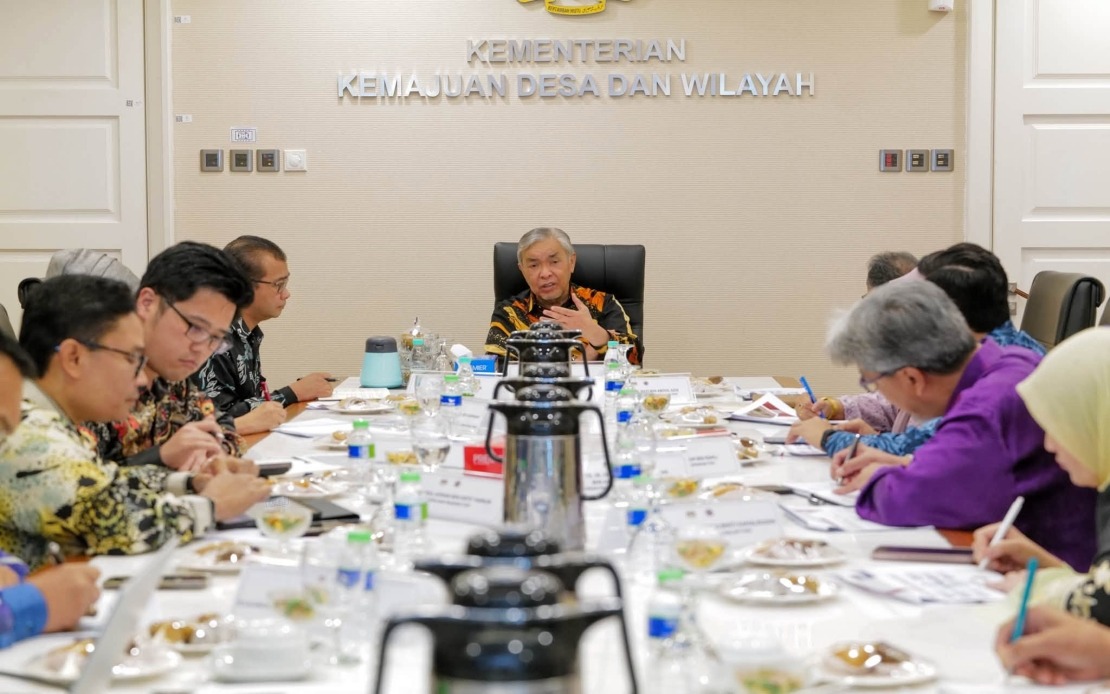
Malaysia is embarking on an ambitious restructuring of its technical and vocational education and training system, with Deputy Prime Minister Datuk Seri Dr Ahmad Zahid Hamidi unveiling a comprehensive strategic framework designed to reshape skills development over the next decade. The establishment of the Strategic TVET 2.0 Task Force 2026-2035, coupled with the formation of ten specialized TVET Strategic Committees, represents a watershed moment in the country's efforts to create a workforce equipped for contemporary economic demands and future technological shifts.
The initiative signals a deliberate pivot towards more coordinated and measurable outcomes in Malaysia's TVET landscape. Where previous approaches may have operated in relative silos, the new governance architecture aims to integrate policy-making across multiple domains—from institutional reform to industry alignment. Ahmad Zahid, speaking in his capacity as both Deputy Prime Minister and Chairman of the National TVET Council, emphasized that this structural overhaul reflects a government commitment to treating skills development as a cornerstone of human capital investment rather than a secondary educational pathway.
The Strategic TVET 2.0 Task Force will be chaired by Emeritus Professor Datuk Dr Siti Hamisah Tapsir, president and vice-chancellor emeritus of UCSI University, bringing academic credibility and institutional experience to the leadership role. This appointment signals an intention to ground the agenda in evidence-based policy and university-industry partnerships. Tapsir's background positions her to bridge the often-fractious relationship between academic institutions and commercial training providers, a persistent challenge in Malaysia's TVET ecosystem.
The ten supporting committees address specific pain points that have historically constrained Malaysia's TVET effectiveness. The TVET Governance and Institutional Reform Committee, headed by Datuk Dr Asyraf Wajdi Dusuki, will tackle structural inefficiencies and regulatory barriers that have fragmented the sector. Meanwhile, the TVET Industry and Employers Committee, chaired by Datuk Khairul Azwan Harun, places employers at the decision-making table—a critical shift that should theoretically reduce the persistent misalignment between curriculum content and workplace requirements that employers frequently cite.
Financial sustainability remains a perennial concern for vocational training systems across Southeast Asia, where TVET often struggles for adequate funding compared to academic pathways. The creation of a dedicated TVET Financing and Sustainability Committee under Ramelle Ashram Ramli acknowledges this vulnerability explicitly. This committee's remit will likely encompass examination of alternative funding models, public-private partnerships, and mechanisms to attract private sector investment—areas where Malaysia has experimented with varying degrees of success in recent years.
The inclusion of a Women Empowerment in TVET Committee, chaired by Datuk Dr Masilla Kamalrudin, addresses a significant demographic gap in Malaysia's technical workforce. Women remain substantially underrepresented in traditional TVET fields such as engineering, construction trades, and advanced manufacturing, representing both a social equity issue and an economic inefficiency given the tight labour markets many sectors face. This committee's prominence within the formal governance structure suggests the government views gender inclusion as integral rather than peripheral to workforce development goals.
The ten-year timeframe spanning 2026-2035 provides adequate runway for systemic change while establishing concrete accountability benchmarks. Malaysian policymakers have learned from previous initiatives that transformational agendas require sustained commitment beyond electoral cycles. By anchoring the TVET 2.0 framework to a specific decade with structured milestones, the government is attempting to insulate the agenda from political short-termism and create continuity irrespective of which coalition occupies power.
For Malaysia's regional position, this TVET overhaul carries implications beyond domestic labour markets. As competitors like Vietnam and Thailand aggressively court manufacturing and advanced industrial investment, Malaysia risks ceding ground if its skills pipeline cannot reliably produce workers suited to contemporary production demands. The TVET 2.0 framework positions Malaysia to compete more effectively in attracting capital-intensive foreign direct investment predicated on workforce quality. Countries pursuing economic upgrading have repeatedly demonstrated that vocational training excellence forms a competitive advantage alongside university-level education.
The emphasis on responsiveness to industry needs suggests an explicit rejection of a top-down, supply-driven approach to curriculum design. Too often, TVET programmes in Malaysia have been designed by educators with limited meaningful input from employers, resulting in graduates lacking practically relevant skills. By institutionalizing employer participation through dedicated committees, the framework aims to create feedback loops that keep training content current with evolving technical demands—a particularly acute challenge in fields like information technology and green energy where change accelerates.
Implementation success will ultimately depend on resource allocation and bureaucratic coordination. Malaysia's federal structure, with education traditionally falling under state jurisdiction in certain domains, creates potential coordination challenges. Whether the Strategic TVET 2.0 Task Force possesses sufficient authority to override jurisdictional silos and align state-level TVET institutions with national priorities remains to be seen. Past Malaysian policy initiatives have sometimes faltered during execution when inter-agency coordination proved weaker than strategic blueprints suggested.
The government's framing of TVET as fundamental to MADANI—Malaysia's governance philosophy emphasizing people-centric development and inclusive growth—provides ideological scaffolding for the agenda. If executed effectively, the TVET 2.0 framework could meaningfully expand vocational pathways for lower and middle-income Malaysians, potentially reducing skill-based wage inequality and broadening economic participation. Conversely, if implementation stalls or committees become bureaucratic theatre rather than decision-making bodies, the initiative risks becoming another well-intentioned policy document gathering dust.
The coming months will prove telling as these committees establish operational procedures, define measurable outcomes, and begin translating strategic vision into curriculum reforms, funding mechanisms, and governance changes. For Malaysia's workforce development trajectory—and by extension, its economic competitiveness in an increasingly demanding global marketplace—the TVET 2.0 agenda represents perhaps the most substantive attempt in recent memory to systematically address the country's vocational training infrastructure.

