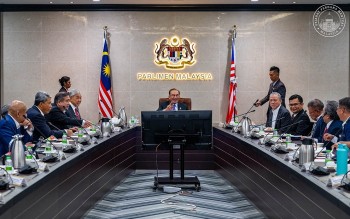
Prime Minister Datuk Seri Anwar Ibrahim has instructed Malaysia's Ministry of Investment, Trade and Industry and the Ministry of Economy to directly engage with struggling manufacturers as the country confronts intensifying pressures from a destabilised global supply ecosystem. The directive emerged following a meeting of the National Economic Action Council chaired by Anwar, who also holds the finance portfolio, signalling the administration's determination to cushion the domestic manufacturing base from external economic headwinds that threaten production costs and profitability across multiple industries.
The timing of this intervention reflects growing anxiety within Malaysia's manufacturing heartland, where operators report mounting difficulty sourcing materials and components at predictable prices. By mobilising two separate government agencies for coordinated outreach, the administration underscores the scale and urgency of the challenge. Anwar's public announcement via social media on Monday amplified the government's commitment to fashioning concrete relief mechanisms rather than merely acknowledging industry grievances, a distinction that carries weight for businesses already stretched by margin compression and supply volatility.
The plastics sector has emerged as the focal point of government concern, a designation that reflects its outsized influence across Malaysia's industrial ecosystem. Economy Minister Akmal Nasrullah Mohd Nasir outlined the commercial stakes during a public briefing, disclosing that the sector generated RM62.69 billion in sales during 2025—a decline from the RM64.78 billion recorded in the preceding year. This contraction, though modest in percentage terms, signals underlying stress in a sector that anchors production throughout the country's most valuable industries.
Packaging applications dominate the plastics sector's portfolio, commanding 45 per cent of total market value and embedding the material throughout food production, beverage distribution, and consumer goods manufacturing. The electrical and electronics industry follows as the second-largest consumer, absorbing 29 per cent of plastics output. Together, these two segments alone account for nearly three-quarters of demand, creating an interdependency where disruptions to plastic supply propagate rapidly through downstream manufacturing operations. When plastic producers face elevated input costs—whether from petroleum price fluctuations, logistics expenses, or raw material scarcity—those expenses typically flow downstream to food manufacturers, electronics assemblers, and packaging converters with limited ability to absorb the impact.
The vulnerability extends further into the automotive and medical device sectors, both strategically important to Malaysia's industrial identity and export performance. Automotive manufacturers depend on plastic components for interior trim, sealing systems, and increasingly for lightweight structural applications aimed at improving fuel efficiency. Medical device manufacturers similarly rely on specialised plastics meeting strict biocompatibility and sterilisation standards. Construction and agriculture represent additional downstream users, though typically accounting for smaller individual volumes than the anchor sectors. The cascading nature of these dependencies means that a pinch point in plastic supply or cost can transmit strain across diverse industries simultaneously.
The Government's response framework hinges on deepening dialogue between policymakers and industry participants to identify targeted interventions. Rather than imposing broad economic measures, the administration seeks to understand sector-specific constraints and develop calibrated solutions addressing particular bottlenecks. This consultative approach acknowledges that different manufacturers face distinct supply chain architectures and cost structures, making one-size-fits-all remedies ineffective. MITI and the Economy Ministry will examine whether tariff adjustments, import licensing streamlining, domestic sourcing incentives, or technology adoption support might offer relief appropriate to particular circumstances.
The global context amplifies Malaysia's vulnerability to supply chain disruption. As an economy heavily dependent on manufacturing exports and intricate regional supply networks, Malaysia sits at the mercy of international logistics patterns, commodity price movements, and geopolitical disruptions affecting maritime routes and production hubs. The country lacks significant domestic petroleum reserves for feedstock production and relies substantially on imported raw materials, creating natural exposure to currency fluctuations and transportation cost volatility. Recent years have demonstrated how fragile these connections remain, with semiconductor shortages, shipping congestion, and port disruptions cascading through Malaysian factories with minimal warning.
The stakes for economic performance are substantial. Malaysia's manufacturing sector accounts for roughly a quarter of gross domestic product and employs hundreds of thousands directly, with additional employment spread through supply chain networks. Erosion of manufacturing competitiveness, whether through cost escalation or supply unreliability, threatens export earnings, government revenues, and employment stability in dependent communities. The slight year-on-year contraction in plastics sales already suggests margin pressure is translating into reduced output and potentially into workforce adjustments. Allowing these conditions to deteriorate risks reinforcing a negative cycle where higher costs drive capacity utilisation down, further squeezing profitability and discouraging capital investment.
Regional dynamics add another layer of complexity that the government engagement effort must navigate. Thailand, Vietnam, and Indonesia operate competing plastics and manufacturing sectors, capturing market share when Malaysian producers face cost disadvantages. The coordinated ministry approach implicitly acknowledges that Malaysia cannot compete solely on labour cost and must instead leverage infrastructure, regulatory efficiency, and stable policy environments. This positioning requires demonstrating government responsiveness to industry challenges, reassuring investors and manufacturers that policy remains supportive of long-term operations rather than treating manufacturing as a secondary economic concern.
The articulation of government concern through formal council meetings and ministerial direction signals to markets and industry observers that supply chain resilience ranks among administration priorities. For Malaysian manufacturers already contemplating price increases, production relocations, or input sourcing changes, the government's engagement commits substantial administrative capacity to exploring alternatives. For international firms operating Malaysian facilities or sourcing from Malaysian suppliers, the visible government response provides some assurance that policy will not passively accept competitiveness erosion.
Moving forward, the concrete outcomes of MITI and Economy Ministry engagement will determine whether this intervention translates into measurable relief or remains largely symbolic. The ministries must balance industry demands against macroeconomic constraints, fiscal realities, and international commitments. Solutions addressing cost pressures might include accelerated depreciation allowances for supply chain automation, simplified approval processes for import sourcing diversification, or targeted support for domestic substitute material development. Whether such measures materialise, and whether they prove sufficient to reverse cost escalation trends, will substantially influence manufacturing sector performance through the remainder of 2025 and into subsequent years.

