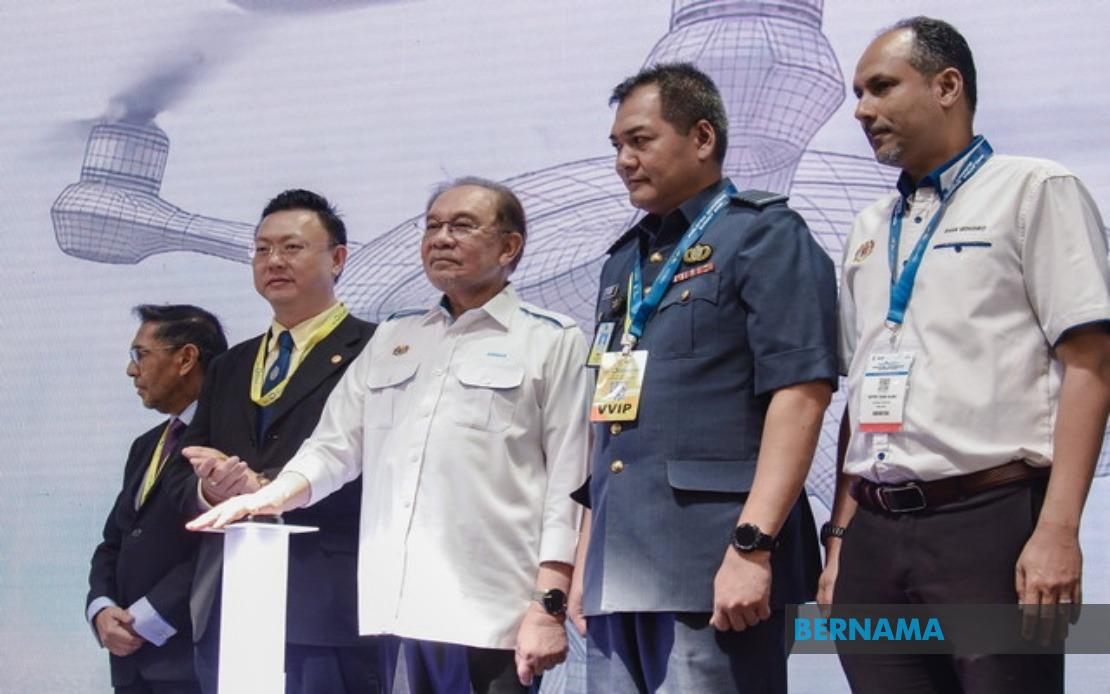
Prime Minister Datuk Seri Anwar Ibrahim has underscored the urgency for Malaysia to rapidly develop and adopt unmanned aerial vehicle (UAV) and drone technologies, emphasizing that the country's economic competitiveness depends on moving swiftly in emerging sectors. Speaking at the closing ceremony of MyDrone Expo 2026 (MDX2026) in Sepang, Anwar positioned drone development alongside artificial intelligence and digital transformation as interconnected technologies reshaping the global economy. His remarks signal a strategic pivot toward innovation-driven sectors that could diversify Malaysia's economic base beyond traditional manufacturing and services.
The drone industry represents far more than a niche technological segment, according to the Prime Minister's assessment. By framing UAVs within the broader context of digital technology and AI, Anwar highlighted the sector's systemic importance to future productivity gains across multiple economic domains. The technology's applications span defence and aerospace to agriculture, logistics, and infrastructure inspection, making it a foundational capability for modernizing various industries simultaneously. This integration narrative reflects growing international recognition that drone ecosystems function as economic multipliers, enabling efficiency improvements and cost reductions across sectors that employ millions of workers.
The scale of opportunity is substantial. Global projections indicate the UAV market will exceed USD55 billion by 2030, representing a compound growth trajectory that creates first-mover advantages for nations establishing leadership positions now. The low-altitude economy—the emerging domain of airspace and services below traditional aircraft corridors—is becoming increasingly central to investment decisions by multinational corporations and venture capital firms. For Malaysia, capturing even a modest share of this expanding market could generate significant employment, especially in high-skill manufacturing, software development, and specialized services. Southeast Asia's geographic position, logistics advantages, and growing tech talent pool position the region competitively if countries act decisively.
Anwar has directed comprehensive governmental support across multiple fronts to establish Malaysia as a credible player in drone innovation and production. Cabinet ministers, policymakers, research institutions, and regulatory agencies have been tasked with creating conditions conducive to industry development. This whole-of-government approach acknowledges that technology sectors cannot flourish through private-sector efforts alone; they require coordinated policy frameworks, research infrastructure, and regulatory clarity. The approach mirrors successful models in Singapore, South Korea, and Taiwan, where strategic state support combined with market mechanisms generated innovation ecosystems that became globally competitive.
The government's commitment extends to modernizing the regulatory environment governing drone operations and certification. Clear, predictable regulations that balance safety with innovation are critical for attracting private investment and enabling Malaysian companies to compete internationally. Existing frameworks designed primarily for traditional aviation often create unnecessary friction for emerging technologies. By streamlining approvals and establishing testing facilities, Malaysia can accelerate the development cycle and reduce barriers to commercialization. Such regulatory modernization also builds confidence among international partners and investors evaluating Malaysia as a manufacturing or R&D base.
The MyDrone Expo 2026 itself demonstrated substantial market interest and regional engagement. Organized jointly by the World UAV Federation (WUAVF) Malaysia Chapter and the Malaysia UAV Development Association (MUDA), the event attracted more than 100 exhibition booths and thousands of visitors from 46 countries. This international attendance indicates recognition of Malaysia's potential as a hub for drone innovation and development in Southeast Asia. The diversity of participating nations suggests opportunities for technology transfer, partnerships, and knowledge exchange that could accelerate Malaysia's sector maturation. Such events create networking infrastructure essential for translating policy support into actual business ventures and collaboration agreements.
Government support will also focus on research funding and institutional capacity building. Anwar specifically mentioned commitment to enhancing research resources and establishing testing and certification facilities. These investments create the foundational infrastructure enabling innovation at earlier stages of technology development. Universities, research councils, and government laboratories require adequate resources to conduct applied research, train specialized personnel, and validate new drone designs and applications. Without such institutional investment, Malaysia risks remaining dependent on imported technologies rather than developing indigenous capabilities that generate higher-value employment and intellectual property.
Talent development emerges as a critical component of the strategy. Anwar called for closer collaboration between private sector companies, government research institutions, and universities to establish robust talent pipelines comparable to existing structures in AI and quantum computing. Drone technology expertise spans multiple disciplines—aeronautical engineering, materials science, software development, control systems, and data analytics. Building sufficient supply of skilled professionals requires coordinated curriculum development, industry internship programs, and graduate-level research opportunities. Malaysia's existing investments in AI and quantum computing education provide a template for how government, academia, and industry can collaborate to develop the specialized workforce sectors require.
The civil applications emphasis in government messaging reflects recognition that sustainable economic growth depends on non-defence commercial uses. Agricultural productivity remains a central challenge across Southeast Asia, where labor shortages and climate variability pressure traditional farming methods. Drones enable precision agriculture, crop monitoring, targeted pesticide application, and yield optimization—technologies particularly valuable for smallholder farmers and plantation operators. Similarly, infrastructure inspection, environmental monitoring, disaster response, and logistics applications create substantial commercial demand. By positioning drones as tools for economic productivity across civilian sectors, government messaging broadens political support and attracts diverse industry participation beyond defense contractors.
The timing of this policy emphasis carries strategic significance within the broader Southeast Asian context. Regional competitors including Thailand, Vietnam, and Indonesia are similarly exploring drone technology development. Competition for investment, talent, and manufacturing capability is intensifying. Malaysia's advantages include established manufacturing infrastructure, English-language fluency in technical sectors, political stability, and existing digital technology investments. However, these advantages are not permanent—they require continuous reinforcement through updated policies, infrastructure investment, and institutional development. The government's clear public commitment, as demonstrated through the Prime Minister's remarks, signals to international investors and domestic entrepreneurs that drone sector development enjoys sustained political backing.
Implementing this ambitious agenda requires sustained coordination beyond rhetorical support. Bottlenecks typically emerge in areas including spectrum allocation for autonomous drone operations, insurance and liability frameworks, export promotion, and intellectual property protection. Different government agencies may have conflicting priorities regarding airspace management, security considerations, and environmental concerns. Successful execution depends on establishing clear decision-making authority, resolving inter-agency conflicts proactively, and maintaining policy consistency as government administrations change. Regional examples suggest that establishing independent regulatory bodies with clear mandates and adequate resources reduces bureaucratic friction and improves outcomes.
For Malaysian businesses and investors, the government's stated commitment creates both opportunities and risks. Opportunities emerge in drone manufacturing, software development, specialized services, and supporting industries. Government preference signals potential access to contracts, preferential regulatory treatment, and research partnerships. Conversely, overreliance on government support creates vulnerability to policy shifts, budgetary pressures, and political changes. Successful companies will combine government support with genuine commercial viability, international competitiveness, and independent revenue sources. The most resilient sector participants will be those building capabilities and markets that survive regardless of government policy fluctuations.
Looking forward, Malaysia's drone sector development trajectory will significantly depend on how thoroughly the government translates policy statements into concrete actions. The next eighteen to twenty-four months will be critical for establishing testing facilities, streamlining regulations, funding research initiatives, and implementing talent development programs. International observers will be assessing whether Malaysia's commitments match those of rival nations in terms of resource allocation and institutional support. Success requires not just rhetoric about drone importance but substantial budget allocations, institutional reorganization, and regulatory modernization. For Malaysia's economy, demonstrating competence in developing high-technology sectors may ultimately prove as important as the drone industry itself, signaling to global investors the country's broader capability to compete in innovation-driven sectors essential for long-term prosperity.

