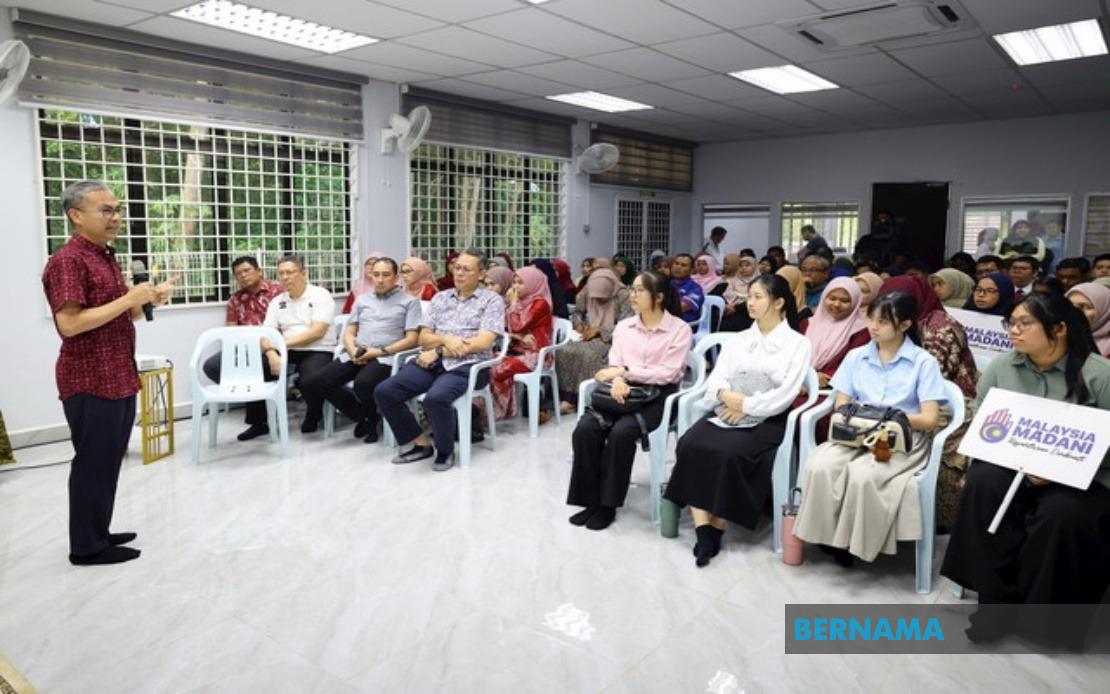
Communications Minister Datuk Seri Fahmi Fadzil has underscored the critical importance of fostering both patriotic values and digital competency among Malaysia's youth, arguing that secondary school students require continuous exposure to these dual pillars to navigate an increasingly complex modern world. Speaking after an engagement session with Form Six students in Jempol, Fahmi highlighted that the nation cannot afford to neglect either dimension—citizens must understand their historical roots and civic responsibilities while simultaneously developing the critical thinking skills necessary to function responsibly in digital spaces.
The minister's remarks came during a visit to the Jempol District Information Office, where he interacted with approximately 60 Form Six students from three schools in the parliamentary constituency: Sekolah Menengah Kebangsaan Batu Kikir, SMK Seri Perpatih, and SMK Datuk Mansor. The dialogue formed part of the Pentarama X Kelab Malaysiaku programme, a joint initiative between the Department of Information Malaysia and the government's patriotic messaging unit. This educational outreach reflects the government's recognition that young Malaysians face unprecedented pressures—from misinformation to mental health challenges—that demand both institutional support and personal resilience grounded in national identity.
Fahmi stressed that understanding Malaysia's history and each citizen's role in the nation's progress represents a fundamental civic obligation. Rather than treating patriotism as an abstract concept, he positioned it as a practical framework for decision-making and social responsibility. His comments suggest that the government views national consciousness not as nostalgia but as an anchoring force that helps younger generations resist fragmentation and maintain cohesion in an era of rapid social and technological change. The emphasis on "becoming Malaysians who can help move the country forward" frames patriotism in forward-looking terms, connecting historical awareness to contemporary ambition.
What emerged distinctly from the minister's account of the session was the sophistication of student concerns. Rather than passive recipients of government messaging, the Form Six participants demonstrated genuine engagement with pressing issues: the proliferation of fake news, the mental health implications of social media usage, and the transformative potential of artificial intelligence. These are not peripheral anxieties but central challenges shaping Malaysia's future competitiveness and social stability. Students explicitly raised questions about their prospects in a technologically accelerating economy, suggesting anxiety about whether current educational pathways adequately prepare them for jobs that may not yet exist.
The government's response, embodied in the Pentarama X Kelab Malaysiaku initiative, attempts to bridge generational and institutional divides through what officials describe as an "edutainment" approach. Rather than traditional lectures or top-down directives, the programme employs singing, dancing, and drama to communicate patriotic messages and policy information. This methodology acknowledges that young people process information differently than previous generations and that emotional engagement often precedes intellectual acceptance. By making civic education performative and participatory, the initiative seeks to make patriotism feel contemporary and relevant rather than obligatory or antiquated.
The expansion of Kelab Malaysiaku clubs to 850 nationwide indicates institutional commitment to embedding these values across Malaysia's school system. The clubs function as vehicles for promoting independence, unity, and national celebration messaging at the grassroots level, distributing responsibility for civic cultivation beyond federal ministries to individual educational institutions. This decentralization potentially increases effectiveness by allowing local adaptation while maintaining consistent thematic messaging around Malaysia Day and National Day commemorations.
Digital literacy, in this context, encompasses more than technical proficiency with devices or platforms. Fahmi's invocation of "ethical social media use" suggests awareness that digital natives require guidance in distinguishing reliable information from manipulated content, understanding how algorithms shape their information environments, and recognizing their own capacity to spread harmful material inadvertently. This represents a departure from viewing digital literacy merely as a skills-based competency toward understanding it as an ethical and civic practice that demands judgment and restraint.
The timing of such initiatives carries significance for Malaysia specifically. The nation has experienced periods of divisive online discourse, with social media amplifying pre-existing communal tensions. Misinformation has demonstrably affected electoral processes and public health responses. In this context, developing young people's capacity to think critically about digital content and recognize manipulation becomes a form of democratic inoculation. When students understand how fake news operates and why they might be susceptible to it, they develop resilience against coordinated disinformation campaigns that could otherwise exploit generational vulnerabilities.
The integration of artificial intelligence concerns into this discussion reflects appropriate foresight. Malaysia, like other Southeast Asian economies, faces significant questions about whether its workforce can transition into AI-era employment. Students worried about economic prospects deserve more than reassurance; they deserve education systems that teach complementary human skills—creativity, emotional intelligence, ethical reasoning—that machines cannot easily replicate. Patriotic education that emphasizes Malaysia's potential and individual contributions to national development may provide psychological scaffolding for navigating technological disruption.
JaPen director-general Erwin Khairul Ahmad's emphasis on the expanded Kelab Malaysiaku programme's contributions to National Month celebrations and Malaysia Day preparations suggests these initiatives occupy political space traditionally reserved for ceremonial observance. By transforming national celebrations into platforms for deeper civic engagement among youth, the government attempts to refresh what might otherwise feel rote or disconnected from young people's lived experiences. This reframing positions national commemorations not as obligations to historical memory but as opportunities for forward-looking conversation about shared purpose.
The presence of Malaysian Communications and Multimedia Commission (MCMC) representatives at the Jempol session underscores the multi-institutional approach required to address digital challenges. Regulation, education, and industry cooperation must operate in concert; no single ministry can adequately address the complex ecosystem of digital platforms, content creation, and information distribution that younger Malaysians inhabit. The MCMC's involvement signals that digital literacy initiatives extend beyond informational campaigns toward regulatory frameworks and infrastructure intended to create safer digital environments.
For Malaysian and Southeast Asian policymakers observing these initiatives, several implications emerge. Youth engagement cannot be treated as episodic or secondary to adult-focused governance; it represents investment in long-term institutional legitimacy and social stability. Second, patriotic education and digital literacy are not contradictory imperatives but complementary ones, each strengthening the other. Citizens grounded in national identity and historical understanding are less vulnerable to extremist narratives or divisive misinformation. Third, young people's concerns deserve serious institutional responses, not dismissal as youthful angst; they identify genuine gaps in current systems and point toward emerging vulnerabilities.
Ultimately, Fahmi's emphasis on continuous cultivation of both patriotism and digital competency reflects sophisticated understanding that Malaysia's future depends on young people who are simultaneously rooted in national identity and agile navigators of technological change. Neither quality alone suffices; together they represent the foundation for a generation capable of addressing the interlocking challenges of democratic participation, economic transformation, and social cohesion that will define Southeast Asia's next two decades.

