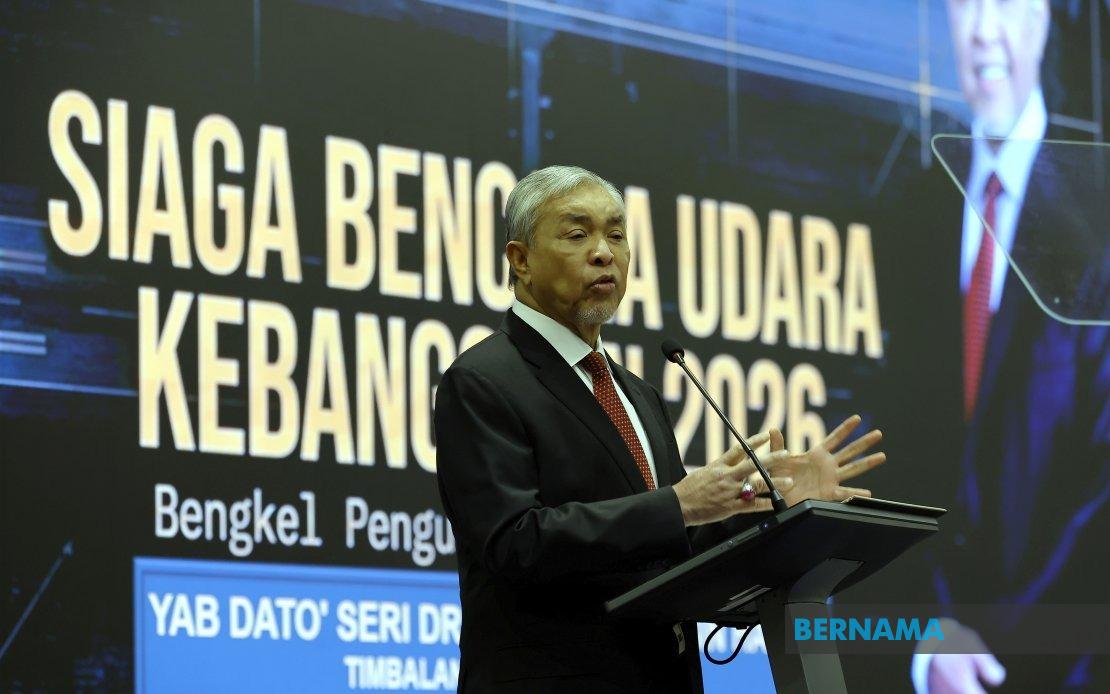
Malaysia needs to establish a cohesive air disaster management system where all agencies operate from a shared operational framework and respond to emergencies through unified command structures, Deputy Prime Minister Datuk Seri Dr Ahmad Zahid Hamidi said at Sepang on July 27. Speaking at the launch of the National Air Disaster Preparedness 2026 workshop, he underscored that effective emergency response requires abandoning siloed approaches in favour of coordinated action that prioritises saving lives and containing crises swiftly.
The principle that should guide Malaysia's disaster preparedness architecture is simple yet demanding: one system, one command, and one action. Ahmad Zahid articulated that this framework must allow government agencies to harmonise their assets, specialised knowledge, and decision-making authority towards a shared goal. In practice, this means that when an air disaster occurs, Malaysia's response machinery must function as an integrated national team rather than separate organisations pursuing independent agendas. The theoretical framework matters less than operational reality; procedures drafted at planning tables must perform flawlessly under the intense pressure and uncertainty of actual emergencies.
Crucially, Ahmad Zahid cautioned against postponing critical tests of readiness until a genuine catastrophe unfolds. Waiting until a disaster strikes to discover whether commands are intelligible, communication channels function properly, or agencies can synchronise their activities represents an unacceptable level of institutional risk. The workshop therefore serves as a controlled testing ground where Malaysia's disaster response apparatus can evaluate its own preparedness before facing real consequences. This diagnostic approach recognises that fragmentation among response agencies can itself become a secondary disaster, compounding casualties and hindering recovery efforts.
The measures Ahmad Zahid identified as priorities for strengthening Malaysia's capacity reflect sophisticated understanding of modern emergency management. First, the country must review and reinforce its chain of command and decision-making authority, ensuring clarity about which officials hold which responsibilities and that procedures for escalating decisions remain unambiguous even as situations develop rapidly. Second, information sharing infrastructure and inter-agency communication protocols require substantial enhancement, so that all participating organisations access the same data and understand it identically. Third, scenario-based training must expand beyond airport terminals to encompass remote locations and difficult-to-reach areas, recognising that air disasters may occur at staging areas or in terrain where conventional airport resources prove insufficient.
Digitalisation of disaster management processes constitutes the fourth pillar. Modern technology enables real-time data sharing, automated alerts, and digital coordination of dispersed teams. By systematising these tools rather than relying on ad hoc telephone chains and paper-based records, Malaysia can dramatically accelerate decision cycles and reduce communication errors. Ahmad Zahid's emphasis on building systems that perform under pressure rather than merely appearing complete on documentation reflects mature crisis management thinking. A system tested only in ideal conditions often fractures when information flows rapidly, ambiguity clouds the situation, and officials must make consequential choices within minutes.
Present at the workshop launch were Deputy Transport Minister Datuk Hasbi Habibollah, National Disaster Management Agency director-general Datuk Meor Ismail Meor Akim, Malaysia Airports Holdings Bhd chairman Tan Sri (Dr) Azmil Khalid, and Malaysia Airports managing director Datuk Mohd Izani Ghani, representing the breadth of agencies involved in aviation safety and emergency response. Over 100 representatives from government ministries, law enforcement, security and rescue services, airlines, airport operators, and industry observers attended the two-day workshop, reflecting the complexity of coordinating air disaster response across multiple sectors.
Ahmad Zahid contextualised this focus on air disaster preparedness within Malaysia's broader economic interests and reputation. The aviation sector functions as a critical infrastructure supporting tourism, trade, and investment attraction. Malaysia received 42.2 million international tourists last year, generating RM110.6 billion in revenue, while domestic tourism expenditure reached RM121.3 billion. These figures underscore that aviation safety transcends technical or operational considerations; it represents a strategic national asset. International travellers and investors calibrate their confidence in Malaysia partly on perceptions of safety and emergency response capability. Any air disaster, regardless of cause, damages Malaysia's image globally and potentially deters future tourism and investment.
This economic dimension transforms disaster preparedness from a bureaucratic obligation into an investment protecting Malaysia's developmental trajectory. Every RM spent on improving emergency response infrastructure, training personnel, and strengthening coordination mechanisms preserves the confidence that sustains international travel and business activity. Conversely, a poorly managed air disaster—one where response failures exacerbate casualties or confusion—inflicts economic damage extending far beyond the immediate incident. The government's commitment to supporting disaster preparedness through improved policies, enhanced coordination, and expanded capacity building thus represents rational protection of national economic interests alongside humanitarian imperatives.
The workshop methodology itself embodies modern emergency management doctrine. Rather than passive lectures, participating agencies conduct practical exercises testing existing procedures and communication protocols against realistic scenarios. This active evaluation identifies procedural weaknesses, clarifies operational roles that participants may have misunderstood, and assesses whether the overall system functions coherently under simulated pressure. Evaluators and observers from multiple organisations provide external perspectives on system performance, flagging coordination failures or information bottlenecks that internal participants might overlook.
For Malaysia's disaster management apparatus, this structured, systematic approach to improvement reflects recognition that aviation safety and emergency response require continuous refinement rather than assuming current arrangements suffice. The National Air Disaster Preparedness 2026 framework indicates a multi-year commitment to building institutional capacity incrementally, learning from exercises, and adapting procedures based on evaluation findings. By establishing clear benchmarks, regular testing protocols, and mechanisms for inter-agency learning, Malaysia positions itself to respond effectively should a genuine air disaster occur, thereby protecting both lives and the national interest.

