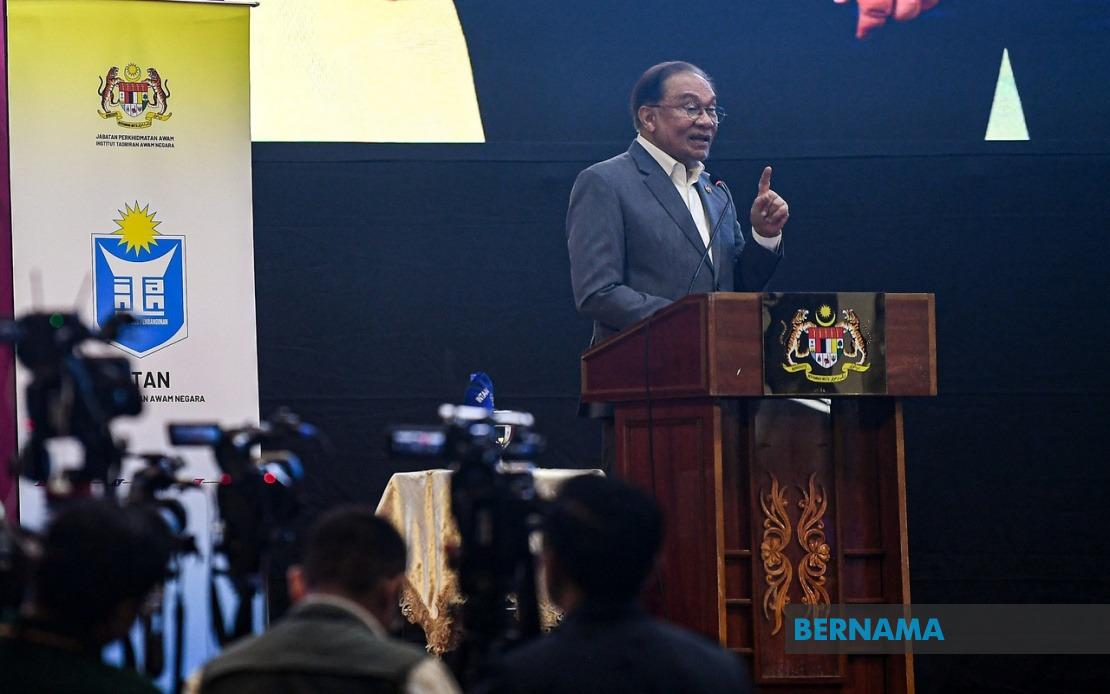
Prime Minister Datuk Seri Anwar Ibrahim has issued a forceful call for Malaysians to cast off the psychological legacies of colonial rule that continue to privilege Western frameworks as the gold standard for governance, education and development. Speaking at Universiti Islam Selangor during an engagement with central zone civil servants, Anwar framed this recalibration of national thinking as essential to completing the project of independence that was formally achieved decades ago but remains unfinished in the realm of ideas and institutional practice.
The Prime Minister's remarks reflect a growing concern within Malaysian leadership circles about the persistent dominance of Western paradigms in shaping how the country's educated classes approach fundamental questions of policy, pedagogy and cultural orientation. He emphasised that true national independence extends far beyond the ceremonial hoisting of the Jalur Gemilang or the formal transfer of administrative authority from colonial administrators to elected Malaysian leaders. Rather, substantive independence demands that contemporary Malaysians actively construct their own intellectual and institutional frameworks rather than defaulting to imported blueprints simply because of their Western provenance.
Anwar highlighted a paradox he observes among segments of the post-independence generation: individuals who are physically and legally Malaysian but remain psychologically tethered to Western worldviews and systems. He described this cohort as those whose "thinking remains half-English" despite their brown skin, capturing a contradiction between demographic identity and intellectual orientation. This characterisation underscores his concern that even after seven decades of self-governance, Malaysia's policy elites and opinion-shapers continue to measure national performance and aspirations against external Western yardsticks rather than developing homegrown metrics rooted in Malaysian contexts and values.
The Prime Minister's critique extends across multiple domains of national life. He pointed specifically to education, where English-medium instruction remains dominant in elite institutions and is often positioned by families as the gateway to international competitiveness and opportunity. Anwar's observation that some Malaysians believe education "must be in English" and that cultural expression "must be English" reflects deeper anxieties about linguistic and cultural assimilation among the professional classes. Similarly, his reference to the uncritical adoption of Western economic and political systems suggests that Malaysia's development trajectory continues to be shaped more by mimicry of established Western models than by authentic experimentation with approaches tailored to local circumstances.
For Malaysian readers, Anwar's intervention carries particular resonance given the nation's ongoing debate about Bahasa Melayu's role in technical and higher education, the place of traditional governance structures and customary law within a modern nation-state, and the tension between pursuing global competitiveness and preserving distinct cultural identity. The speech addresses an audience of central government civil servants, positioning bureaucratic leadership as crucial to this broader reorientation. Since the public service shapes policy implementation and institutional culture, Anwar's appeal to government workers carries implicit instruction that the machinery of state should begin consciously privileging Malaysian-sourced solutions and values in decision-making.
The gathering included Chief Secretary to the Government Tan Sri Shamsul Azri Abu Bakar and Director-General of the Public Service Tan Sri Wan Ahmad Dahlan Abdul Aziz, indicating that this message represents an official policy direction rather than a passing rhetorical flourish. The presence of these senior administrative figures suggests that the Prime Minister is signalling his expectation that the civil service will operationalise this philosophical reorientation in concrete ways—from how government agencies structure their operations to how they train personnel and develop institutional capacity.
Anwar's framing of this challenge as a matter of national responsibility speaks to the idea that the current generation of Malaysians bears an obligation not merely to inherit the independence won by their predecessors but to deepen and complete it. This invocation of generational duty suggests that remaining psychologically colonised—accepting Western superiority across domains from governance to culture—represents a form of abdication of the nationalist project itself. The implicit argument is that allowing Western models to remain the default reference point perpetuates a subtle form of dependency that undermines genuine sovereignty.
For Southeast Asia more broadly, Anwar's remarks align with a wider regional conversation about asserting non-Western approaches to development and governance in an era of competing great power influence. As regional nations navigate relationships with China, India, Japan and the United States, questions about whether to adopt external models or develop region-specific approaches have become increasingly salient. Malaysia's experience as a middle-income nation grappling with how to modernise without Westernising offers relevant lessons for neighbours pursuing similar trajectories.
The challenge Anwar identifies, however, is not without complications. Malaysia's position as a trading nation deeply integrated into global value chains, its substantial English-speaking professional class, and its participation in international institutions all create practical pressures toward adopting globally standardised systems and languages. Entirely rejecting Western frameworks would require navigating considerable structural constraints and competitive disadvantages in globalised markets. The more nuanced reading of Anwar's intervention suggests he is calling not for wholesale rejection of Western ideas but for more deliberate, critical engagement—selecting and adapting external insights rather than accepting them uncritically as universally applicable solutions.
The Prime Minister's emphasis on building Malaysian development "on its own values, identity and strengths" places the onus on the nation's leadership to articulate what these distinctive values and strengths actually are. This requires moving beyond critique of Western models toward constructive articulation of alternative approaches—a considerably more demanding intellectual and political project. It also requires building coalitions across Malaysia's diverse communities around shared national values that can serve as anchors for this reorientation without suppressing legitimate differences of opinion about what Malaysian identity should encompass.
Anwar's remarks ultimately constitute a call for intellectual independence to accompany formal political sovereignty. They suggest that Malaysia's development trajectory will remain incomplete as long as significant segments of the governing and professional classes continue to treat Western systems as inherently superior and more worthy of emulation than locally-sourced alternatives. Whether this exhortation translates into concrete institutional changes—from educational curricula to governance structures to economic policy approaches—will determine whether it represents a genuine strategic reorientation or primarily a rhetorical gesture toward nationalist sentiment.

