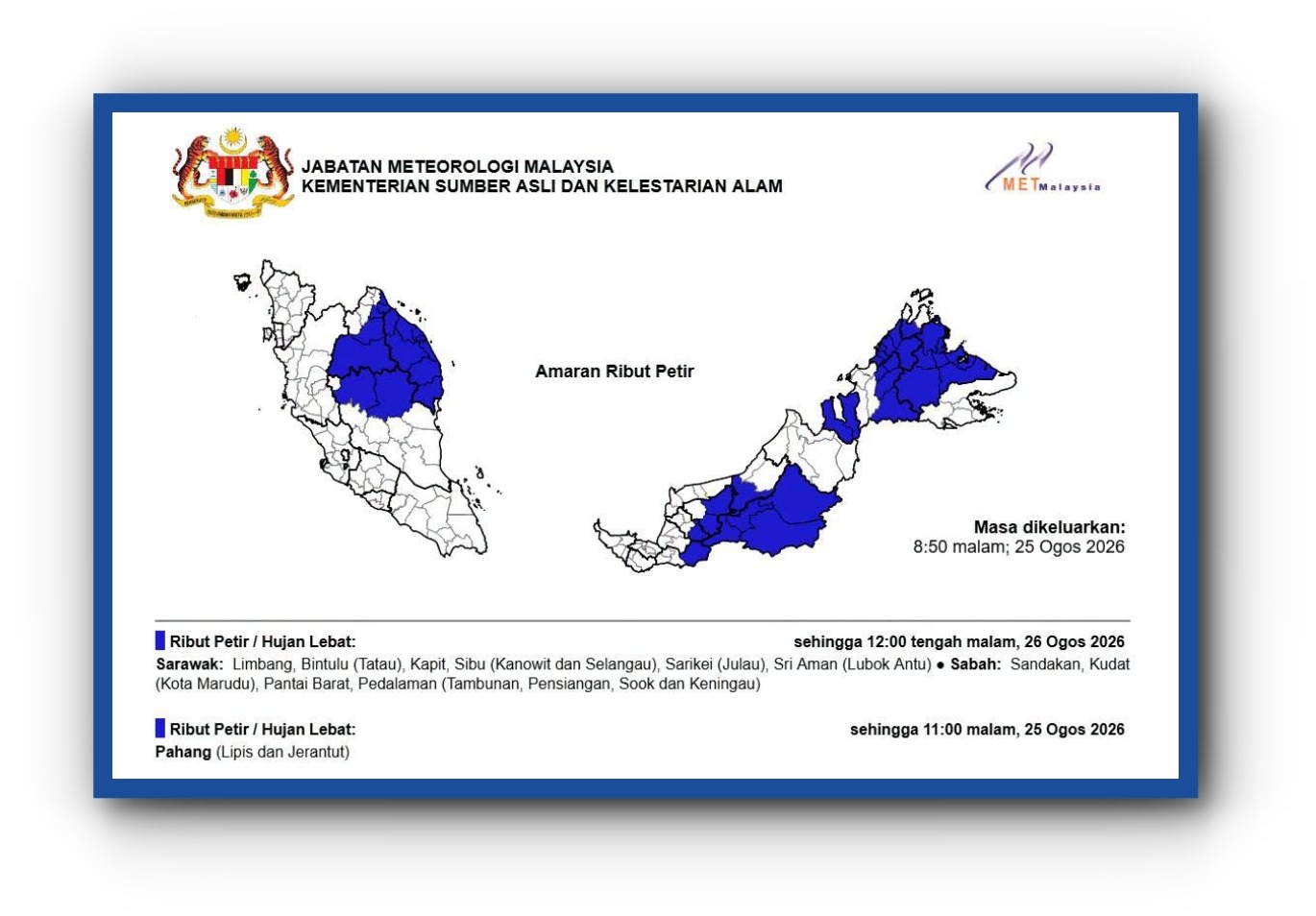
The Malaysian Meteorological Department (MetMalaysia) issued a tropical storm advisory on August 25 for NARRA, a tropical weather system currently positioned northwest of Malaysian airspace and advancing in a northeasterly direction. As of 8:00 pm the previous evening, the storm was centred at latitude 20.0 North and longitude 108.9 East, approximately 39 kilometres northwest of Sandu, China, and roughly 1,691 kilometres northwest of Kudat in Sabah.
The tropical cyclone is moving at a measured pace of 19 kilometres per hour, a relatively moderate forward speed that allows meteorologists to track its progression across the western Pacific region with reasonable confidence. Current wind measurements indicate maximum sustained speeds of 65 kilometres per hour, placing NARRA within the definition of a tropical storm rather than a more powerful cyclone system. While these wind velocities are significant for maritime activities and coastal regions in its direct path, they remain below the thresholds that typically trigger widespread disruptions across large populated areas.
According to MetMalaysia's assessment at the time of the advisory, the tropical system has not produced any significant adverse effects on Malaysian territory, whether on the peninsula or across Sabah and Sarawak. The considerable distance separating NARRA from Malaysia's maritime boundaries means the country's residents, infrastructure, and economic activities continue operating under normal conditions. This geographical separation provides meteorological forecasters with adequate lead time to monitor any potential changes in the storm's trajectory or intensity that might eventually bring it closer to Southeast Asian territory.
The positioning of NARRA near the China coast reflects typical seasonal tropical cyclone behaviour during the late summer months in the western Pacific basin. Storms at this latitude and longitude often drift northwestward toward East Asia, though some systems veer northeastward toward Japan and the broader North Pacific. The direction NARRA is currently taking—northeastward—suggests it may track away from the Malaysian region entirely, though meteorological conditions can alter a storm's path with relatively little warning.
For Malaysia's maritime industries, including shipping, fishing, and offshore energy operations, tropical storm advisories serve as critical early warning signals. Vessel operators and port authorities use such information to coordinate movements, secure vessels, and implement safety protocols well in advance of any potential impact. Even though NARRA currently poses no direct threat, the advisory system demonstrates the transparency and preparedness that MetMalaysia maintains across the region.
The tropical Atlantic and western Pacific hurricane seasons peak during late summer and early autumn, a period when atmospheric conditions favour storm development. Malaysia's position in the equatorial and subtropical western Pacific means the country remains on the periphery of most cyclone activity, though historical records show major storms have occasionally tracked far enough south and west to affect the region. The August timing of NARRA's emergence falls squarely within this seasonal window of heightened tropical cyclone occurrence.
MetMalaysia's monitoring capabilities have expanded significantly over recent decades through satellite technology, advanced modelling systems, and international data-sharing agreements with regional meteorological services. This infrastructure allows the department to provide Malaysian stakeholders—from government agencies to private industry—with detailed, timely advisories that inform decision-making across multiple sectors. The Tropical Storm Advice issued for NARRA exemplifies this operational readiness.
Regional cooperation on meteorological matters has become increasingly important as climate patterns shift and weather systems sometimes behave unpredictably. Southeast Asian nations, including Malaysia, participate in information-sharing networks coordinated through international bodies, ensuring that tropical storm warnings issued by one country benefit neighboring nations in the wider region. NARRA's proximity to China means coordinated monitoring with Chinese meteorological authorities provides additional perspective on the system's behaviour and trajectory.
For Malaysian residents and businesses, awareness of tropical storm activity—even when occurring thousands of kilometres away—contributes to overall climate literacy and preparedness. Understanding how weather systems develop, move, and potentially impact the region helps communities recognize the importance of maintaining emergency preparedness plans and following official guidance during severe weather events. While NARRA currently remains distant, its tracking serves as a timely reminder of the dynamic tropical weather environment that characterises Malaysia's geographic location.
MetMalaysia will continue monitoring NARRA's progression and will issue updated advisories as the system evolves. Any change in the tropical storm's trajectory, forward speed, or intensity could trigger updated guidance to Malaysian authorities and the public. Stakeholders dependent on maritime conditions or coastal activities should remain informed through official MetMalaysia channels and maintain established severe weather protocols until the advisory status changes or is formally cancelled by the department.

