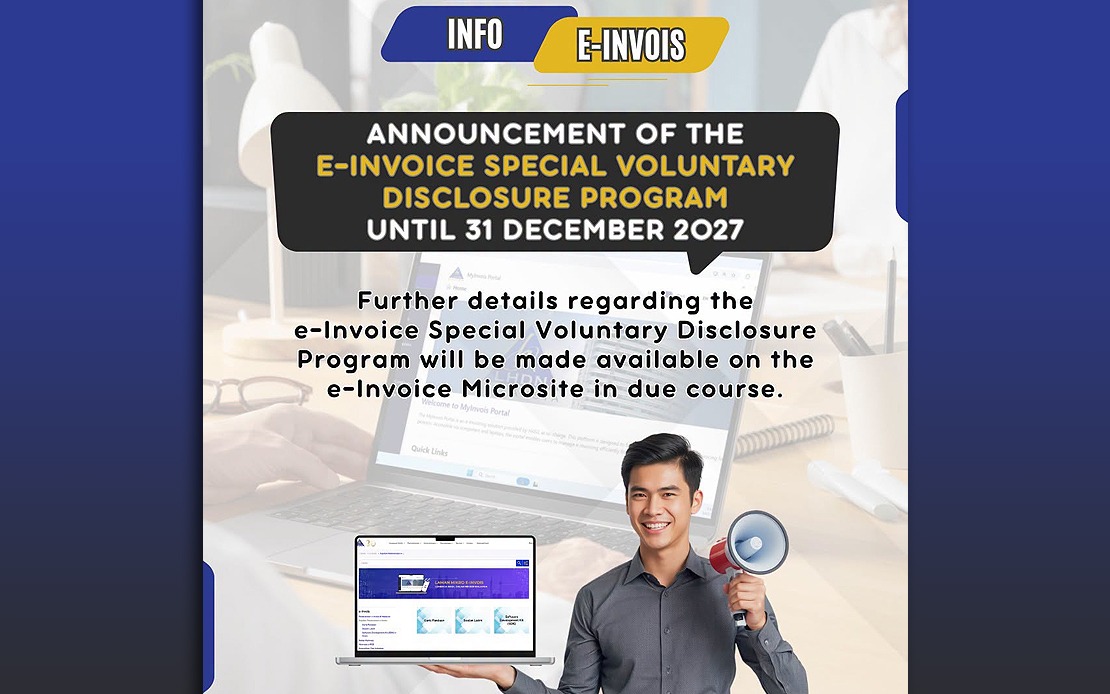
Prime Minister Datuk Seri Anwar Ibrahim announced today that the government is introducing a special voluntary disclosure programme for e-Invoice submissions that will remain open until December 31, 2027. The initiative represents a deliberate policy shift aimed at easing the administrative burden on Malaysia's business community, particularly the crucial micro, small, and medium enterprise sector that forms the backbone of the nation's economy. By allowing a three-year window for compliance corrections, the government signals its commitment to digitalisation without creating undue hardship for businesses navigating the transition.
The Inland Revenue Board (IRB) has clarified that the amnesty programme encompasses three distinct categories of taxpayers. The first group includes those who completely failed to submit e-Invoices for certain qualifying transactions covered under the mandatory implementation requirements. The second category covers entities that did submit e-Invoices but with substantive errors or deficiencies that breached the stipulated technical or procedural standards. The third category applies to taxpayers who entirely neglected their e-Invoice submission obligations during any period since the mandatory implementation date was established. This three-tiered structure ensures broad accessibility while maintaining administrative clarity about which compliance lapses qualify for the voluntary disclosure process.
Under the programme framework, businesses can voluntarily come forward to update, review, and correct their e-Invoice submissions without triggering any financial penalties from the tax authorities. This amnesty approach contrasts sharply with the typical enforcement posture of revenue departments globally, reflecting a pragmatic recognition that the transition to digital invoicing requires accommodation for genuine compliance difficulties. The IRB has emphasised that all voluntary disclosures must still adhere to the General and Specific e-Invoice Guidelines to ensure the integrity of the digital ecosystem and maintain the legitimacy of the amnesty.
The initiative serves multiple policy objectives simultaneously. Beyond immediate compliance improvement, it aims to build taxpayer confidence in the e-Invoice system by demonstrating that authorities are willing to work constructively with businesses experiencing implementation challenges. This confidence-building approach is particularly significant in Malaysia's business environment, where many MSMEs remain in the early stages of digital transformation. By removing the fear of penalties during the correction window, the government removes a major psychological barrier that might otherwise deter businesses from voluntarily upgrading their compliance posture.
In recognition of businesses that have already achieved full e-Invoice compliance, the government is simultaneously introducing accelerated tax incentive provisions. These provisions allow taxpayers to claim capital allowances for information and communication technology equipment purchases within a single fiscal year, rather than spreading deductions across multiple years as standard depreciation rules would require. Additionally, expenses associated with developing or modifying computer software specifically for e-Invoice implementation can now be deducted in a more accelerated manner. These incentives serve as positive reinforcement, rewarding early adopters and encouraging peers to follow suit.
The timing of this announcement reflects broader policy priorities within the Anwar Ibrahim administration. As Finance Minister alongside his Prime Ministerial role, Anwar has positioned compliance simplification as a core economic strategy designed to enhance Malaysia's competitiveness and reduce the regulatory friction that constrains business growth. The e-Invoice voluntary disclosure programme aligns with this agenda by demonstrating government willingness to adapt rigid compliance frameworks when they impose disproportionate costs on economically important constituencies like MSMEs. For Southeast Asian observers, Malaysia's approach offers a template for balancing digitalisation ambitions with practical business realities.
The IRB has established multiple support channels to assist taxpayers navigating the voluntary disclosure process. Businesses can access guidance through IRB offices located throughout Malaysia, utilise a dedicated e-Invoice helpdesk operating at 03-8682 8000, engage the MyInvois Live Chat support service, or submit enquiries via email to designated IRB addresses. This multi-channel support infrastructure acknowledges that compliance barriers often stem not from deliberate non-compliance but from confusion about technical requirements or procedural steps. By investing in accessible support mechanisms, the IRB addresses the supply-side constraints that prevent willing businesses from achieving compliance.
The e-Invoice system represents a fundamental modernisation of Malaysia's tax administration infrastructure. Digital invoicing enables real-time tracking of business transactions, reduces opportunities for revenue leakage, and creates verifiable audit trails that strengthen tax compliance across supply chains. However, the system's effectiveness depends on adoption rates and data quality. When significant portions of the business community remain non-compliant—whether through genuine confusion or deliberate avoidance—the system fails to deliver its intended benefits. The voluntary disclosure programme therefore serves a strategic function in achieving the critical mass of compliance necessary for the system to function effectively as a revenue management tool.
For businesses in Malaysia, the programme creates a clearly delineated period during which companies can address accumulated compliance deficiencies without jeopardising their broader tax relationship with authorities. This is particularly valuable for smaller enterprises that may lack dedicated tax compliance personnel and might have inadvertently drifted into non-compliance through operational oversights rather than deliberate evasion. The three-year timeline also acknowledges that digital system implementation across diverse business environments—from sophisticated manufacturing operations to informal retail traders—necessarily requires extended transition periods.
The announcement reflects recognition that digitalisation, while economically imperative, creates genuine implementation challenges across heterogeneous business populations. SMEs operating with limited technology expertise or financial resources face steeper adoption curves than large multinational corporations with dedicated IT departments. By providing penalty-free correction windows and accelerated incentives, Malaysian policy makers are attempting to democratise access to the benefits of digital transformation while maintaining the integrity of the tax system. This represents a substantive reorientation toward supportive rather than purely punitive compliance frameworks, a shift with potentially significant implications for how governments across Southeast Asia approach their own digital tax administration transformations in coming years.

