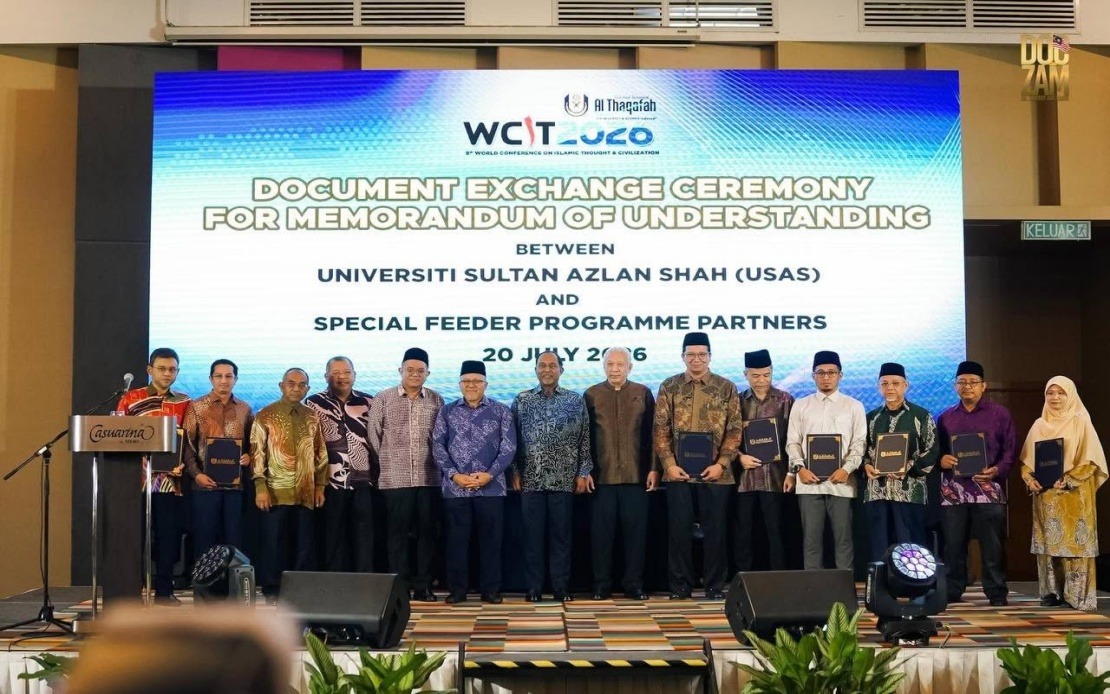
Malaysia is doubling down on its ambitions to become a leading centre for intellectual engagement on Islamic civilisation while simultaneously establishing itself as a regional powerhouse in higher education. Higher Education Minister Datuk Seri Dr Zambry Abdul Kadir articulated this vision at a gathering in Ipoh, emphasising that the nation intends to serve as a crucial bridge for fostering meaningful dialogue among global scholars, policymakers, and thought leaders concerned with advancing Islamic knowledge systems in contemporary contexts.
The 8th World Conference on Islamic Thought and Civilisation (WCIT2026) represents a tangible manifestation of these aspirations. Hosted by Universiti Sultan Azlan Shah (USAS), the three-day conference convenes more than 180 delegates, academics, researchers, and intellectuals from multiple nations to explore pressing challenges facing both the Islamic world and humanity broadly. By creating this assembly of minds, Malaysia seeks to position itself not merely as a venue for discussion, but as an incubator for generating practical solutions that resonate across religious and cultural boundaries.
During his address, Zambry articulated a philosophical position that distinguishes contemporary Islamic thought from nostalgic reverence for historical achievements. The minister contended that the Muslim ummah requires forward-looking institutions grounded in empirical research, technological innovation, ethical leadership, and competitive educational frameworks rather than dwelling upon past glories. This framing is significant because it acknowledges global trends toward knowledge-based economies whilst simultaneously asserting that such progress need not undermine Islamic values or intellectual traditions.
The minister's invocation of historical destruction—from the Mongol devastation of Baghdad to the fall of Granada, the Balkans conflicts, and ongoing Palestinian struggles—served as a potent rhetorical device connecting physical destruction of educational institutions to civilisational decline. By drawing these parallels, Zambry underscored a critical premise: universities and libraries represent more than physical infrastructure; they embody the accumulated intellectual capital and future potential of societies. This argument carries particular resonance for Southeast Asian nations building knowledge economies whilst navigating geopolitical complexities.
Malaysia's positioning as a neutral ground for such conferences holds strategic significance within regional and global contexts. As a Muslim-majority nation with pluralistic governance frameworks and established academic institutions, Malaysia can facilitate dialogues that might prove more contentious in other venues. The country's capacity to host diverse scholarly perspectives without partisan overtones enhances its soft power credentials and appeals to international academic communities seeking apolitical platforms for intellectual exchange.
Zambry's emphasis that knowledge transcends national and civilisational boundaries represents a deliberate internationalist stance. By framing education as shared human heritage rather than proprietary assets of particular nations or traditions, the minister advocates for collaborative research ecosystems that break down insularity. This perspective aligns with Malaysia's broader development agenda, which has increasingly emphasised knowledge transfer, research partnerships, and talent mobility as pathways to economic competitiveness.
The conference's timing and scope reflect broader currents in Islamic world engagement with modernity. Participants will grapple with synthesising traditional Islamic intellectual frameworks with contemporary challenges—ranging from technological disruption to environmental sustainability to governance innovations. For Malaysian policymakers, this gathering provides opportunities to absorb international perspectives whilst showcasing domestic educational achievements and research capabilities to global audiences.
Higher education institutions across Southeast Asia face mounting pressure to balance academic excellence with relevance to local and regional development needs. Malaysia's investment in hosting such high-profile intellectual platforms strengthens institutional reputations, attracts research talent, and generates knowledge networks that yield long-term economic and cultural benefits. Universities participating in WCIT2026 gain visibility within international scholarly circuits, potentially enhancing their capacity to compete for research funding and attract postgraduate students.
The minister's aspirations extend beyond episodic conferences toward building sustainable institutional ecosystems. His remarks suggest that Malaysia intends to maintain momentum in higher education development through deliberate policy choices favouring research innovation, cross-border academic mobility, and integrity-driven institutional leadership. For regional observers, this signals confidence in Malaysia's long-term commitment to intellectual infrastructure despite economic pressures and competing priorities.
The conference outcomes carry implications for how Islamic-majority nations engage with global knowledge production systems. If WCIT2026 successfully generates resolutions addressing contemporary challenges whilst respecting diverse methodological and philosophical approaches, it could establish templates for future collaborative scholarship within the Muslim world and beyond. Malaysia's role in facilitating such outcomes would strengthen its international standing as a reliable convener of high-level intellectual dialogue.
Looking forward, Malaysia's higher education sector stands at an inflection point. Competing with advanced economies requires sustained investment in research infrastructure, academic talent development, and international partnership frameworks. Hosting flagship conferences like WCIT2026 demonstrates governmental commitment to these priorities whilst generating immediate visibility and networking opportunities for Malaysian institutions. Success in positioning the nation as an intellectual hub depends not merely on hosting capacity, but on translating conference discussions into tangible research collaborations and institutional improvements.

