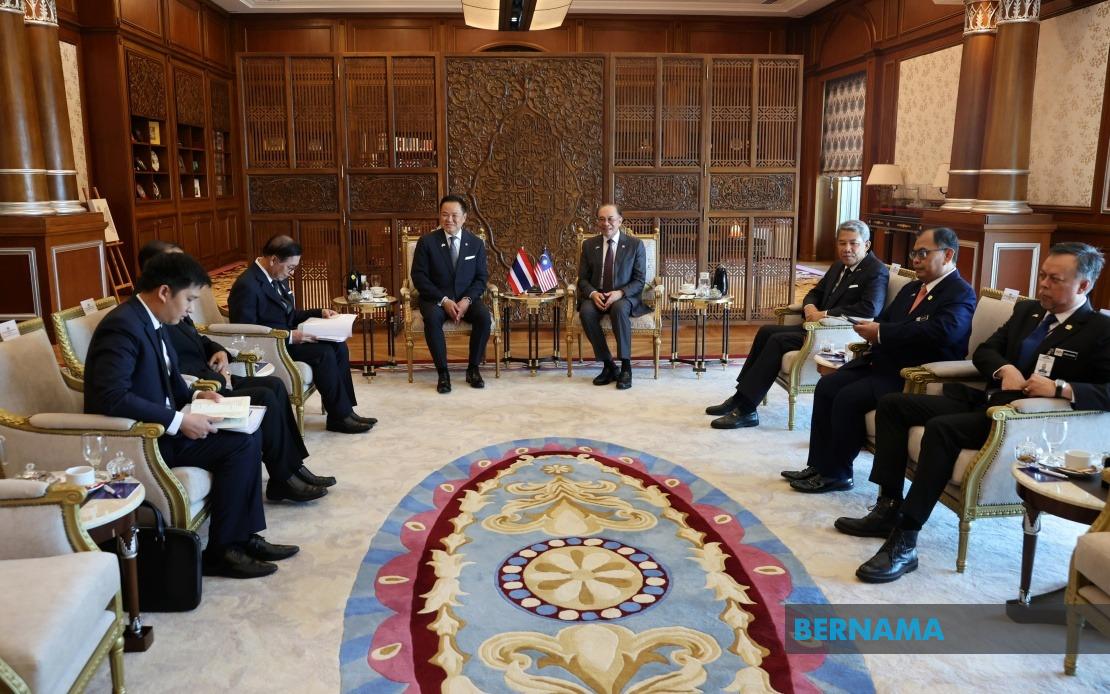
Prime Minister Datuk Seri Anwar Ibrahim has reasserted Malaysia's conviction that Myanmar's protracted political turmoil can only be resolved through sustained diplomatic engagement rather than confrontational approaches, while simultaneously elevating Thailand's status as a crucial regional intermediary in brokering peace. Speaking at a joint press conference in Putrajaya during bilateral talks with visiting Thai Prime Minister Anutin Charnvirakul on Thursday, Anwar articulated Malaysia's foundational belief that Burmese citizens must retain agency in determining their nation's trajectory, a position that reflects Kuala Lumpur's broader commitment to non-interference and self-determination principles within the ASEAN framework.
The Malaysian premier's emphasis on engagement-based diplomacy reflects growing international frustration with the Myanmar junta's resistance to pressure following its February 2021 coup that toppled Aung San Suu Kyi's civilian government. Since that watershed moment, ASEAN has grappled with the intricacy of maintaining collective pressure while respecting the principle of non-interference that underpins the association's founding charter. Malaysia's position sits at this delicate intersection, advocating for dialogue while refusing to advocate punitive measures that could alienate the military regime or fracture ASEAN consensus. For regional observers, Anwar's remarks signal Kuala Lumpur's continuing effort to balance humanitarian concerns with geopolitical pragmatism.
Anutin's reappointment as Thai Prime Minister in March 2026 following his previous tenure provides Bangkok with renewed diplomatic capital to serve as interlocutor between Myanmar's military hierarchy and the broader international community. Thailand's geographical proximity to Myanmar, combined with deep historical ties, shared cultural heritage, and substantial trade linkages, positions Bangkok uniquely to maintain communication channels that other capitals cannot access. The Thai Prime Minister's reciprocal interest in engagement-based solutions, as noted by Anwar, suggests coordinated diplomatic messaging emerging from Southeast Asia's frontline states. This alignment between Malaysia and Thailand—two nations with contrasting political systems yet converging strategic interests—may strengthen ASEAN's collective voice on Myanmar governance.
The Five-Point Consensus, adopted by ASEAN leaders in April 2021 and subsequently endorsed repeatedly, remains the blueprint for Myanmar's political resolution. This framework calls for immediate cessation of violence, humanitarian assistance, dialogue facilitation, observer access, and ASEAN's special envoy engagement. Yet implementation has stalled substantially, with Myanmar's military demonstrating reluctance to commit to timelines or concrete benchmarks. Malaysia's reiteration of this approach suggests patience tempered with persistent diplomatic persistence. For observers monitoring ASEAN's cohesion, the fact that both Malaysia and Thailand publicly reaffirm these principles indicates that the bloc retains commitment despite setbacks, though whether this translates into tangible pressure remains contested.
During the same press conference, Anwar addressed the Thailand-Cambodia border situation, a secondary but significant regional security matter that has periodically threatened stability. His expression of appreciation for Thailand's commitment to peace preservation, coupled with Malaysia's assertion that it trusts affected leaders' wisdom in resolving disputes peacefully, reflects Kuala Lumpur's philosophical approach to regional conflicts generally. Malaysia positions itself as a confidence-builder and conflict de-escalator rather than partisan judge. This stance carries particular weight given Malaysia's historical role as a stabilising force and its presidency rotation within ASEAN. By publicly validating Thailand's peace commitment and calling for continued dialogue, Anwar reinforces the principle that bilateral border disagreements should not derail broader regional cooperation or Myanmar-focused initiatives.
Anutin's two-day official visit, his first bilateral trip to Malaysia since his March 2026 reappointment, carries significance beyond ceremonial protocol. The timing and scope suggest deeper bilateral coordination on Myanmar strategy and other pressing regional matters. The planned visit to Bukit Kayu Hitam in Kedah on Friday, where Anwar and Anutin will jointly inaugurate the road connecting Malaysia's Immigration, Customs, Quarantine and Security Complex with Thailand's Customs, Immigration and Quarantine Complex in Sadao, demonstrates practical cooperation infrastructure development alongside political dialogue. This crossing, once fully operational, will facilitate smoother trade flows and people movement between Southeast Asia's third and fifth largest economies, reducing logistical barriers that have historically complicated bilateral commerce.
For Malaysian and Thai businesses, the infrastructure development carries tangible economic implications. Enhanced border crossing efficiency addresses longstanding complaints about delays and procedural redundancy that inflate costs for manufacturers dependent on cross-border supply chains. The automotive sector, electronics assembly, and agricultural exports—categories representing substantial portions of bilateral trade—stand to benefit from reduced transit times. From a geopolitical perspective, however, improved connectivity simultaneously signals deepening Malaysia-Thailand integration, potentially creating shared interests that transcend traditional state rivalries and enhance both nations' leverage within ASEAN consensus-building processes.
Anwar's diplomatic framing of Myanmar's resolution reflects Malaysia's evolving role within ASEAN as a mediator state possessing credibility across ideological divides. Unlike Indonesia, which bears greater weight as ASEAN's largest economy and demographic powerhouse, Malaysia operates as what some scholars term an "honest broker," lacking hegemonic aspirations but wielding sufficient influence to shape consensus direction. This positioning becomes increasingly valuable as ASEAN confronts transnational challenges—maritime security, climate migration, counterterrorism—requiring coordinated responses that cannot succeed if foundational unity fractures over Myanmar paralysis.
The Myanmar crisis itself has evolved considerably since 2021. The military junta has consolidated administrative control, though it faces persistent armed resistance from the National Unity Government and ethnic armed organisations controlling substantial territory. Civilian casualties continue mounting, humanitarian conditions deteriorate, and refugee outflows burden neighbouring states including Thailand and Malaysia. Within this deteriorating context, Malaysia's insistence on engagement-based approaches might appear quixotic to critics viewing the situation as necessitating stronger pressure. However, Kuala Lumpur's calculus recognises that isolation strategies risk pushing Myanmar toward geopolitical competitors, particularly China, which maintains the junta's strongest external patron and would benefit from Myanmar's complete turn toward Beijing as cost of economic and security dependency increases.

