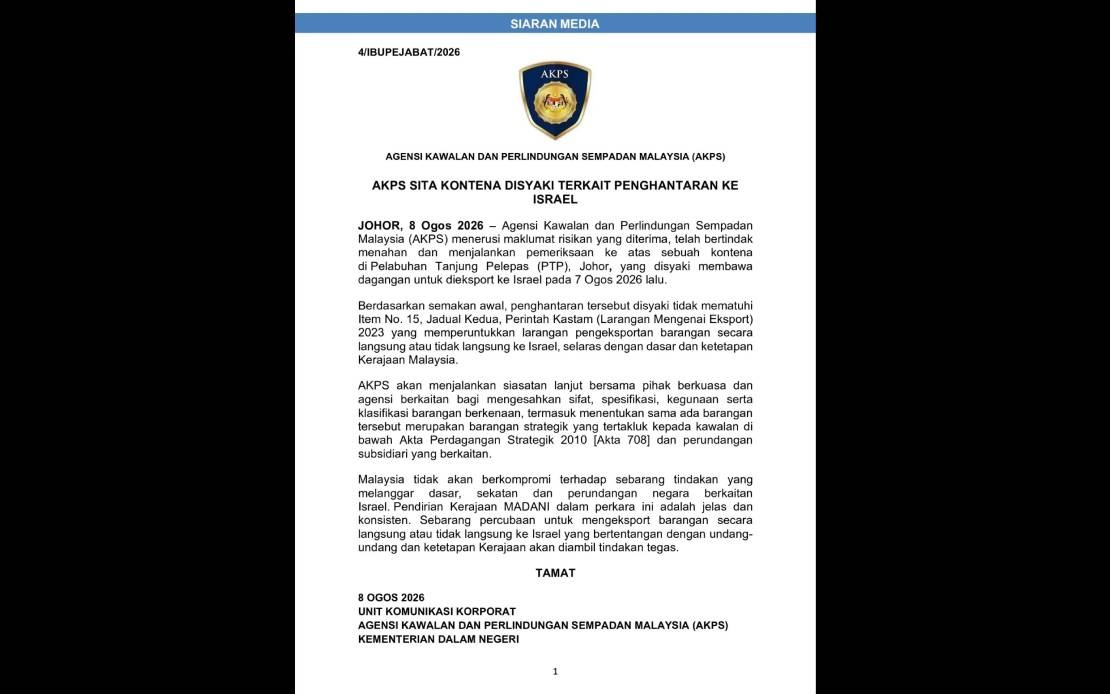
Malaysia has intercepted a cargo shipment suspected of destined for Israel at the Port of Tanjung Pelepas in Johor, prompting Prime Minister Datuk Seri Anwar Ibrahim to hail the interception as a demonstration of the country's unwavering commitment to preventing its territory from facilitating trade that could bolster Israeli operations. The Malaysian Border Control and Protection Agency (AKPS) detained and inspected the container after discovering it allegedly contained strategic goods intended for export to Israel, triggering a formal investigation into potential violations of Malaysia's export restrictions.
Anwar's public endorsement of the seizure, delivered through a Facebook statement, underscores how Palestine remains a central pillar of Malaysia's foreign policy positioning. The Prime Minister characterised the interdiction as proof that Malaysian authorities are vigilant in enforcing compliance with domestic policies that prohibit trade flows benefiting Israel, casting the action within a broader framework of principle-based governance. His comments also stressed Malaysia's alignment with The Hague Group, a diplomatic coalition coordinating responses to the Israeli-Palestinian conflict, signalling that such enforcement measures reflect consensus among like-minded nations rather than isolated unilateral action.
The detained shipment allegedly breached Item No. 15 of the Second Schedule of the Customs (Prohibition of Exports) Order 2023, which explicitly forbids direct or indirect export of merchandise to Israel in accordance with government policy. This legal provision has formed the backbone of Malaysia's trade enforcement apparatus since its adoption, creating regulatory teeth for what might otherwise remain rhetoric. The specificity of this legislative framework demonstrates that Malaysia's stance is not merely declaratory but encoded into operational customs procedures, requiring border officials to screen containers against a comprehensive list of prohibited destinations.
Malaysia's trade restrictions targeting Israel intensified in December 2023 when the government implemented a blanket prohibition on Israeli-flagged vessels and ships carrying Israeli cargo from accessing the country's ports. This measure represents one of the most stringent port-based sanctions among Southeast Asian nations, effectively closing Malaysia's maritime infrastructure to Israeli commercial shipping. For Malaysian importers and exporters, the restrictions mean that Israel-bound transactions cannot leverage Malaysian ports or transit routes, significantly increasing logistics costs and complexity for any enterprise attempting to route goods through the region destined for Israeli markets.
The seizure carries particular weight in the Malaysian context, where public sentiment regarding Palestinian issues runs deep and political parties regularly mobilise support around anti-Israeli positions. The government's enforcement of export bans demonstrates responsiveness to constituent expectations and maintains consistency with campaign commitments made by the ruling coalition. However, the interception also raises practical questions about enforcement capacity and whether AKPS possesses sufficient resources and expertise to systematically identify disguised shipments or complex supply chains designed to circumvent restrictions through transshipment or re-labelling tactics.
From a regional perspective, Malaysia's aggressive enforcement of Israel trade restrictions distinguishes it within ASEAN, where approaches vary considerably. While several member states have expressed sympathy for Palestinian causes, Malaysia has institutionalised its position through concrete trade policy mechanisms. This differential approach reflects Malaysia's historical role as a vocal advocate for Palestinian self-determination and its domestic political composition, where support for Palestine transcends party lines and appeals across diverse constituencies. Neighbouring countries like Singapore maintain more pragmatic commercial relationships with Israel despite political statements acknowledging Palestinian grievances, creating divergent economic and diplomatic postures across the region.
The broader implications for Malaysian businesses engaging in international trade warrant consideration. Compliance requirements have become more complex, particularly for enterprises involved in logistics, shipping, or general merchandise that might conceivably transit through or be exported to Israel. Corporations must now conduct enhanced due diligence on customer identities and end-use certifications to ensure unwitting participation in prohibited trade flows. For smaller businesses lacking sophisticated compliance infrastructure, this creates operational friction and potential liability exposure that may discourage certain commercial relationships or supply chain configurations.
Anwar's emphasis on upholding humanitarian principles and international law positions Malaysia within a normative framework that extends beyond bilateral Israeli-Palestinian dynamics. The Prime Minister articulated Malaysia's actions as consistent with broader commitments to universal human rights standards and justice mechanisms, framing trade restrictions as mechanisms for accountability rather than purely political gestures. This rhetorical positioning acknowledges the existence of international legal mechanisms and seeks to legitimise Malaysia's enforcement actions as expressions of commitment to established international norms rather than ad hoc punitive measures.
The interception also reflects broader security and customs modernisation efforts within Malaysian border agencies. AKPS's capacity to identify and detain the shipment suggests that intelligence gathering, scanning technologies, and interagency coordination have reached sufficient sophistication to identify suspect containers amid the massive volume of traffic transiting Malaysian ports daily. This operational capability underpins Malaysia's ability to translate policy directives into tangible enforcement outcomes, distinguishing rhetoric from genuine border control implementation. As such, the seizure represents not merely a symbolic political act but evidence of institutional capacity to execute complex regulatory oversight.
Looking forward, the consistency with which Malaysia enforces these restrictions will significantly influence their actual impact on trade flows and their credibility as policy tools. Sporadic enforcement undermines both commercial certainty and diplomatic messaging, whereas systematic application demonstrates genuine commitment while providing clarity to legitimate traders. The government's willingness to continue publicising such seizures through official channels also suggests that enforcement will remain visible and politically salient, serving dual purposes of regulatory compliance and domestic political communication regarding values and commitments.
For Malaysian exporters, importers, and logistics providers, navigating these restrictions requires enhanced compliance frameworks and supply chain transparency. The seizure serves as a practical reminder that Malaysia's export ban enjoys active enforcement backing and that companies cannot rely on regulatory ambiguity or loopholes to circumvent explicit prohibitions. As regional trade patterns continue evolving and pressure mounts on Malaysia from various international actors regarding commerce policies, the government's demonstrated willingness to intercept Israel-bound shipments indicates that Palestinian solidarity remains institutionalised within Malaysia's regulatory apparatus rather than merely reflecting periodic political positioning.

