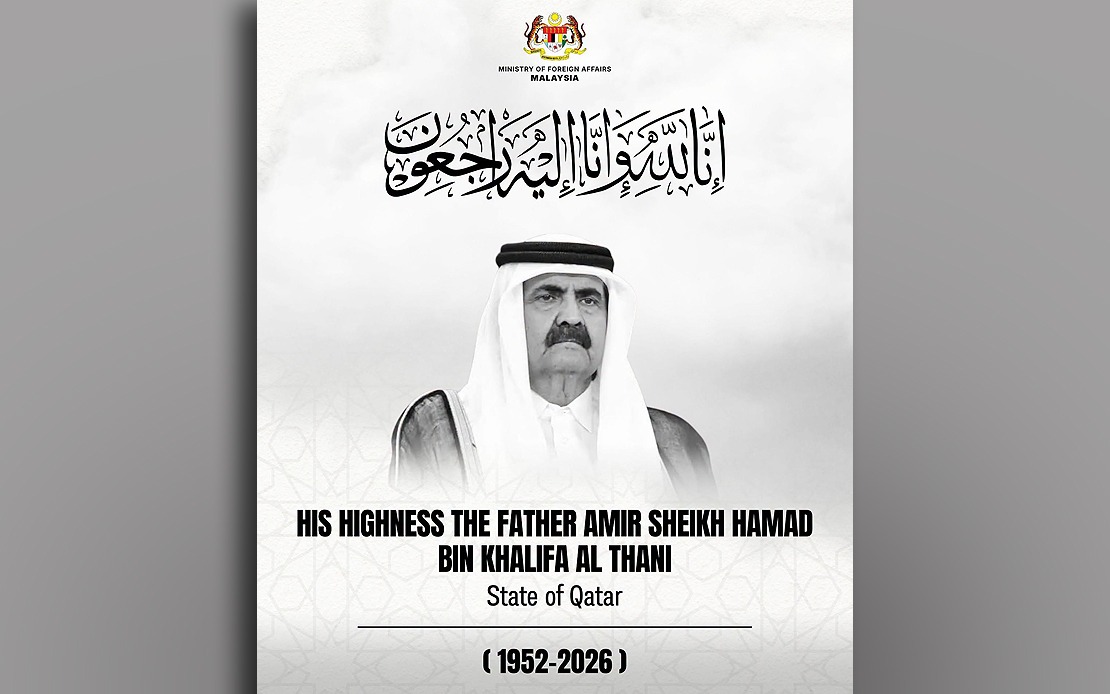
Malaysia's Higher Education Minister Datuk Seri Dr Zambry Abdul Kadir will represent the Malaysian government during the official mourning period for the late Father Amir of Qatar, Sheikh Hamad bin Khalifa Al Thani, attending condolence ceremonies from July 13 to 14. The decision to dispatch a senior minister underscores the diplomatic importance Kuala Lumpur places on its relationship with one of the Arab world's most influential and wealthy nations.
The current Amir of Qatar, Sheikh Tamim bin Hamad Al Thani, will receive condolences and tributes from foreign heads of state, members of the Qatari ruling family, government officials, and citizens at Lusail Palace. The three-day reception period, running from July 13 to 15, provides an opportunity for the international community to pay formal respects and reaffirm ties with the Gulf monarchy during this significant transition.
Qatar has declared a four-day national period of mourning beginning Sunday, July 12, marking the formal observance following the death of Sheikh Hamad bin Khalifa Al Thani, who ruled Qatar for nearly two decades before his abdication in 2013. This extended mourning reflects the symbolic importance of the late Amir in the nation's modern history and his role in transforming Qatar into a regional and global player.
During the official mourning period, all government ministries, state entities, and public institutions across Qatar have suspended normal operations. This comprehensive shutdown demonstrates the cultural and political significance accorded to the passing of the late Father Amir, with the entire state apparatus pausing to honour his memory and support the ruling family during this period of national reflection.
In a statement released through its Foreign Ministry, Malaysia expressed its condolences, noting that the country is "profoundly saddened by this loss." The government emphasised that Malaysia "stands in solidarity with the leadership and people of the State of Qatar during this period of mourning." This measured diplomatic language reflects the careful balance maintained between Southeast Asian nations and Gulf powers, particularly important given the significant economic, educational, and cultural ties that bind the region together.
Qatar holds particular strategic importance for Malaysia across multiple dimensions. The Gulf nation serves as a major destination for Malaysian overseas investment, hosts substantial Malaysian expatriate communities, and plays a central role in Islamic finance and education sectors in which Malaysia seeks leadership. The state funeral therefore represents not merely a ceremonial obligation but an opportunity to reaffirm bilateral relationships at the highest levels.
The appointment of the Higher Education Minister to lead Malaysia's delegation carries specific symbolic weight. Education constitutes a cornerstone of Malaysia-Qatar relations, with numerous Malaysian students pursuing tertiary studies in Qatari institutions, and Qatar being home to multiple satellite campuses of international universities. Dr Zambry's presence signals Malaysia's commitment to maintaining and deepening these educational linkages during a period when Qatar's leadership transition is underway.
The timing of this state funeral occurs during a broader regional context of Gulf leadership transitions and evolving Middle Eastern geopolitics. Sheikh Hamad bin Khalifa Al Thani's long tenure saw Qatar emerge as a major financial power, cultural hub, and diplomatic player far exceeding what its relatively small population and territorial size might suggest. His legacy encompasses significant infrastructure development, hosting the FIFA World Cup in 2022, and establishing Qatar as a centre for Islamic finance and scholarship.
For Malaysia, participating in such high-profile state occasions reinforces its position as a respected member of the global Islamic community and a nation that values its relationships across the Muslim world. The gesture acknowledges Qatar's historical significance and current international standing while demonstrating that Malaysia views the Gulf state as more than simply a commercial partner or investment destination.
The diplomatic protocol surrounding state funerals in the Arab world carries considerable weight. The presence of foreign dignitaries, the choreography of condolence ceremonies, and the formal nature of proceedings all communicate messages about bilateral relationships and regional alignment. Malaysia's decision to send a cabinet-level representative, rather than a lower-ranking official, indicates the priority attached to this relationship.
Beyond the ceremonial aspects, the state funeral provides an occasion for quiet bilateral discussions between Malaysian officials and Qatari leadership regarding ongoing cooperation in trade, investment, education, and cultural matters. These informal conversations at international events frequently yield substantive outcomes that formal diplomatic channels might take longer to achieve.
The mourning period also reflects broader cultural and religious considerations that resonate across the Muslim world. Islamic tradition emphasizes communal support during times of loss, and the gathering of international delegates at Lusail Palace embodies this principle on a geopolitical scale. For Malaysia, a Muslim-majority nation with significant Islamic scholarly and institutional influence regionally, participation in such observances reinforces cultural and religious solidarity.

