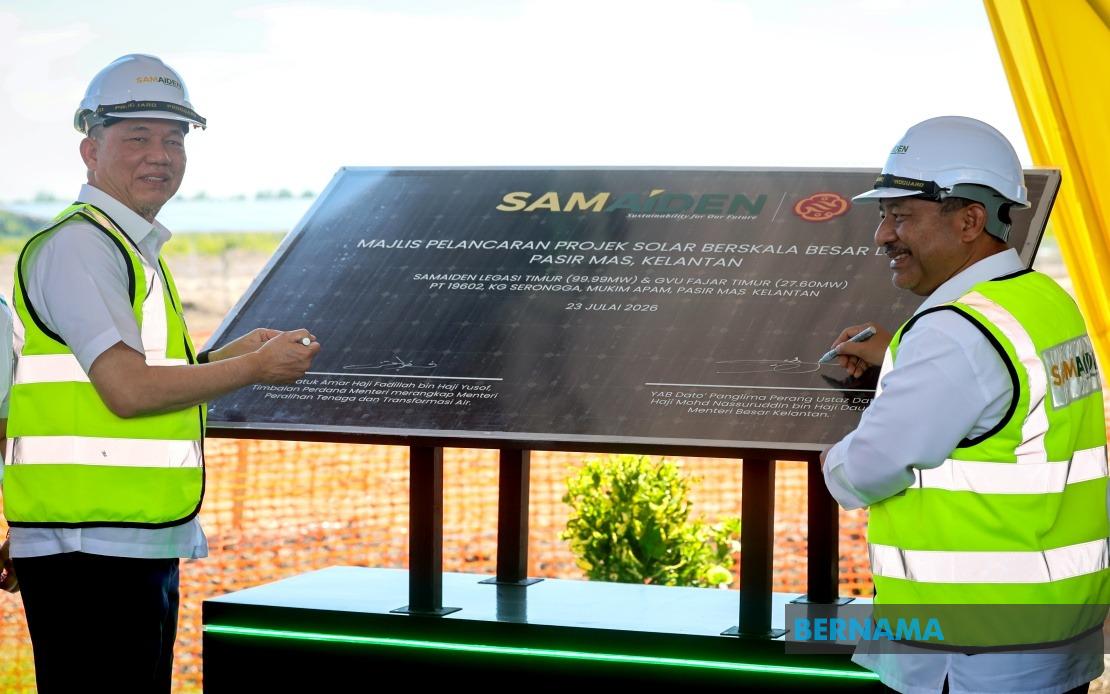
Malaysia's renewable energy transition is gathering momentum, with installed capacity reaching nearly 32 per cent as of June—a significant milestone that positions the country to exceed its 2030 target of 35 per cent renewable generation. Deputy Prime Minister Datuk Seri Fadillah Yusof made the announcement while launching the Large-Scale Solar Project (LSS5) in Pasir Mas, Kelantan, underscoring the government's commitment to transforming the nation's energy landscape through structured, long-term planning under the National Energy Transition Roadmap.
The trajectory toward Malaysia's renewable energy goals reflects deliberate policy execution and growing investor confidence in the nation's clean energy framework. By December 2025, the country had already secured 31 per cent renewable capacity, exceeding the government's interim benchmark. Looking ahead, the targets become increasingly ambitious: 35 per cent by 2030 and a transformative 70 per cent by 2050. These milestones represent not merely incremental improvements but a fundamental restructuring of how Malaysia generates, distributes, and consumes electricity across the economy.
Fadillah, who also serves as Minister of Energy Transition and Water Transformation (PETRA), framed energy transition as a strategic imperative rather than an optional environmental initiative. He articulated a vision where renewable energy expansion directly strengthens Malaysia's energy security—reducing vulnerability to volatile international fuel markets—while simultaneously enhancing economic resilience and attracting premium foreign investment. This positioning is particularly relevant for Southeast Asia's largest economies, where energy independence and industrial competitiveness are intertwined. Countries that secure reliable, affordable renewable supplies gain competitive advantage in manufacturing and technology sectors increasingly demanding clean power credentials.
The government's balancing act involves reconciling three often-competing priorities: ensuring energy security, maintaining cost affordability for consumers and businesses, and pursuing genuine sustainability. Rather than pursuing renewable expansion at any cost, Malaysian policymakers are emphasizing measured transitions that safeguard grid stability and economic viability. This measured approach appeals to both investors concerned about regulatory reliability and communities dependent on affordable electricity. For Southeast Asian regional observers, Malaysia's framework offers a middle-ground model between rapid decarbonization and fossil fuel entrenchment.
Kelantan's emergence as a renewable energy hub exemplifies how regional economic development and clean energy can align strategically. The LSS5 project in Kampung Serongga signals investor confidence in the state's institutional capacity and natural advantages. Kelantan Menteri Besar Datuk Mohd Nassuruddin Daud positioned the initiative as a catalyst for attracting high-value investments anchored in sustainability and green technology. For a state historically navigating economic diversification challenges, renewable energy infrastructure offers tangible pathways to job creation, industrial growth, and technology sector development.
The solar project's localized benefits extend beyond megawatt generation figures. Developers, construction firms, equipment suppliers, and maintenance service providers form an ecosystem of economic activity concentrated in and around Pasir Mas and the broader Kelantan region. Communities gain employment opportunities across skill levels, from project management to technical installation and ongoing operations. Local enterprises can position themselves as suppliers or service providers, capturing value within renewable energy supply chains. This distributed economic model contrasts with traditional fossil fuel energy, where benefits often concentrate at extraction and generation sites while communities bear environmental costs.
Kelantan's abundant suitable land for solar deployment—a critical resource constraint limiting renewable expansion in densely populated states—provides structural competitive advantage for large-scale projects. The state government's proactive support and the private sector's active participation create the institutional framework necessary for project success. For Malaysian policymakers considering how to distribute renewable energy development geographically, Kelantan's example demonstrates that peripheral regions possess genuine advantages that, if leveraged effectively, transform them into development opportunities rather than lagging economic zones.
Beyond utility-scale projects, the Solar ATAP Programme represents a distributed renewable strategy targeting rooftop installations across residential, commercial, and religious properties. Fadillah's encouragement to homeowners, mosques, and businesses to adopt rooftop solar reflects recognition that energy transition succeeds when embedded across society rather than concentrated in specialized infrastructure. Rooftop solar democratizes renewable generation, reducing grid pressure, lowering individual electricity bills, and building social buy-in for broader energy transition goals. For densely built Malaysian urban areas, rooftop capacity represents underutilized renewable potential that requires only policy enabling and consumer education.
The LSS5 project and its accompanying renewable energy announcements carry significance extending beyond Malaysia's borders. Southeast Asia confronts climate imperatives while navigating competing development priorities. Malaysia's visible progress toward ambitious renewable targets influences regional momentum—neighboring countries observe successful deployment models, investment frameworks, and regulatory approaches. As major Southeast Asian economies evaluate their own energy transition pathways, Malaysian achievements provide credible proof that ambitious renewable targets remain economically feasible when coupled with realistic timelines, balanced policy frameworks, and genuine investor engagement.
Mohd Nassuruddin's emphasis on maintaining safety, environmental protection, and community relations during project implementation addresses legitimate concerns about renewable development quality. Large-scale solar projects can generate social friction if deployed without community consultation or if they degrade environmental quality despite their clean energy credentials. Kelantan's commitment to transparent, investor-friendly governance while protecting local interests and environmental standards represents the nuanced approach necessary for sustainable renewable expansion. This model contrasts sharply with either uncritical renewable promotion or fossil fuel entrenchment—both positions that ignore legitimate stakeholder concerns.
The convergence of federal policy ambition, state government support, and private sector investment demonstrated through LSS5 suggests Malaysia's renewable transition possesses institutional depth. When energy transition depends on a single actor—government directives, for instance—projects become vulnerable to political shifting or resource constraints. Malaysia's multi-stakeholder approach, where federal targets align with state development goals and private investors find profitable opportunities, creates redundancy and resilience. Even as electoral cycles rotate or political priorities shift, renewable energy expansion maintains momentum through diverse motivations and institutional arrangements.
Looking forward, Malaysia's progress toward 2030 and 2050 renewable targets will require sustained policy consistency and continued infrastructure investment. The 35 per cent 2030 target represents achievable ambition—sufficiently ambitious to drive transformation without creating acute grid management challenges. The 70 per cent 2050 target demands technological advancement, substantial battery storage deployment, and possibly grid interconnection with neighboring nations possessing complementary renewable resources. For Malaysian businesses, policymakers, and investors, the trajectory toward 2030 provides a testing ground for scaling renewable capacity while managing technical, economic, and social complexities that will intensify significantly as targets become more demanding in subsequent decades.

