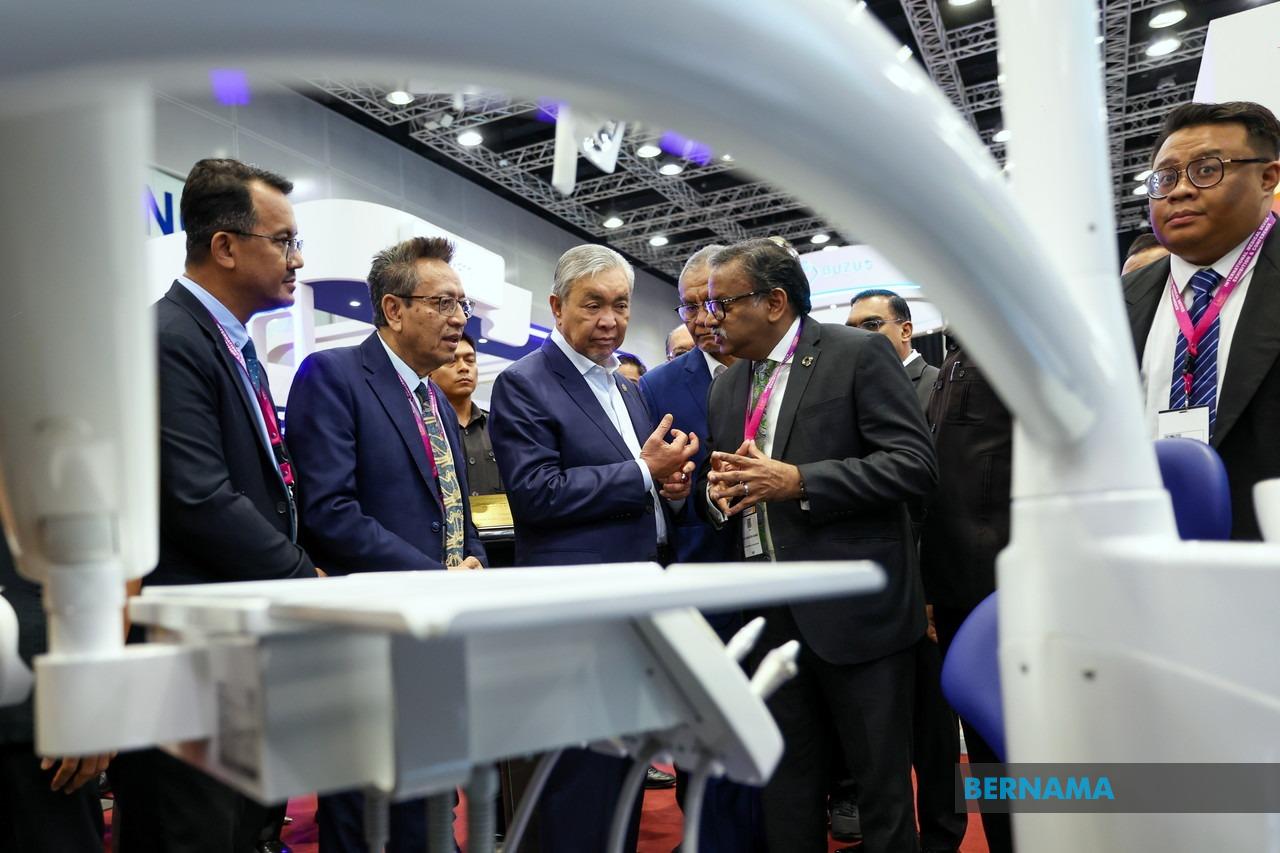
Malaysia is positioning itself for significant expansion in the medical technology sector, with Deputy Prime Minister Datuk Seri Dr Ahmad Zahid Hamidi unveiling an ambitious export target of RM50 billion by 2030. The goal represents a substantial leap from the RM34.54 billion in exports recorded last year, signalling the government's confidence in the nation's capacity to capture greater market share in a rapidly expanding global industry. Speaking at the closing ceremony of the International Medical Device Exhibition and Conference (IMDEC) 2026, Ahmad Zahid outlined a comprehensive vision for transforming Malaysia into a high-value MedTech hub capable of competing on the world stage.
The trajectory towards this ambitious target rests on three interconnected objectives that Ahmad Zahid framed as essential benchmarks for measuring sectoral progress over the next four years. Beyond the headline export figure, the government seeks to establish at least 10 Malaysian MedTech champions—companies with genuine competitive advantages in regional and global markets. Equally significant is a commitment to develop homegrown innovation capacity, ensuring that Malaysian firms not only manufacture devices but also own the intellectual property and drive technological advancement. This multifaceted approach reflects a deliberate shift away from a model dependent on low-cost assembly work towards one centred on knowledge creation and value addition.
The final pillar of this strategy addresses employment quality, targeting that at least 50 per cent of new MedTech jobs created by 2030 should be managerial, technical, and supervisory positions. This objective underscores a critical weakness in Malaysia's current manufacturing economy: whilst capital and production capacity have attracted substantial foreign investment, the corresponding workforce development has often lagged, leaving skill gaps that companies must address reactively. At present, the MedTech sector's index for such high-value roles stands at only 33.1 per cent, revealing a significant disparity between Malaysia's manufacturing capabilities and the calibre of employment it generates. By raising this benchmark to 50 per cent, the government aims to ensure that economic growth translates into genuine prosperity and skills advancement for Malaysian workers.
Ahmad Zahid's remarks carried an implicit critique of Malaysia's historical approach to industrial development, where multinational corporations arrived with production lines but left limited technological expertise or career progression pathways within the nation. He emphasised that capital flows are necessary but insufficient; Malaysia must retain capability and institutional knowledge domestically. The Deputy Prime Minister called on potential investors to engage with Malaysia's education and vocational training systems far earlier in their decision-making, collaborating with institutions to design curricula, identify emerging skill requirements, and establish apprenticeship opportunities before workforce shortages emerge. This represents a philosophical recalibration—moving from a reactive, supply-chasing model to a proactive, demand-shaping approach.
As the National Technical and Vocational Education and Training Council chairman, Ahmad Zahid highlighted the instrumental role that education infrastructure plays in attracting quality investment. He challenged companies to view Malaysia not merely as a destination for labour recruitment but as a jurisdiction where they can shape the next generation of skilled professionals. This positioning has profound implications for how Malaysia competes against other Southeast Asian nations and global MedTech hubs. Countries like Singapore and South Korea have long prioritised this integration of industry and education, creating virtuous cycles where companies help design talent pipelines and graduates attract investment seeking high-calibre workforces.
The global context underscores both the opportunity and urgency of Malaysia's strategy. The worldwide medical device industry was valued at over USD572 billion last year and is projected to exceed USD1 trillion by 2034, with double-digit annual growth rates anticipated across most segments. This expansion is driven by aging populations, rising chronic disease prevalence in developing economies, and technological innovations in diagnostics, surgical instruments, and digital health solutions. Malaysia, with its established manufacturing base, strategic location, and existing relationships with global supply chains, is positioned to capture an increasing portion of this growth. However, competition from established players in developed nations and from emerging manufacturers in Vietnam, Thailand, and India is intensifying, requiring Malaysia to differentiate through specialisation and innovation rather than cost alone.
Recent investment performance provides encouragement for these ambitions. During 2025, RM4 billion in new medical device investments was approved across 46 distinct projects, generating nearly 3,400 employment opportunities. Whilst this demonstrates continued investor confidence, the scale of investment relative to the RM50 billion export target suggests that accelerated growth will require either larger individual projects, an increased number of ventures, or a combination of both. The data also hints at a fragmentation risk: 46 projects generating only 3,400 jobs averages approximately 74 positions per project, indicating that many initiatives are likely relatively modest or highly automated. Achieving the target whilst simultaneously raising the proportion of high-value employment will require both larger manufacturers and a strategic focus on projects with substantial human capital requirements in technical and managerial roles.
The IMDEC 2026 conference itself, which concluded with Ahmad Zahid's remarks, reflected the growing sophistication of Malaysia's MedTech ecosystem. Attracting more than 160 exhibitors and over 50 regional and international speakers addressing regulation, innovation, and healthcare transformation, the event demonstrated that Malaysia has transitioned from a peripheral player to a venue of genuine commercial and intellectual importance. The presence of both multinational corporations and emerging local enterprises, alongside regulatory authorities and healthcare professionals, suggests a maturing industry cluster capable of generating innovation through cross-pollination of ideas and expertise.
For Malaysian policymakers, the challenge lies in translating these ambitious targets into concrete institutional changes. Ahmad Zahid's emphasis on workforce development and skills partnerships suggests that government strategy will increasingly focus on aligning vocational education curricula with industry needs, facilitating collaboration between training institutions and companies, and potentially offering incentives for employers who invest in workforce upgrading. The private sector, meanwhile, faces pressure to recognise that genuine competitiveness in high-value MedTech production requires investment in people and research capabilities, not merely in production infrastructure.
Regionally, Malaysia's strategy has broader implications for ASEAN's collective ambitions to develop innovative, technology-driven economies. As individual nations articulate their sectoral specialisations—Singapore in biotech research, Thailand in medical tourism and device distribution, Indonesia in pharmaceuticals—Malaysia's focus on device manufacturing with embedded innovation offers a complementary positioning. Success in achieving these targets could establish a template for how Southeast Asian nations can participate meaningfully in global high-value industries without depending solely on established multinational corporations.
The RM50 billion export target by 2030 is neither arbitrary nor unrealistic, but achieving it will require sustained policy coherence, substantial private sector investment, and genuine transformation of Malaysia's educational infrastructure. Ahmad Zahid's presentation of three mutually reinforcing ambitions—export growth, indigenous champions, and quality employment—reflects recognition that sustainable sectoral development cannot rest on a single pillar. Whether Malaysia can realise this vision will depend on the consistency with which government agencies and private firms translate rhetoric into institutional change over the coming years.

