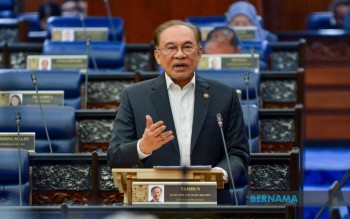
Prime Minister Datuk Seri Anwar Ibrahim has outlined how the nascent Malaysia-Thailand Border Economic Zone will fundamentally reshape trade flows across Southeast Asia by dismantling long-standing customs barriers that have hampered Malaysian exporters seeking to reach the economies of Laos, Cambodia and Vietnam. Speaking in Parliament during Minister's Question Time, Anwar, who also serves as finance minister, emphasised that Thai authorities have committed to streamlining their procedural requirements for goods crossing their territory, a concession that opens significant commercial opportunities for sectors that have historically faced friction at border checkpoints.
Malaysian fisheries and agricultural producers have long grappled with cumbersome transit procedures when moving products through Thailand toward downstream markets in the Indochinese Peninsula. These delays and compliance burdens have made Thai routes economically uncompetitive compared to alternatives, constraining Malaysian suppliers' ability to capture market share in neighbouring economies. The agreement between Bangkok and Kuala Lumpur to relax these restrictions removes a critical bottleneck, permitting goods to flow through standard customs channels without the additional encumbrances that previously made cross-border commerce commercially unfeasible for many operators. This regulatory harmonisation represents a pragmatic acknowledgment by both governments that mutual prosperity requires friction-free movement of legitimate trade.
The Border Economic Zone concept extends beyond the two initial anchor points—Sadao and Bukit Kayu Hitam—that were jointly inaugurated with Thailand's Prime Minister Anutin Charnvirakul days prior to Anwar's parliamentary statement. The initiative deliberately incorporates Rantau Panjang in Kelantan, with implementation accelerated through coordination with the state administration. This geographic expansion signals ambition to create a comprehensive trading ecosystem along the entire land boundary, rather than treating the zone as isolated pockets of commercial activity. By encompassing multiple crossing points, the framework allows businesses to optimise logistics and choose corridors based on their particular cargo characteristics and destination markets.
Anwar articulated that the overarching objective is stimulating substantially greater trade intensity between Malaysia and Thailand, a bilateral relationship that possesses considerable latent potential but remains underexploited. Current exchange volumes, whilst meaningful, do not reflect the complementary nature of the two economies or their geographic proximity. The BEZ represents a structural intervention designed to eliminate artificial impediments that constrain what would otherwise be a natural expansion of commerce. By removing administrative friction, policymakers anticipate that traders will reorient supply chains and discover new commercial opportunities previously obscured by procedural costs.
Crucially, the government has committed to ensuring that benefits percolate beyond large corporations to encompass small and medium-sized enterprises and communities situated along the border regions. Anwar indicated that the development framework prioritises job creation and vocational training initiatives, acknowledging that border zones can either concentrate wealth among well-connected large operators or broadly distribute economic gains. Intentional design mechanisms, including targeted support for SMEs and human capital development in frontier localities, represent recognition that genuine development requires inclusive growth architecture. Without such deliberate interventions, border economic zones frequently replicate patterns of regional inequality rather than alleviating them.
The East Coast Rail Link emerges as critical infrastructure underpinning the zone's long-term viability and ambition. Federal authorities have determined to extend the ECRL terminus to Rantau Panjang, transforming what was originally a peninsula-focused project into a transnational connectivity backbone. This railway extension fundamentally alters logistics economics by providing alternative transport modalities that reduce reliance on road corridors and enhance capacity for bulk commodity movement. During discussions with Anutin, Malaysian officials broached the prospect of extending the railway into Thai territory along the existing route alignment, a proposal that would create a genuinely integrated transport corridor spanning both nations.
Such transnational rail connectivity carries profound implications for regional supply chain architecture. Malaysian manufacturers could source inputs from or distribute products to Thailand and beyond with unprecedented efficiency, whilst Thai producers gain direct access to Malaysian ports and Southeast Asian trading networks. The infrastructure investment essentially rewires the economic geography of the northern peninsula, shifting gravitational pulls and creating centripetal forces drawing investment and commerce toward border regions that have historically occupied marginal positions in national economies. This represents a deliberate strategic reorientation away from concentrating economic activity in established urban centres toward frontier development.
The customs relaxation and zone development must be contextualised within broader regional integration dynamics. ASEAN economies are incrementally deepening interdependencies through various frameworks and agreements, yet significant barriers persist at bilateral frontiers. The Malaysia-Thailand initiative demonstrates how targeted, pragmatic cooperation on specific technical issues—customs procedures, infrastructure connectivity, SME support—can yield tangible commercial benefits without requiring wholesale harmonisation of national regulations or surrendering significant sovereignty. This model potentially offers lessons for other bilateral relationships within Southeast Asia confronting similar impediments.
For Malaysian exporters currently constrained by Thai transit restrictions, the prospective relaxation represents a transformative opportunity to reconceptualise their market reach and supply chain strategies. Agricultural and fisheries sectors, which form the backbone of many border communities' livelihoods, stand to experience particular benefits if customs smoothing translates into lower transaction costs and faster clearance times. The gap between formal agreement and implementation, however, remains significant. Success depends on Bangkok and Kuala Lumpur maintaining bureaucratic commitment to the spirit of simplification once the zone becomes operationally active, resisting impulses to reimpose restrictions when political pressures mount. Regional observers will scrutinise whether this initiative becomes a substantive transformation of trade dynamics or merely an aspiration constrained by entrenched institutional interests.

