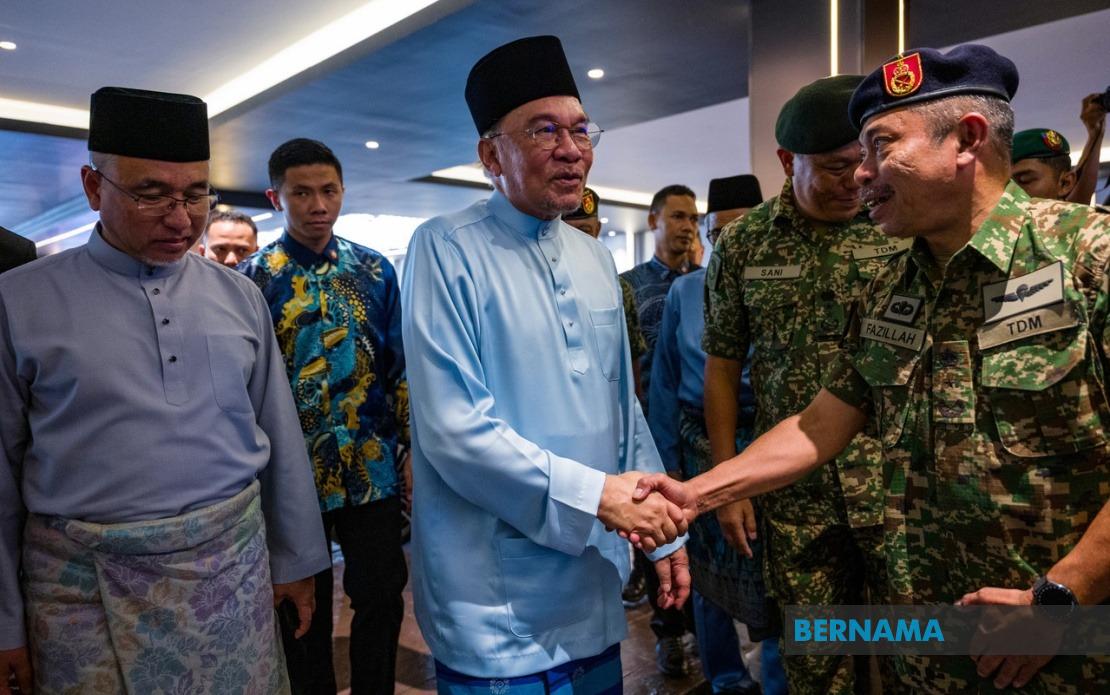
Prime Minister Datuk Seri Anwar Ibrahim has signalled the government's intention to raise defence spending in Budget 2027, a move that reflects Kuala Lumpur's broader strategic emphasis on keeping the Malaysian Armed Forces equipped and operationally capable in an increasingly complex regional security environment. The commitment comes as Malaysia navigates evolving challenges across maritime domains and faces growing demand for military modernisation to sustain deterrence capabilities across its expansive borders and territorial waters.
Chief of Defence Force General Tan Sri Malek Razak Sulaiman characterised the allocation increase as evidence of governmental resolve to elevate the MAF into a modern, integrated force capable of serving as the nation's primary defence instrument. His remarks, delivered during the Semarak Kenegaraan Programme at Terendak Camp in Melaka, underscored the military establishment's appreciation for civilian commitment to defence investments, a politically significant endorsement given the military's influence on budgetary discussions.
The increased defence funding targets multiple strategic objectives simultaneously. The government intends to direct fresh resources towards modernising ageing military assets and equipment, aligning spending priorities with the MAF's Future Force strategic development roadmap. This plan, developed over several years, identifies specific capability gaps and technological deficiencies that constrain the armed forces' ability to respond to contemporary security threats. Such investments carry particular weight for a nation with substantial maritime responsibilities, including vast exclusive economic zones and complex territorial arrangements with neighbours.
Beyond hardware acquisitions, the budgetary initiative addresses the human dimension of military effectiveness. Personnel welfare improvements feature prominently in the government's announcement, with explicit commitments to upgrade military housing quarters, construct a modern medical facility, and secure basic infrastructure such as reliable water supply systems. These initiatives recognise that soldier morale and retention directly influence operational effectiveness and unit cohesion, particularly as Malaysia competes for talented individuals against civilian employment opportunities offering superior compensation and lifestyle benefits.
Anwar Ibrahim, who holds the dual portfolio of Prime Minister and Finance Minister, announced that the defence budget expansion will encompass comprehensive welfare enhancements designed to improve quality of life for military personnel and their families. This holistic approach addresses long-standing grievances within the armed forces regarding accommodation standards and medical services, grievances that have periodically surfaced in media reports and veteran advocacy discussions. By tackling these concerns through budgetary reallocation, the government signals responsiveness to military institutional needs while demonstrating fiscal prioritisation of defence alongside other competing budgetary demands.
A subsidiary yet significant policy development emerged from the Melaka event: the government has accepted in principle a proposal to streamline and accelerate promotion procedures for both MAF and Royal Malaysia Police personnel. The reformed system aims to align military advancement mechanisms with established public service promotion frameworks, potentially reducing bureaucratic delays that have frustrated career progression in security agencies. This administrative simplification, while seemingly technical, carries implications for officer retention and morale by clarifying career advancement pathways and reducing perceived inequities in promotion timelines.
The timing of these announcements reflects Malaysia's evolving strategic posture in Southeast Asia. Regional tensions, including maritime disputes and great power competition for influence, have prompted increased defence spending across ASEAN nations. Malaysia's defence budget decisions occur within this competitive landscape, where neighbouring countries have pursued significant military modernisation programmes. The allocation increase positions Malaysia to maintain technological parity and operational readiness without triggering destabilising regional arms race dynamics, a delicate balance that Malaysian defence planners must navigate.
Malaysia's defence modernisation carries particular urgency given the aging inventory of military equipment inherited from earlier procurement cycles. The Future Force plan addresses capability shortages in air defence, maritime surveillance, and rapid response capabilities, all crucial for protecting national interests across Malaysia's three main geographic regions. Budget increases enable accelerated acquisition timelines and reduce dependency on piecemeal equipment purchases that strain operational efficiency and training standardisation.
From a fiscal perspective, the defence spending increase must be contextualised within Malaysia's broader budgetary constraints and development priorities. Defence expenditure competes with allocations for education, healthcare, and infrastructure, making budgetary decisions politically sensitive. The government's emphasis on personnel welfare and modernisation—rather than expansionist force growth—suggests a strategy prioritising efficiency and capability over numerical expansion, an approach consistent with Malaysia's economic constraints and regional security requirements.
The policy trajectory outlined by Anwar and endorsed by military leadership indicates sustained government commitment to defence investment beyond the immediate electoral cycle. Such multi-year strategic planning typically requires cross-party consensus and sustained fiscal discipline, suggesting that defence modernisation has achieved sufficient political consensus to survive potential governmental transitions. This institutional continuity provides defence planners with the budgetary predictability necessary for long-term procurement programmes and capability development initiatives.
Southeast Asian observers note Malaysia's balancing act between military modernisation and maintaining regional stability. Unlike some neighbours pursuing more assertive military postures, Malaysia's defence strategy emphasises credible deterrence through capability enhancement while avoiding provocative force deployments. The 2027 budget approach aligns with this doctrine, prioritising technological upgrades and personnel readiness over aggressive military expansion that might trigger regional concern.
The announcement also carries implications for Malaysian defence contractors and the domestic defence industrial base. Budget allocations for modernisation create opportunities for local companies to participate in supply chains, whether as primary contractors or subcomponent suppliers. However, the complexity of modern military equipment frequently requires technology transfer arrangements and international partnerships, limiting opportunities for purely domestic procurement without compromising capability standards.
Looking forward, the success of Malaysia's defence modernisation agenda depends on sustained budgetary discipline, effective project management, and strategic coherence in equipment acquisition. The government's commitment signals confidence in the security environment's trajectory and institutional stability, though regional developments could necessitate revised priorities or accelerated procurement timelines. The integration of personnel welfare considerations into defence budgeting reflects contemporary understanding that military effectiveness derives not merely from equipment sophistication but from personnel quality, morale, and retention—factors that Malaysia's budgetary approach now explicitly addresses.

