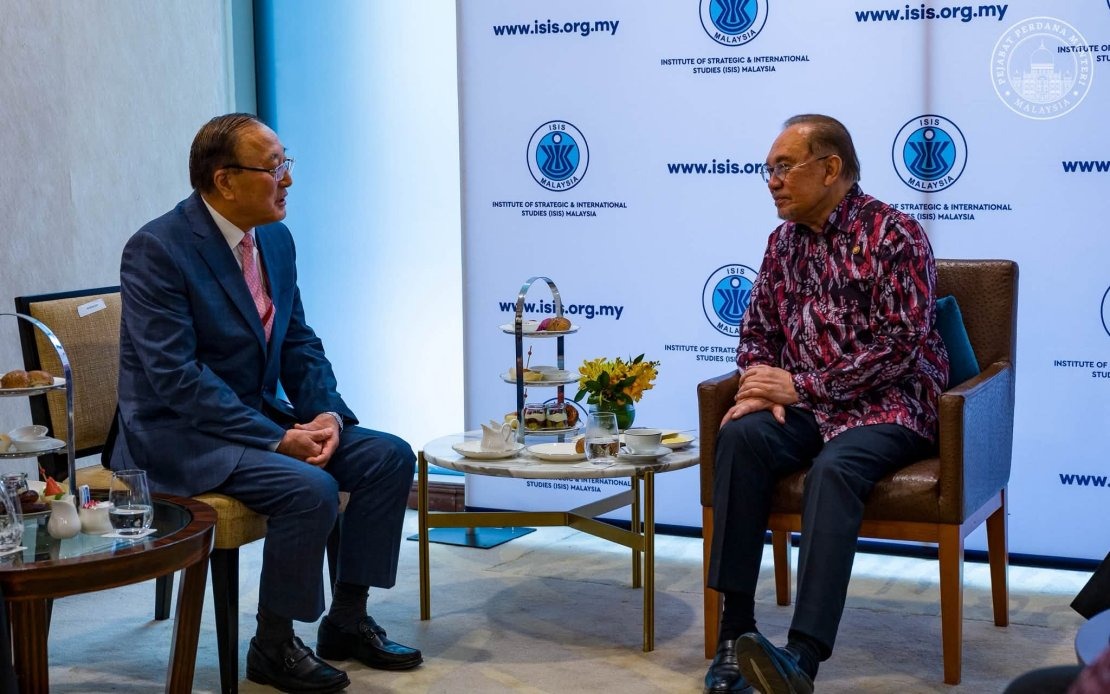
Prime Minister Datuk Seri Anwar Ibrahim has signalled Malaysia's commitment to deepening cooperation with the Boao Forum for Asia across a broad spectrum of priority areas, ranging from trade and investment through to cutting-edge technological advancement. The announcement came during a meeting with BFA Secretary-General Zhang Jun, who visited Kuala Lumpur to engage in discussions about navigating the increasingly complex regional and global operating environment. The Malaysian leader, who concurrently holds the Finance Ministry portfolio, underscored the strategic importance of this partnership at a time when the region confronts mounting pressures from multiple directions.
The scope of the proposed collaboration spans seven substantive domains that reflect both traditional economic interests and emerging development priorities. Trade and investment cooperation remains foundational, representing Malaysia's long-established role as a significant ASEAN trading hub and investment destination. Alongside these commercial pillars, the partnership will extend into digital transformation and artificial intelligence—sectors where Malaysia is positioning itself as a regional leader in Southeast Asia's digital economy. The inclusion of energy transition reflects the growing imperative across Asia to balance economic growth with environmental sustainability, a concern particularly acute for Malaysia given its substantial hydrocarbon reserves and expanding renewable energy ambitions.
Food security emerges as a critical dimension of this framework, addressing vulnerabilities that became starkly apparent during recent global supply chain disruptions. Malaysia, as both an agricultural producer and a net food importer, faces the delicate challenge of ensuring domestic food sufficiency while maintaining international trade relationships. The education and talent development component signals recognition that human capital development will determine regional competitiveness as economies shift toward knowledge-intensive industries. These pillars collectively form a coherent strategy for addressing the structural transformations reshaping Asian economies.
Anwar's emphasis on dialogue-based cooperation and regional inclusiveness carries particular weight given the current geopolitical landscape across Asia. The reference to geopolitical uncertainties appears calculated, acknowledging tensions between major powers without naming them directly—a diplomatic formulation common among Southeast Asian leaders navigating great power competition. Economic pressures continue mounting, with inflation, supply chain fragility, and divergent recovery patterns creating disparities across the region. Rapid technological change presents both opportunity and risk, benefiting early adopters while potentially marginalizing those left behind in the digital transition.
The Prime Minister's framing positions Malaysia within a broader Asian community facing common challenges that transcend bilateral relationships. By stressing that regional cooperation, inclusiveness, and dialogue constitute essential pillars for achieving stability and prosperity, Anwar articulates a vision that aligns with ASEAN's traditional consensus-based approach while acknowledging that purely bilateral engagements prove insufficient for addressing transnational concerns. This philosophy reflects Malaysia's historical role as a bridge-builder within Southeast Asia, balancing interests across diverse political systems and development levels.
The Boao Forum for Asia itself represents an important platform for Asian voices in global affairs. Founded in 2001 and based in China's Hainan province, BFA has evolved into a venue where political leaders, business executives, and intellectual figures from across Asia gather to deliberate on regional development trajectories. Malaysia's active engagement with BFA positions the country as a participant in high-level strategic conversations shaping Asia's future. For Malaysian readers, this cooperation carries implications for how their country approaches regional integration and technological adoption.
The emphasis on tangible benefits for ordinary citizens reflects political awareness that grand strategic frameworks only retain legitimacy if they translate into concrete improvements in living standards, employment opportunities, and social development. Trade expansion creates export opportunities for Malaysian businesses and potentially cheaper imports for consumers. Digital transformation and AI investment promise productivity gains and new employment categories, though they also risk displacing workers in traditional sectors—a consideration policymakers must address through workforce retraining initiatives. Energy transition investments could generate employment while reducing Malaysia's carbon footprint and enhancing air quality in major urban centers.
Food security improvements directly affect household budgets, particularly for lower-income Malaysians spending disproportionate shares of income on food. Enhanced regional cooperation in agriculture and food systems could stabilize prices and improve supply resilience. Education and talent development cooperation opens pathways for Malaysian students and professionals to access international learning and employment opportunities, particularly in high-growth sectors like technology and renewable energy. These granular implications connect abstract cooperation frameworks to individual Malaysian experiences.
The timing of this announcement reflects Malaysia's positioning within broader Asian geopolitical shifts. As major powers compete for influence and economic partnerships reshape traditional alliances, medium-sized economies like Malaysia must cultivate multiple partnerships while avoiding excessive dependence on any single great power. The BFA provides a platform for doing precisely this—engaging with China and other Asian nations through a multilateral structure rather than exclusively bilateral channels. For Malaysia, this approach offers strategic flexibility and reduces vulnerability to bilateral pressure.
Looking forward, the practical implementation of this enhanced cooperation will determine whether these aspirations translate into substantive outcomes. Mechanisms for translating high-level commitments into operational initiatives—funding arrangements, institutional frameworks, technology transfer agreements, and human exchange programs—will prove crucial. Malaysian policymakers and businesses will need to engage actively with BFA structures to ensure that national priorities receive adequate attention alongside the interests of larger Asian economies.
The partnership also reflects recognition that regional resilience increasingly depends on proactive cooperation addressing structural vulnerabilities. Climate change, pandemic risks, technology disruption, and demographic shifts affect all Asian nations and require coordinated responses. Malaysia's willingness to engage substantively with the BFA on these comprehensive fronts positions it as a constructive regional actor committed to collective problem-solving rather than zero-sum competition. This approach aligns with both Malaysia's ASEAN commitments and its broader strategic interests in maintaining a stable, prosperous Asian region conducive to Malaysian economic and security interests.

