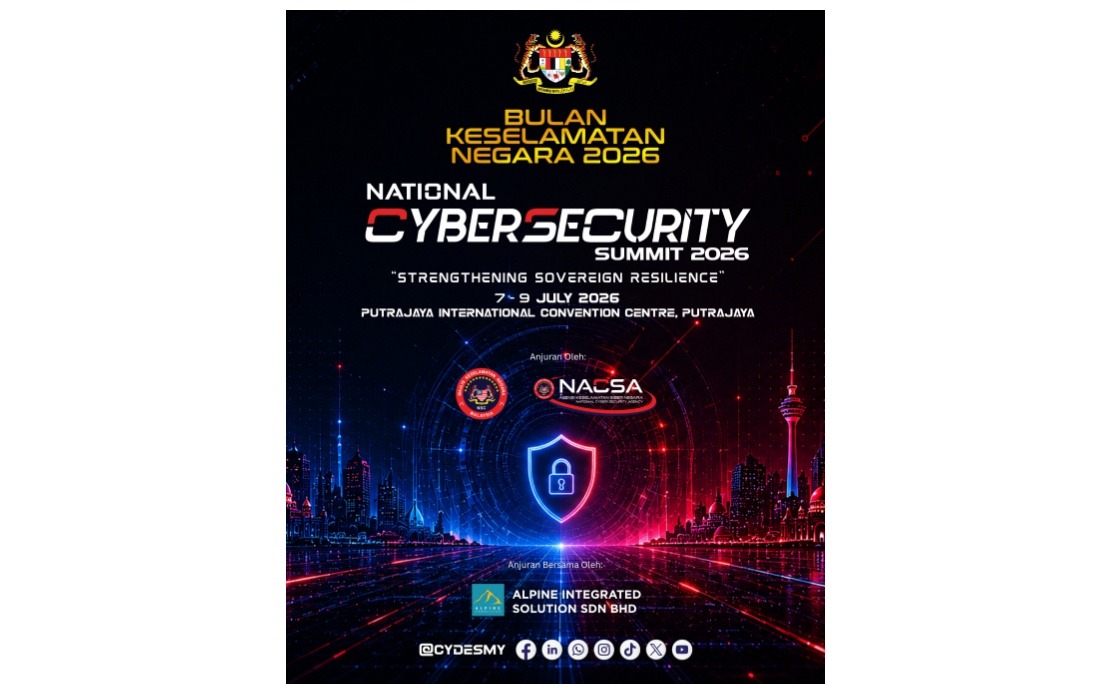
Malaysia will host the National Cyber Security Summit 2026 from July 7 to 9 at the Putrajaya International Convention Centre, with the National Cyber Security Agency convening policymakers, industry figures, practitioners and security specialists to advance the country's cyber resilience capabilities. The three-day gathering, organised under the National Security Council within the Prime Minister's Department, represents a strategic inflection point for Southeast Asia's third-largest economy as it confronts mounting digital threats and seeks to position itself as a regionally trusted player in cyber governance.
The timing of the summit proves particularly significant. The Dewan Rakyat passed the Cybercrimes Bill 2026 just days before the event on July 1, establishing fresh legislative foundations for digital security enforcement. This convergence underscores how the government intends to align legal frameworks with operational capacity-building across public and private institutions. The bill itself emerges from implementation efforts surrounding the Malaysian Cyber Security Strategy 2025-2030, a comprehensive roadmap that shapes the nation's digital security trajectory across the coming lustrum.
Organised under the banner "Strengthening Sovereign Resilience," the summit frames cyber security as intrinsic to national sovereignty rather than merely a technical concern. This conceptual reorientation reflects growing recognition that digital infrastructure underpins economic competitiveness, critical services delivery and geopolitical positioning. For Malaysian policymakers and business leaders, the summit articulates a vision of interconnected, mutually reinforcing defences spanning government agencies, telecommunications providers, financial institutions and technology enterprises.
The conference structure reveals ambition in scope and depth. Planners have programmed 41 substantive sessions incorporating Malaysian Cyber Security Strategy forums, dedicated discussions on cyber crime investigation, conventions for information and communications technology security officers, and specialised tracks addressing women's participation in the cyber profession. Technical presentations and closed-door workshops will enable participants to engage with emerging challenges beyond public discourse, fostering the behind-the-scenes collaboration essential for effective threat response.
Attendance projections underscore the event's regional and international dimensions. A total of 96 speakers and panellists representing government ministries, law enforcement bodies, private sector firms, tertiary institutions and the broader cyber security ecosystem will address audiences drawn from both Malaysia and abroad. Participation from 122 companies—comprising 78 domestic enterprises and 44 international firms originating from seven countries—demonstrates that the summit functions simultaneously as a networking platform for the regional cyber security industry and a showcase of Malaysian governance thinking.
Expected attendance of approximately 3,000 participants, along with 250 distinguished guests, positions the summit among the region's premier annual security conferences. Trade visitors and conference delegates will circulate among exhibitors and panellists, generating commercial and intellectual exchange that extends well beyond formal sessions. This scale of engagement suggests the government views the summit as instrumental in building constituency support for more stringent security protocols and investment in digital resilience infrastructure.
Prime Minister Datuk Seri Anwar Ibrahim will preside over the unveiling of three major policy instruments, each signalling Malaysia's intent to strengthen governance architecture. The National Security Policy 2026-2030 will articulate whole-of-government security priorities within which cyber considerations occupy an enhanced position. The National Cryptography Policy—branded MyKriptografi—and its accompanying action plan address the mathematical and computational foundations of secure communications, recognition that encryption standards must evolve as quantum computing and artificial intelligence capabilities advance. The Artificial Intelligence Systems Cybersecurity Framework represents forward-thinking acknowledgment that autonomous systems and machine learning applications introduce novel vulnerability vectors requiring proactive regulatory responses.
For Malaysian enterprises and public sector organisations, the summit and its policy outputs carry practical implications. Stricter compliance expectations will likely flow from enhanced legislative and strategic frameworks, necessitating investment in security infrastructure, personnel training and incident response planning. Small and medium enterprises may face particular adjustment pressures as baseline security standards rise across supply chains serving larger corporations and government agencies. Technology vendors and managed security services providers, by contrast, anticipate expanded market opportunities as demand for conformance solutions accelerates.
The summit's alignment with National Security Month (BKN) frames cyber security within a broader national consciousness-raising effort. Public awareness campaigns, educational initiatives and stakeholder engagement activities scheduled throughout the month aim to embed digital security thinking into collective understanding of national resilience. This holistic approach recognises that technical controls alone prove insufficient without corresponding changes in organisational culture and individual behaviour across society.
Regionally, the summit positions Malaysia as an active participant in Southeast Asian cyber governance discussions. Association of Southeast Asian Nations members grapple collectively with questions of digital sovereignty, cross-border cyber crime coordination, critical infrastructure protection and standards harmonisation. Malaysia's convening of this summit and unveiling of strategic frameworks contribute to emerging regional consensus on appropriate governance responses to evolving digital threats. International companies and experts attending from outside the region will carry impressions of Malaysian cyber maturity back to their home jurisdictions, potentially influencing bilateral cooperation arrangements and technology partnerships.
The emphasis on strategic partnerships and information sharing reflected in official statements indicates recognition that contemporary cyber threats transcend organisational and national boundaries. Malware, data breaches, ransomware attacks and infrastructure disruptions affecting one institution rapidly cascade through interconnected systems, affecting others. Effective defence therefore demands unprecedented collaboration between government agencies traditionally oriented toward operational secrecy and private sector entities competing commercially. The summit provides neutral ground where such cooperation can be negotiated, protocols established and relationships strengthened beyond crisis moments.
Looking forward, the policy launches and summit outcomes will likely shape Malaysian cyber governance for the remainder of the decade. Investment levels in government cyber agencies, hiring of specialised personnel, procurement of detection and response technologies, and international partnerships in intelligence sharing and capability building will reflect strategic choices crystallised during these July days. For regional observers and international partners assessing Malaysia's cyber maturity and threat response capabilities, this summit and its concurrent policy announcements offer crucial signals regarding the nation's seriousness in addressing digital security as a strategic imperative.

