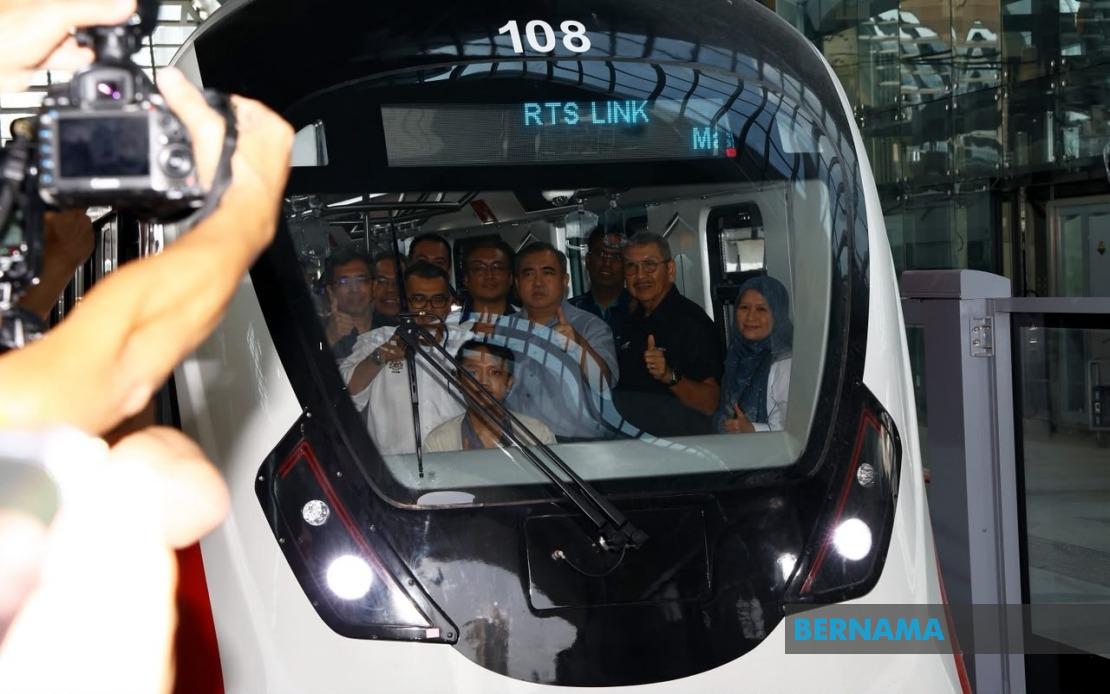
The Malaysian government has greenlit a RM60 million infrastructure project designed to seamlessly connect the upcoming Bukit Chagar RTS Link Station with the KTMB Komuter rail service, addressing one of the most critical challenges facing the cross-border transport corridor. Transport Minister Anthony Loke announced the decision following an inspection of the Bukit Chagar terminal, emphasizing that the initiative forms part of a broader strategy to establish an integrated multi-modal transport ecosystem in the Johor Bahru region.
The bridge construction, to be managed by the Ministry of Transport with approval from the Ministry of Economy, represents a significant evolution in how Malaysian authorities are approaching the final-mile connectivity problem inherent in major transport projects. Rather than forcing passengers into lengthy detours through JB Sentral, the direct pedestrian link will dramatically reduce travel time and friction for commuters transitioning between services. This approach acknowledges that seamless integration—not merely proximity—determines whether passengers embrace public transport alternatives to private vehicles.
The completion timeline of approximately 12 months positions the bridge for operational readiness well before the RTS Link's January 1, 2025 launch date, though final commissioning will depend on concurrent construction milestones. The decision to prioritize this connectivity solution underscores growing recognition within Malaysia's transport planning community that infrastructure must be designed around passenger experience rather than administrative convenience. The financial commitment of RM60 million, while substantial, reflects the Ministry's assessment that the integration costs are justified by the anticipated passenger volumes and the strategic importance of the Johor Bahru gateway.
Beyond the bridge itself, the government is simultaneously advancing the Stage Bus Service Transformation 2.0 initiative, which will introduce at least 200 additional buses to serve residential neighborhoods across Johor Bahru with direct routes to Bukit Chagar. This parallel expansion demonstrates a systems-thinking approach rarely seen in Malaysian transport planning, where rail, bus, and feeder services are being choreographed to arrive at operational maturity simultaneously. The operator agreement remains under finalization, with final approval contingent on Ministry of Finance endorsement, suggesting that cost negotiations may still be underway despite the firm commitment to service expansion.
The timing of bus service expansion to coincide with RTS Link operations reflects lessons learned from previous transport corridors where infrastructure opened to insufficient feeder networks, creating bottlenecks and disappointing utilization figures. By planning for passenger dispersal at the outset, authorities are attempting to avoid the scenario where passengers concentrate at limited hub points, overwhelming immediate surroundings and creating the impression of inadequate capacity. This coordinated approach is particularly important for the cross-border context, where smooth passenger flow carries diplomatic implications alongside economic benefits.
The envisioned transformation of Bukit Chagar into a comprehensive multi-modal transport hub encompasses integration with JB Sentral, e-hailing platforms, and additional public transport networks. This vision extends beyond simple physical connectivity to encompass information systems, fare coordination, and spatial design that guides passengers intuitively between services. For Malaysian commuters familiar with fragmented transport networks where transferring between modes requires navigation skills and patience, this integrated hub concept promises a markedly improved travel experience. The hub's success will likely establish a template for other regional transport developments.
Construction of the Bukit Chagar facility itself has reached substantial completion, with the building structure, Customs, Immigration and Quarantine complex, and RTS Link station all finished. The project has now transitioned into the rigorous testing and commissioning phase that will ultimately determine operational reliability. System integration testing will verify that all electronic and mechanical systems communicate effectively, followed by extensive fault-free and trial runs to simulate real-world passenger flows under controlled conditions. This methodical approach, while extending the pre-launch timeline, is essential for a transport facility handling cross-border operations where technical failures carry serious operational consequences.
The RTS Link itself represents one of Southeast Asia's most significant recent transport infrastructure investments, designed to move up to 10,000 passengers hourly in each direction between Bukit Chagar and Woodlands North in Singapore. These theoretical capacity figures, while impressive, depend entirely on the quality of integration infrastructure and feeder services that deliver passengers to the system. The RM60 million bridge investment, in this context, represents a cost-effective means of unlocking the full potential of a far more expensive primary infrastructure asset, a relationship that underscores sound infrastructure planning logic.
For Malaysian policymakers and transport planners, the Bukit Chagar project exemplifies how attention to last-mile connectivity and modal integration can transform the effectiveness of major transport investments. The decision to build the bridge rather than accept the existing route via JB Sentral reflects growing maturity in understanding that passenger experience encompasses the entire journey, not merely the primary mode. This holistic perspective, increasingly evident in Malaysian transport policy, suggests that future major projects may benefit from earlier consideration of integration requirements rather than treating them as afterthoughts requiring expensive retrofits.
The project also carries broader implications for Malaysia-Singapore transport cooperation, as a high-functioning cross-border corridor strengthens economic ties and validates further regional integration investments. Johor Bahru's role as an economic hub depends substantially on accessible transport links to neighboring regions, making the seamless integration of Bukit Chagar critical to the city's competitive positioning. The willingness to invest substantially in connectivity infrastructure signals confidence in sustained cross-border demand and commitment to professional transport standards comparable to international benchmarks.
As the January 2025 launch approaches, attention will inevitably focus on whether the supporting infrastructure—the bridge, expanded bus services, and operational readiness—materializes according to schedule. Any delays in these supporting elements risk undermining the RTS Link's impact, as passengers encountering difficulties in accessing or exiting the facility may revert to alternative transport modes. The convergence of multiple projects with a tight timeline creates interdependencies that require precise coordination among multiple agencies and private operators, a complexity that Malaysian transport authorities will need to manage carefully during the final implementation phase.

