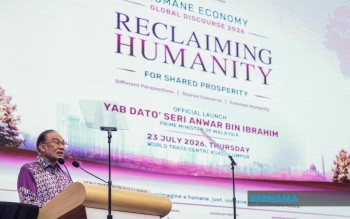
Prime Minister Datuk Seri Anwar Ibrahim has signalled that the government's fiscal planning machinery will shift into high gear next month as it commences work on Malaysia's 2027 budget framework, with the intention to table the spending and revenue plan to Parliament in early October. Speaking at the Humane Economy Global Discourse 2026 here on July 26, Anwar, who wears the dual hat of Finance Minister, outlined the philosophical underpinnings that will shape the budget's architecture and policy priorities in the years ahead.
The emphasis on what Anwar terms a "humane economy" represents a deliberate repositioning of how Malaysia measures and pursues economic success. Rather than viewing prosperity through the narrow lens of gross domestic product growth, inflation rates or consumption volumes, the Prime Minister has articulated a vision wherein economic expansion serves a deeper moral purpose rooted in human dignity and social cohesion. This framing carries particular resonance for Malaysian citizens who, despite the nation's middle-income status, have witnessed growing anxieties over cost-of-living pressures, wage stagnation and the accessibility of essential services.
At the heart of Anwar's articulation lies a fundamental questioning of development philosophy itself. He posed a series of probing questions that will presumably guide deliberations within the Treasury and economic planning agencies: whether economic growth expands or contracts opportunity, whether it fortifies or destabilises family units and neighbourhoods, and crucially, whether citizens are treated as active agents in their own development or merely as inputs to be optimised for productivity. These are not rhetorical flourishes but organisational principles that could translate into measurable policy choices when Budget 2027 takes shape.
The commitment to wage improvement stands out as particularly significant for Malaysia's workforce. Despite regional economic integration and technological advancement, real wage growth has lagged behind productivity gains in many sectors, leaving millions of workers caught between modest nominal salary increases and accelerating costs for housing, transport and healthcare. By explicitly positioning wage enhancement as a budget priority, Anwar signals a potential recalibration of labour market and fiscal policies that could address a persistent social friction point.
Housing policy emerges as another critical strand within this humane economy framework. Malaysia's property market, whilst generating substantial wealth for developers and investors, has priced out vast cohorts of young families and low-to-middle income earners from homeownership. The Promise of affordable housing within the budget deliberations suggests policymakers recognise that asset accumulation through property ownership remains a cornerstone of wealth building and intergenerational security in Malaysian society. This could necessitate fresh thinking on construction subsidies, land banking policies, or mortgage accessibility schemes.
Healthcare and education affordability likewise reflect entrenched challenges that Budget 2027 may address. While Malaysia maintains a functioning public health system, out-of-pocket expenditures increasingly burden households facing complex or chronic conditions. Similarly, despite free primary and secondary education, the costs of supplementary tuition, examination fees and tertiary education place formidable pressure on middle and lower-income families. Embedding these within the budget's core narrative suggests a willingness to allocate resources toward reducing financial barriers to health and learning.
The semiconductor strategy, energy transition and digital transformation initiatives that Anwar mentioned will sit alongside this human-centred development agenda. These represent Malaysia's positioning within global supply chains and the race toward net-zero emissions. However, the integration of these technological and industrial priorities with humane economy principles suggests policymakers intend to ensure that workers displaced by automation or energy transition are not left stranded, and that the benefits of digital and semiconductor sector growth accrue more broadly than to capital owners and highly skilled technicians alone.
Sustainability, as Anwar framed it, explicitly invokes intergenerational justice. The notion that current fiscal and environmental burdens should not cascade onto future generations speaks to concerns about national debt trajectories, climate resilience investments and the preservation of natural resource endowments. This philosophical stance could influence budgetary decisions on green infrastructure spending, carbon pricing mechanisms and conservation initiatives, all matters of increasing concern to Malaysian civil society and younger voters.
The timing of the August commencement and October tabling creates a compressed but workable timeline for the formulation process. The Treasury and allied agencies will need to conduct rapid consultations with spending ministries, line agencies and potentially wider stakeholder groups to translate Anwar's vision into concrete allocations and revenue measures. The October tabling allows for parliamentary debate and legislative passage before the new fiscal year, maintaining Malaysia's established budget cycle and providing clarity to the civil service and private sector on the policy and spending outlook.
For Malaysian businesses, especially small and medium enterprises, the budget framework will determine access to credit, taxation burdens, regulatory compliance costs and market opportunities. The emphasis on meaningful work and community vitality could shape labour regulations, entrepreneurship support schemes and local procurement policies. Multinational corporations and foreign investors will scrutinise the budget for signals on semiconductor incentives, renewable energy subsidies and the regulatory environment for digital innovation.
Regionally, Malaysia's budgetary choices carry implications beyond its borders. As a significant ASEAN economy and a bellwether for middle-income countries navigating technological disruption and climate transition, how successfully Malaysia integrates economic dynamism with social protection and environmental stewardship could influence policy thinking across Southeast Asia. The transparency and credibility of the budget process itself—whether the humane economy rhetoric translates into sustained resource allocation—will be closely watched by peers and development partners assessing Malaysia's governance maturity.
As the government enters the formulation phase, the principal test will be whether the philosophical commitments articulated by the Prime Minister survive the inevitable trade-offs and competing pressures that emerge during budget negotiations. Departments will jostle for allocations, fiscal constraints will require difficult choices, and political constituencies will lobby for their priorities. The degree to which the final Budget 2027 preserves the integrity of the humane economy vision will ultimately determine its success in addressing the lived experiences and aspirations of ordinary Malaysians.

