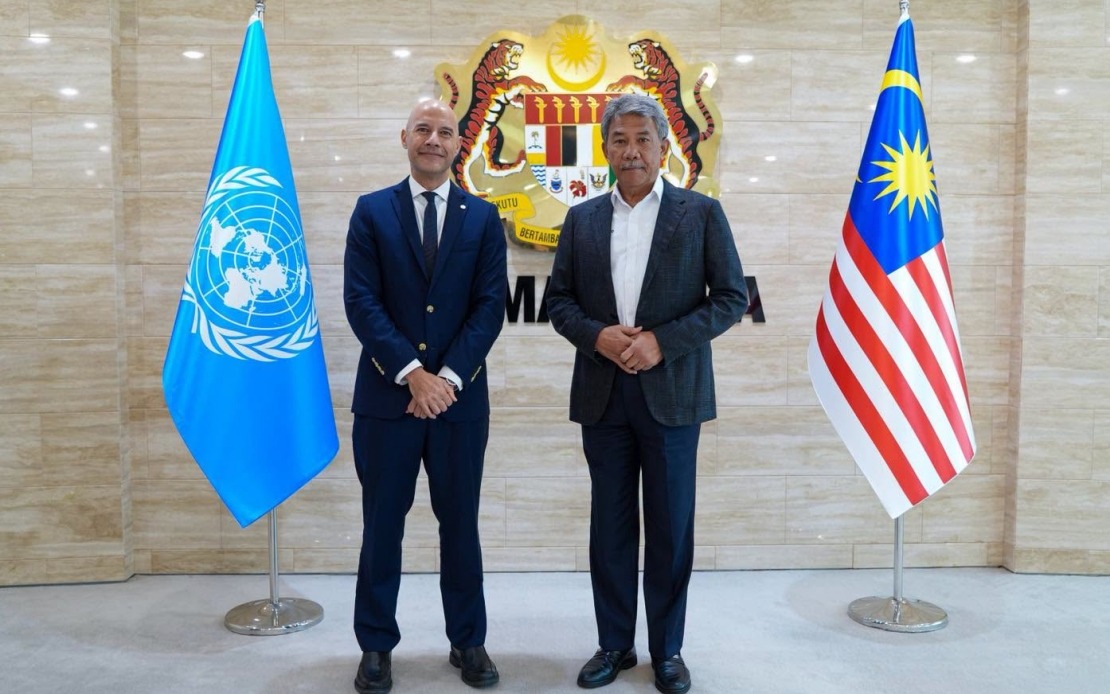
Foreign Minister Datuk Seri Mohamad Hasan hosted United Nations Resident Coordinator Nikolas Myint for a courtesy visit at Wisma Putra on Wednesday, signalling Malaysia's continued engagement with the international organisation as it navigates complex regional and global dynamics. The meeting between the two officials underscored the diplomatic channel through which Malaysia coordinates its multilateral commitments while pursuing domestic development objectives.
The encounter served as a platform for substantive dialogue on the scope and depth of Malaysia's partnership with the United Nations system operating across the country. Mohamad highlighted that such exchanges allow both parties to align their priorities and identify areas where collaborative efforts can generate tangible outcomes. The discussion reflected Malaysia's recognition that effective global governance requires sustained coordination between national governments and UN machinery.
Myint, who assumed his position in May 2026 as UNRC overseeing Malaysia, Singapore, and Brunei, brings responsibility for coordinating UN operations across three prosperous Southeast Asian economies with distinct development profiles and geopolitical significance. His appointment underscores the United Nations' strategic focus on the region, where multilateral cooperation increasingly intersects with national interests in areas ranging from climate action to sustainable development.
The Foreign Minister articulated Malaysia's appreciation for the UN's interventions across a spectrum of contemporary challenges—implicitly referencing climate change, public health, humanitarian crises, and economic transitions that demand coordinated international responses. This framing positions Malaysia as a constructive stakeholder willing to align domestic policy with globally agreed frameworks, a stance that carries implications for how the country shapes its votes in UN bodies and participates in international agreements.
Mohamad's commitment to close collaboration with the UNRC and UN agencies stationed in Malaysia demonstrates the government's intent to leverage international expertise and resources to accelerate its development agenda. Malaysia's sophisticated economy and regional influence mean that UN support often focuses on technical cooperation, capacity-building, and knowledge transfer rather than humanitarian relief, distinguishing it from less developed nations.
The meeting also signals Malaysia's desire to maintain its elevated status within UN structures—a consideration particularly relevant given Malaysia's aspirations for middle-power diplomacy and its participation in key international forums. By publicly emphasising cooperation with the resident coordinator, the government reinforces its image as a responsible international actor committed to the rules-based order.
The timing of this engagement reflects post-appointment protocol, but it carries deeper significance amid regional tensions and debates over global governance reform. Malaysia, as a developing economy with considerable soft power, often navigates between advancing third-world interests while maintaining constructive relations with major powers. The UN provides a neutral institutional space for such balancing acts.
For Malaysian readers, the implications extend to how government priorities align with international development targets. Areas such as poverty reduction, education, health, and environmental sustainability increasingly depend on coordination between Putrajaya and UN agencies. The Foreign Minister's comments about development aspirations likely reference Malaysia's Vision 2025 agenda and its commitments under the Sustainable Development Goals framework.
The establishment of regular high-level contacts between Malaysia's foreign ministry and UN leadership also facilitates smoother implementation of international agreements at the national level. UN agencies operating in Malaysia benefit from such political support, enabling them to pursue initiatives that address both national priorities and global imperatives. This alignment reduces bureaucratic friction and accelerates project delivery across health, education, and environmental sectors.
Myint's appointment covering three nations reflects the UN's organisational efficiency but also highlights these economies' similar development challenges and opportunities. Malaysia's engagement with this regional UN architecture means that decisions affecting Singapore and Brunei may have spillover effects, particularly in areas such as transboundary environmental management and regional peacekeeping.
Looking forward, this courtesy call establishes the diplomatic foundation for deeper collaboration on emerging issues that will dominate Malaysia's multilateral agenda. Climate finance, digital transformation, pandemic preparedness, and regional security cooperation increasingly demand coordinated action between national governments and UN specialised agencies.
The meeting represents routine diplomatic activity that nonetheless carries weight in maintaining the institutional relationships essential for effective international engagement. As Malaysia continues evolving its role in global affairs, sustained partnership with the UN system remains a cornerstone of its development strategy and international standing.

