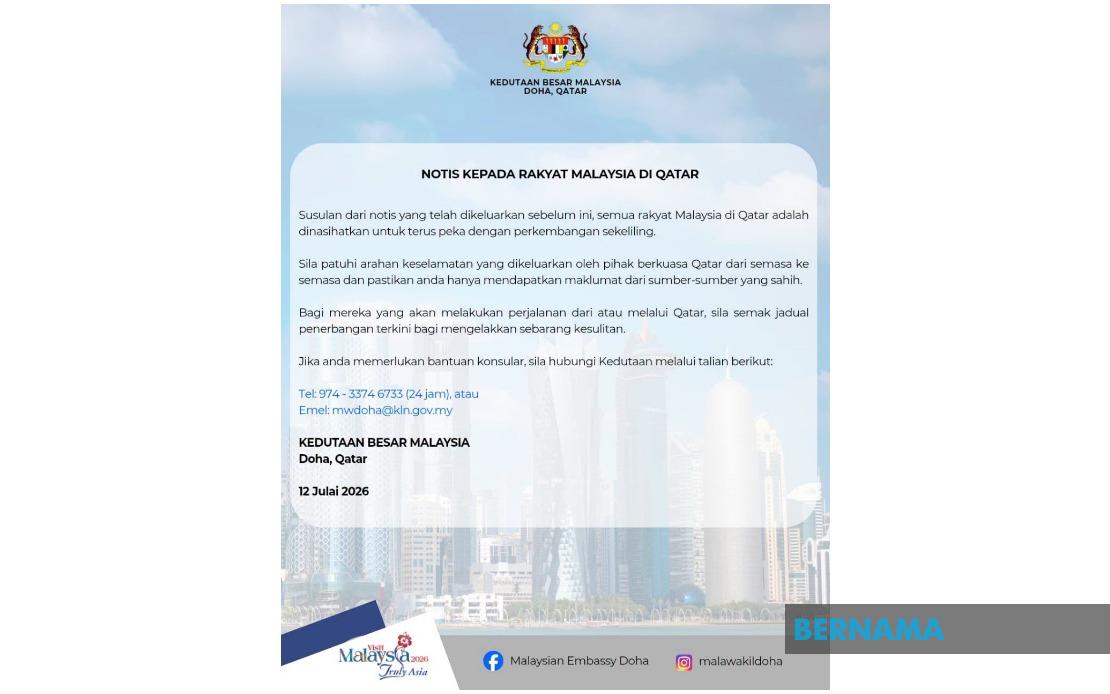
The Malaysian Embassy in Doha has issued an urgent advisory to all Malaysian nationals residing in or transiting through Qatar, instructing them to maintain heightened awareness of their surroundings and strictly follow security protocols established by Qatari authorities. The warning comes in response to a sharp escalation in military confrontations between the United States and Iran, which have created significant uncertainty across the Middle East and threatened critical regional infrastructure.
In a statement posted to its official social media channels, the embassy emphasized the importance of obtaining reliable information solely from authoritative sources rather than relying on unverified reports circulating online or through informal channels. The guidance reflects growing concerns among diplomatic missions throughout the Gulf region about the potential for further destabilization as both military powers continue their tit-for-tat operations.
Malaysians planning to travel from or through Qatar have been advised to check the most recent airline schedules frequently, as aviation disruptions remain a genuine possibility given the volatile security situation. The embassy has also activated its round-the-clock emergency support line, available at +974-3374 6733, to assist citizens who may require immediate consular help or evacuation support if circumstances deteriorate.
The advisory gains particular significance given Malaysia's substantial expatriate population in Qatar, many of whom work in the energy sector, hospitality, construction, and professional services. The country has long maintained strong economic ties with Qatar, and a significant number of Malaysian businesses operate throughout the Gulf state. Any prolonged military conflict could disrupt commerce and employment for thousands of Malaysian workers stationed in the region.
The tensions underlying the current crisis trace back to late February, when a major conflict erupted between Tehran and Washington, causing widespread regional instability. However, diplomatic efforts appeared to gain traction in June when Pakistani mediators facilitated negotiations resulting in a memorandum of understanding signed by both nations. This agreement was designed to halt all active military operations, terminate the American naval blockade imposed on Iran, and restore maritime passage through the strategically vital Strait of Hormuz, which serves as a critical conduit for global energy supplies.
Despite these diplomatic achievements, the ceasefire has proven fragile. This past Sunday, the Iranian military opened fire on a commercial vessel traveling through the Strait of Hormuz, prompting the United States to launch its third consecutive wave of military strikes against Iranian targets within the space of a single week. These renewed hostilities suggest that underlying grievances and security concerns remain unresolved despite the apparent agreement.
In response to the American strikes, Iran's Islamic Revolutionary Guard Corps naval command announced an indefinite closure of the Strait of Hormuz, declaring that no vessels would be permitted passage until all US military involvement in the region ceases completely. This assertion of control over one of the world's most crucial maritime chokepoints carries enormous implications for global trade and energy markets, as approximately one-third of all seaborne petroleum shipments transit these waters daily.
The escalation represents a fundamental test of the Pakistan-brokered agreement, which explicitly included provisions for restoring the Strait to full commercial operation and ending the blockade. The fact that both sides have already violated these terms within weeks of signing suggests that deeper structural issues—likely involving questions of regional hegemony, nuclear concerns, and proxy conflicts—remain fundamentally unresolved beneath the surface of the formal accord.
For Malaysia specifically, the implications extend beyond immediate safety concerns for expatriate workers. As a major global trader heavily dependent on stable maritime routes and affordable energy imports, any prolonged disruption to shipping through the Strait of Hormuz could increase transportation costs and fuel prices, ultimately affecting Malaysian consumers and businesses. The country's manufacturing sector, particularly electronics and petrochemicals, relies on predictable energy supplies and uninterrupted maritime commerce.
The Malaysian government has historically maintained a balanced approach to Middle Eastern geopolitics, avoiding close alignment with either Western powers or Islamic nations while emphasizing the primacy of international law and regional stability. This measured stance has generally served Malaysian interests well, allowing the country to maintain productive relationships across the geopolitical divide. The current crisis tests this balancing act, as Malaysia must simultaneously protect its citizens while respecting the sovereignty and perspectives of all parties involved.
The situation also underscores the broader vulnerability of Southeast Asian nations to distant conflicts that disrupt critical global infrastructure. While Malaysia itself has no direct involvement in US-Iran disputes, the region's prosperity depends fundamentally on stable international systems for trade and energy supply. This interdependence means that conflicts in the Middle East inevitably reach across vast distances to affect Malaysian livelihoods and security.
Looking ahead, the Malaysian government and private sector will likely monitor developments carefully. Business continuity planning for Malaysian firms operating throughout the Gulf has probably already commenced, with contingencies being prepared for extended port closures, rerouted shipping, and potential evacuation scenarios. The embassy's heightened alert status suggests that official Kuala Lumpur assessments indicate genuine risk, even if immediate catastrophic escalation remains unlikely.
Malaysian citizens in Qatar are therefore well-advised to take the embassy's warnings seriously. Maintaining situational awareness, establishing communication protocols with employers and family members, and avoiding areas of known security concern represent prudent precautions during this period of elevated regional tension.

