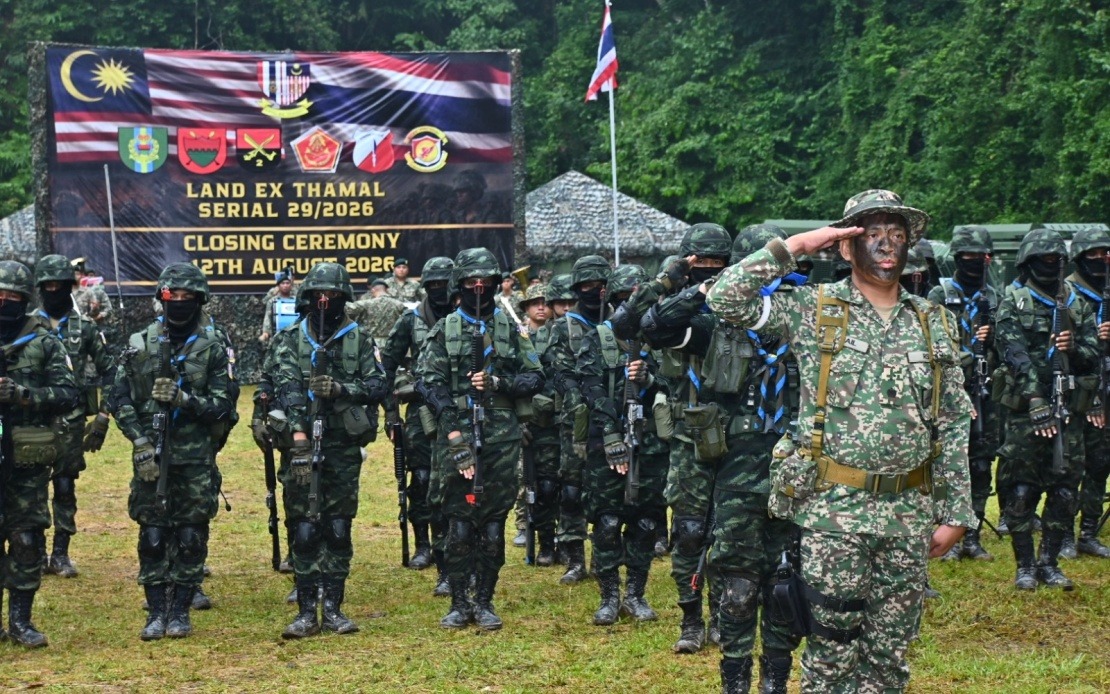
A comprehensive military training operation involving 252 officers and enlisted personnel from Malaysia's armed forces and their Thai counterparts is underway in the northern border town of Gerik, representing one of the most significant collaborative defence exercises between the two countries in recent years. The joint initiative, designated Exercise LAND THAMAL Series 29/2026, commenced on August 5 and has drawn participation from 197 Malaysian Army personnel alongside 55 members of the Royal Thai Army, providing both militaries with a structured platform to refine their operational capabilities in a coordinated manner.
The exercise, which operates under the operational supervision of the 2nd Malaysian Infantry Division headquarters, is structured across three distinct phases designed to progressively build competency and interoperability. The Cross Training Exercise phase establishes foundational understanding, followed by the Field Training Exercise component that places soldiers in realistic operational scenarios, and culminates with Combined Military Civil Action initiatives that extend the military's engagement into civilian communities. This layered approach ensures that personnel progress from theoretical knowledge to practical application while simultaneously cultivating the interpersonal relationships necessary for effective multinational operations.
The field training component exposes participating soldiers to a comprehensive range of combat-relevant scenarios that reflect the types of operational challenges both armies might face in their respective operational environments. Training modules encompass tactical fundamentals such as combat manoeuvres, negotiating physical obstacles under fire, establishing forward operating bases, conducting mounted and dismounted patrols, executing ambush tactics, and coordinating assaults on fortified positions. Through systematic exposure to these scenarios, personnel develop muscle memory and decision-making reflexes while simultaneously observing how their counterparts approach similar problems, creating opportunities to absorb alternative methodologies and tactical philosophies.
The exercise framework places deliberate emphasis on knowledge exchange and capability sharing between the two armed forces. Rather than operating as a one-directional training initiative, LAND THAMAL creates multiple forums for soldiers and officers to discuss their approaches to common challenges, debate the relative merits of different tactical procedures, and synthesise lessons learned from each nation's operational experience. This bidirectional learning model reflects contemporary military doctrine, which recognises that organisational learning and capability development accelerate when multiple perspectives are actively solicited and integrated rather than imposed from a single authority.
The opening ceremony on August 5 at Gerik Airstrip featured official participation from senior commanders representing both nations. Brigadier General Datuk Mohd Zaini Hashim, commanding Malaysia's 30th Infantry Brigade, jointly presided over the proceedings with Senior Colonel Taweeporn Kanatong, his counterpart from Thailand's 5th Infantry Brigade. During his remarks, Taweeporn articulated a vision of the exercise extending beyond purely military dimensions, emphasising its role in strengthening the bilateral relationship between Malaysia and Thailand while simultaneously enhancing both nations' capacity to respond to the diverse security challenges that characterise the contemporary strategic environment across Southeast Asia.
These challenges, as identified during the opening ceremony, span a considerably broader spectrum than traditional interstate conflict scenarios. Natural disasters—including floods, earthquakes, and cyclones that periodically devastate the region—present humanitarian emergencies that benefit from coordinated military response capabilities. Transnational security threats encompassing human trafficking, narcotics smuggling, and organised crime require sophisticated interagency coordination across borders. Regional stability concerns, including maritime disputes and territorial tensions, demand that armed forces maintain a credible deterrent posture while simultaneously cultivating mechanisms for peaceful dispute resolution. By preparing for these multifaceted challenges through joint exercises, Malaysia and Thailand signal their commitment to addressing them cooperatively rather than through unilateral or adversarial approaches.
The exercise's success in building interoperability between the Malaysian Army and Royal Thai Army carries implications for both the bilateral relationship and the broader security architecture of Southeast Asia. When armed forces from different nations train together extensively, they develop common vocabularies for discussing tactics, shared understanding of command procedures, and personal relationships among officers that facilitate communication during actual emergencies. These informal networks often prove decisive when crises demand rapid coordination, as personnel already familiar with their counterparts' communication styles and decision-making approaches can accomplish in minutes what would otherwise require hours of clarification and negotiation.
Beyond the strictly military dimensions, the exercise incorporates community engagement initiatives through the Jiwa Murni Programme, which organises Combined Military Civil Action activities at civilian locations. During the current iteration, personnel from both nations collaborated on community projects at Sekolah Menengah Kebangsaan Sultan Idris Shah II in Gerik, demonstrating to local populations that their militaries operate in service of civilian wellbeing rather than as purely coercive instruments. These activities, which might include infrastructure improvement, disaster preparedness education, or medical services provision, cultivate positive perceptions of the armed forces among civilian populations and reinforce the legitimacy of military institutions within democratic societies.
The continuation of LAND THAMAL as an annual or biennial exercise reflects institutional commitment from both Malaysia and Thailand to deepening their defence relationship despite occasional tensions in the broader diplomatic sphere. Military-to-military cooperation often proceeds independently from political fluctuations at higher levels of government, as the armed forces develop their own institutional interests in maintaining stability and predictability along shared borders. The exercise series, now reaching its 29th iteration in this naming convention, indicates that this cooperation has achieved sufficient durability and institutional support to persist across multiple changes in political leadership in both countries.
For Malaysia specifically, this exercise demonstrates the country's strategic orientation toward deepening engagement with neighbouring countries through defence cooperation mechanisms. As Malaysia navigates the complex security environment created by great power competition, regional territorial disputes, and transnational challenges, maintaining robust relationships with immediate neighbours like Thailand becomes strategically valuable. Through initiatives like LAND THAMAL, Malaysia signals that it views regional security as fundamentally interconnected rather than zero-sum, and that investing in the capabilities and coordination of neighbouring states ultimately enhances Malaysian security interests.
The exercise also reflects evolving definitions of military readiness in the Southeast Asian context. Rather than focusing exclusively on conventional interstate warfare scenarios, armed forces increasingly emphasise the ability to respond to humanitarian emergencies, manage irregular security threats, and coordinate with civilian agencies. By incorporating civil-military action alongside combat training, LAND THAMAL prepares personnel for the multidimensional security challenges that actually dominate operational planning across the region. This evolution in training priorities suggests that both the Malaysian Army and Royal Thai Army recognise the gap between traditional military capabilities and the actual security challenges confronting their respective nations.
Looking forward, the success of Exercise LAND THAMAL Series 29/2026 will likely encourage both nations to consider expanding the scope or frequency of joint training initiatives. As relationships deepen and personnel gain familiarity through repeated exercises, opportunities emerge to address more challenging scenarios involving more complex coordination requirements or extended operational durations. The exercise also provides a testing ground for new tactics and equipment, allowing both armies to evaluate innovations in a collaborative setting before implementing them within their respective institutional structures. In this sense, LAND THAMAL functions not only as a confidence-building mechanism but as a practical instrument for advancing military effectiveness across the region.

