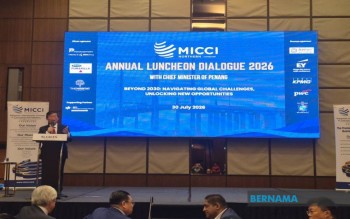
The Malaysian International Chamber of Commerce and Industry has issued a clarion call to the business community to substantially increase spending on workforce development and innovation initiatives as artificial intelligence, automation and digital transformation accelerate across all sectors. Speaking at the MICCI Northern Branch Annual Luncheon Dialogue 2026 in George Town on Tuesday, Northern Branch chairman Datuk Brian Tan Guan Hooi stressed that companies must move beyond reactive responses to technological change and instead position themselves strategically for the opportunities and challenges ahead. The message carries particular weight given Malaysia's position as a middle-income economy seeking to transition towards higher-value manufacturing and services while competing with both regional peers and global players.
The transformation underway extends far beyond simple tool upgrades or process automation. Tan emphasised that AI, automation and digitalisation will fundamentally reshape employment landscapes, simultaneously disrupting traditional job categories while generating entirely new industries and career pathways that do not yet exist. This dual dynamic creates what business leaders increasingly recognise as an existential challenge: companies that fail to evolve their talent strategies risk becoming obsolete, while those that successfully navigate the transition stand to capture substantial competitive advantages. Malaysian firms, particularly those in export-oriented sectors like electronics, semiconductors and advanced manufacturing, face heightened pressure given the global nature of their competition.
What distinguishes Tan's message from generic calls for modernisation is his specific emphasis on the breadth of capabilities required. Beyond technical certifications and formal qualifications, workers must develop what education theorists term "soft skills" or "human-centric competencies"—creativity, effective communication, emotional intelligence and above all, the psychological capacity to embrace continuous learning throughout their careers. This multidimensional approach reflects growing recognition among employers worldwide that rote technical knowledge becomes obsolete quickly, whereas adaptability and creative problem-solving remain perpetually valuable. For Malaysian educators and corporate training departments, this suggests fundamental curriculum redesign rather than incremental enhancement.
The strategic imperative extends to how companies structure their long-term investment portfolios. Tan urged businesses to look beyond immediate quarterly pressures and strengthen foundational capabilities through sustained innovation spending and people development. This proves especially challenging in Malaysia's competitive environment, where many firms operate on tighter margins than counterparts in developed economies and face constant pressure from lower-cost competitors in Southeast Asia and South Asia. Yet paradoxically, companies that defer innovation investment to preserve short-term profitability often find themselves in weakening competitive positions within five to ten years as technological gaps widen.
The dialogue took place against the backdrop of Malaysia's broader economic transformation agenda. Penang Chief Minister Chow Kon Yeow's attendance as guest of honour signalled state government recognition of these challenges, particularly important given Penang's status as a major electronics and semiconductor hub where automation and AI adoption accelerate rapidly. The state's own economic competitiveness depends substantially on whether its industrial base can evolve faster than competitors in neighbouring jurisdictions. Private sector voices like MICCI therefore become crucial counterweights in policy discussions, ensuring that government initiatives align with actual business needs rather than theoretical planning.
Tan's articulation of the public-private partnership imperative addresses a common frustration in Malaysian business circles. Government policies, infrastructure investments and educational curricula sometimes develop on timelines and according to priorities that diverge from what companies require. The digital infrastructure rollout, for instance, has expanded significantly, yet many firms report bottlenecks in implementing AI solutions due to inadequate data governance frameworks or skills shortages in specialised roles. Similarly, vocational and tertiary education systems, though improving, often lag behind industry's evolving skill requirements by several years. Bridging these gaps requires not occasional consultations but genuinely iterative dialogue where industry representatives contribute not just feedback but direct input into policy formulation.
The role MICCI positions itself to play—as honest broker and bridge between sectors—carries historical weight. An organisation that has served Malaysia's business community continuously since 1837, now marking its 189th anniversary, possesses institutional credibility and accumulated knowledge about what works and what fails in Malaysian commercial environments. This institutional memory becomes particularly valuable during periods of rapid change, when both government and businesses risk making similar mistakes that previous generations already learned to avoid. MICCI's advocacy for closer alignment between education and industry needs, for instance, echoes recommendations from multiple decades yet remains perpetually relevant because implementation gaps persist.
For Malaysian companies across sectors—from manufacturing to services to emerging technology fields—Tan's message carries immediate practical implications. Organisations must conduct honest audits of current talent development spending and innovation investment, comparing their levels to international competitors and industry peers. Many will likely discover significant gaps. Equally important, companies must examine how innovation budgets are allocated. True transformation requires not just incremental improvements to existing processes but also exploratory investments in emerging technologies, even when returns remain uncertain. This shift from efficiency-focused to innovation-focused capital allocation fundamentally changes how companies approach risk and resource management.
The timing of this advocacy also reflects Malaysia's position in the broader Asian economic competition. Neighbouring countries including Singapore, South Korea, and increasingly Vietnam and Thailand, have prioritised precisely these capabilities—talent development, innovation ecosystems, public-private collaboration—as core competitiveness strategies. Malaysia risks falling behind if its business community and government move more slowly. Yet Malaysia possesses genuine advantages: a diverse, increasingly educated workforce; substantial existing industrial capacity; and sophisticated financial and logistics infrastructure. Whether these advantages persist depends substantially on implementation of exactly the strategies Tan articulated.
Looking forward, MICCI's continued role as industry advocate will prove essential. Dialogue cannot be one-directional; government must genuinely hear and respond to business concerns, while companies must articulate needs clearly and substantiate them with evidence. On matters like vocational training curriculum development, technology infrastructure standards, or regulatory frameworks for emerging sectors like digital economy services, the iterative exchange between government and business through organisations like MICCI can dramatically improve policy outcomes. Malaysia's economic future increasingly depends on whether these conversations happen regularly and produce genuine alignment.

