Hardened plaque accumulation in the coronary arteries—a condition known as atherosclerosis—remains one of the most significant threats to cardiovascular health in Malaysia and across Southeast Asia. When fatty deposits, cholesterol, calcium, and other substances build up on artery walls over extended periods, they narrow blood vessels and restrict blood flow to vital organs. This narrowing can eventually precipitate heart attacks, heart failure, and strokes if left untreated. While standard treatments including lifestyle modifications, medications, and surgical options have long been available, severe cases involving heavily calcified plaques present considerable clinical challenges that demand increasingly sophisticated interventions.
Conventional approaches to opening blocked arteries have relied on percutaneous coronary intervention (PCI), coronary artery bypass grafting (CABG), and angioplasty. In typical scenarios, cardiologists insert a balloon catheter to crush soft plaque against artery walls, then deploy a stent to maintain vessel patency and prevent renarrowing. However, when calcium deposits become severe and extensive, this straightforward approach becomes significantly more difficult. The hardened mineral deposits resist balloon compression, and attempting to force passage of conventional equipment risks damaging the vessel itself. These technical obstacles can result in poor immediate outcomes and suboptimal long-term patient prognosis, leaving clinicians seeking more advanced solutions.
Intravascular lithotripsy (IVL) represented a major breakthrough when it emerged as a minimally invasive option for severely calcified lesions. The procedure employs a specialized catheter that generates sonic pressure waves to fracture calcium deposits, allowing better blood flow restoration. Datuk Dr Tamil Selvan Muthusamy, a leading consultant cardiologist, explains how conventional IVL functions: ultrasound pulses are generated externally and directed through the catheter at the blockage site, creating acoustic pressure waves that crack the hardened material. However, this technology carries inherent limitations. The number of ultrasound pulses available is finite—typically eight in earlier devices, expanded to twelve in newer versions—meaning all calcification must be successfully fractured within this pulse budget, leaving no margin for error.
Beyond pulse limitations, conventional IVL devices face additional practical constraints in clinical settings. The catheter design is relatively bulky, creating difficulties when attempting to navigate severely narrowed coronary arteries where very little space remains for device passage. When calcified blockages are particularly large, the residual lumen becomes correspondingly small, potentially preventing catheter insertion altogether. This situation then necessitates additional preparatory techniques before the main lithotripsy procedure can even commence. Furthermore, IVL catheters come in fixed sizes, typically matching a single vessel diameter. Since human coronary arteries are not uniform—varying from 3.5mm or 4mm at their origin to 2mm or 3mm at their distal extent—a single-sized balloon cannot adapt to this anatomical variation, limiting treatment flexibility.
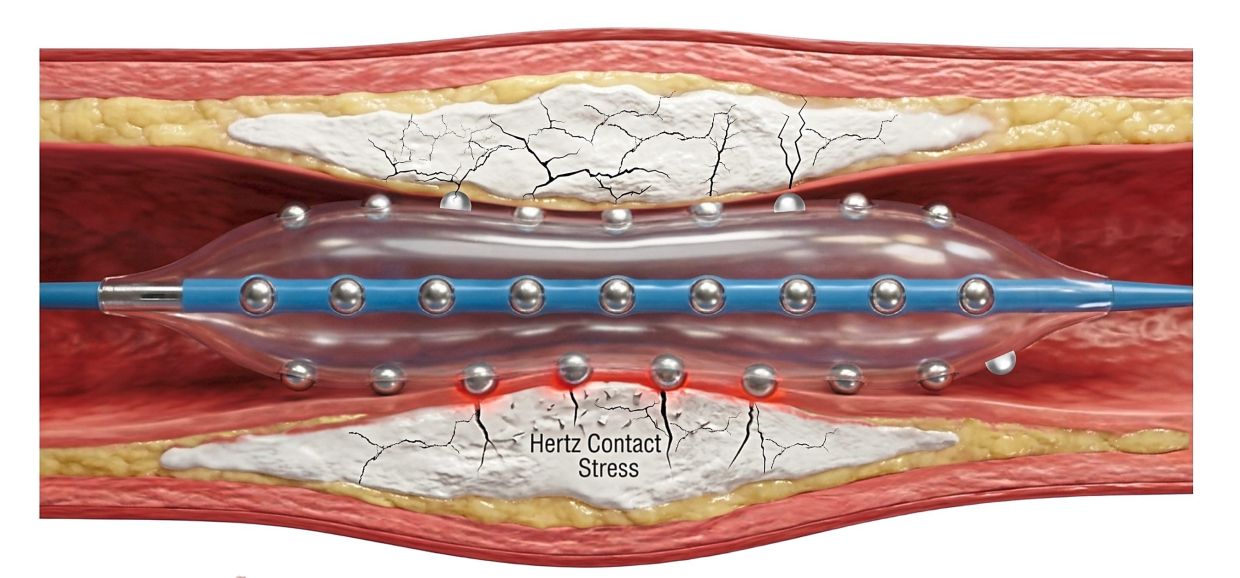
Recognizing these clinical gaps, Malaysian cardiologists under Datuk Dr Tamil Selvan's leadership began investigating a fundamentally different technology in 2025. The Hertz Contact-IVL System (HC-IVL) represents a departure from energy-based lithotripsy by employing a mechanical rather than external-energy approach. Instead of relying on an ultrasound generator, the HC-IVL balloon incorporates integrated metallic hemispheres constructed from stainless steel. When the balloon is pressurized against calcified plaque, these hemispheres contact the hardened material and create focal pressure amplification points. The concentrated forces at these contact areas effectively fracture calcium deposits while distributing mechanical stress in ways that minimize collateral tissue damage to the surrounding artery wall.
The engineering advantages of this mechanical design prove substantial in clinical practice. By eliminating dependence on external energy generation, the device achieves superior deliverability through tortuous coronary anatomy. The catheter can navigate more easily through the entire vessel length, enabling single-device treatment across multiple calcified lesions or extended blockages. This represents a significant practical improvement over conventional IVL, which typically requires multiple procedures or device exchanges for lengthy lesions. Additionally, HC-IVL's mechanical operation permits deeper, wider fracture patterns in calcium deposits without requiring the discrete, limited-pulse sequences that constrain older lithotripsy systems. Once calcium is successfully fractured and the artery lumen expanded, stent deployment becomes more reliable, translating to better long-term patency rates.
The decision to conduct a formal clinical study in Malaysia reflects both international best practices and recognition of local expertise. While the HC-IVL system's developer had completed preliminary investigations through multiple research centres in the United States, those studies remained relatively small in scope. Datuk Dr Tamil Selvan and his colleagues determined that a larger, dedicated Malaysian study would establish a more robust evidence base regarding device safety and efficacy in diverse patient populations. This approach exemplifies how Southeast Asian medical institutions can contribute meaningfully to global clinical knowledge while simultaneously developing expertise in emerging technologies. By conducting comprehensive safety assessments locally, the Malaysian research team ensures that any future adoption of this technology will be grounded in rigorous clinical evidence.
The implications of advanced lithotripsy technologies extend well beyond individual patient outcomes, holding significance for cardiovascular health systems across Malaysia and the broader region. Coronary artery disease remains a leading cause of morbidity and mortality, with calcified atherosclerosis increasingly recognized in aging populations. Many Malaysian patients present with extensive calcification due to delayed diagnosis and treatment, making innovations that improve interventional success rates particularly valuable. Techniques that enable safe, effective treatment of previously challenging cases can reduce procedure times, minimize complications, and improve clinical outcomes, ultimately reducing the burden on cardiac care resources and improving quality of life for affected individuals.
For Malaysian healthcare providers and policymakers, this research represents an opportunity to position the nation as a center for cardiovascular innovation in Southeast Asia. As treatment paradigms evolve toward more sophisticated catheter-based interventions, local expertise in evaluating and deploying these technologies becomes increasingly important. Institutions conducting rigorous clinical research on cutting-edge devices build institutional capacity, attract specialist talent, and establish credibility within international medical communities. The HC-IVL study demonstrates that Malaysian cardiologists possess the technical capability and investigative rigor to contribute meaningfully to global cardiovascular medicine while addressing the specific health challenges facing Malaysian patients. Such initiatives ultimately strengthen the nation's healthcare competitiveness and ensure citizens have access to world-leading treatment options.

