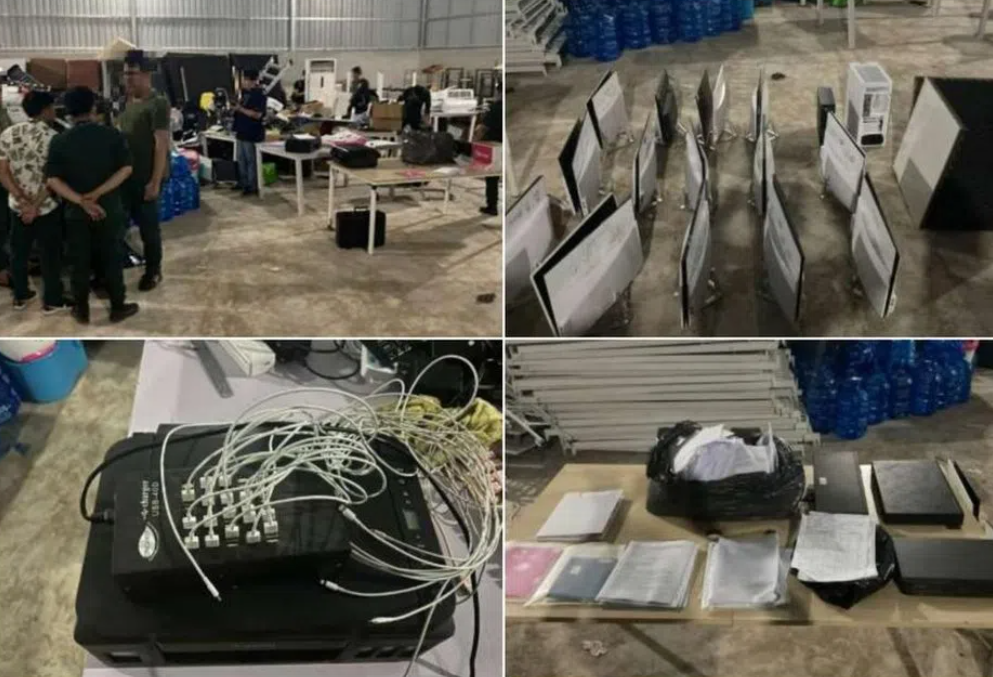
A Malaysian man's brief and unsuccessful foray into transnational fraud has landed him in prison for over a year. Yip Chee Ming, 30, was sentenced on Friday (June 26) to 16 months and two weeks' jail after he pleaded guilty to being a member of an organised crime syndicate. His involvement with a Phnom Penh-based operation lasted merely three days in late November 2024, during which he spectacularly failed to cheat anyone, ultimately leading to his termination by the ring's management.
Yip's entry into the criminal enterprise began innocuously enough when his friend Jason approached him in October 2024 with an unusual job opportunity. The two Malaysians discussed joining what was presented as a lucrative operation in Cambodia, and both agreed to explore the prospect. They were subsequently added to a Telegram group by Tang Soon Wah, identified as one of the syndicate's key leaders, who extended an invitation to visit the scam compound in Phnom Penh to view the facilities firsthand. The facility itself was a five-storey building with security personnel stationed at its entrance, suggesting an organised and established operation. After returning to Malaysia to deliberate the offer, both men committed to the venture and flew to Cambodia on November 21, 2024.
The structure of the criminal organisation reveals the sophistication of modern transnational scam networks operating across Southeast Asia. The syndicate operated a hierarchical system with leadership at the apex responsible for overall strategic direction and commission payments. Beneath them sat supervisors and trainers who managed the day-to-day operations of individual scammers. These trainers played a particularly insidious role, equipping callers with carefully crafted scripts and coaching them on techniques to enhance their deceptive effectiveness—including instruction on adopting Singaporean accents to build rapport with victims. A specialised division handled money laundering, converting illicit proceeds into cryptocurrency to obscure the trail of stolen funds. Police investigations identified at least 78 suspected members across the entire operation, indicating the scale of the criminal infrastructure.
Yip commenced his position on November 22, 2024, tasked with impersonating a bank officer to persuade Singaporeans to transfer money. He was offered a monthly salary of US$1,800 (S$2,333) in cryptocurrency plus a one per cent commission on successfully defrauded victims—a compensation structure designed to incentivise aggressive targeting. Despite having access to the syndicate's prepared scripts and the benefit of trainer guidance, Yip proved remarkably inept at his assignment. His first day of calls yielded no successful frauds. Undeterred, he attempted again the following day with identical results. On November 23, 2024, after a mere two days of actual work, Tang terminated his employment and deleted their message communications, effectively severing Yip's connection to the operation.
The broader context of this case underscores the escalating threat posed by government official impersonation fraud across Singapore and the wider region. Between September 3, 2024, and September 5, 2025, the syndicate Yip briefly joined was implicated in at least 528 reported fraud cases resulting in combined losses of approximately S$52.5 million. This represents an extraordinary financial toll on individual victims and families across Singapore, many of whom were elderly or vulnerable to sophisticated social engineering tactics. The scale of operations demonstrates how criminal syndicates have industrialised fraud, treating it as a production-line enterprise with specialised roles and performance metrics.
Yip's arrest came later, on September 9, 2025, during a coordinated enforcement operation conducted jointly by Singapore police and the Cambodian National Police. He was one of twelve individuals charged in connection with the syndicate. Nine of the accused—Deon Tan Ke Yuan, Lester Ng Jing Hai, Christy Neo Wei En, Heiqal Lee, Tay Jun Xiang, Ng Wei Kang, Zachary Lee Jia An, Melvin Tan Wenzheng, and Lau Haoxiang—are Singapore citizens, while the remaining three include fellow Malaysian Muhamad Asyraf Anuar and Filipina De Villar Rizalyn Panganiban from the Philippines. The multinational composition of the accused reflects the cross-border nature of contemporary organised fraud networks.
Wider enforcement data illustrates why government official impersonation scams have become a priority concern for authorities. While overall scam cases declined in Singapore during 2025, the number of government official impersonation incidents more than doubled from 1,504 cases in 2024 to 3,363 in 2025. This represents a disturbing 123 per cent increase year-on-year, making such scams the fifth most prevalent fraud category island-wide. The trend suggests scammers have identified particular vulnerability in government impersonation tactics and are accordingly concentrating their efforts there. The sophistication of these operations, combined with their profitability, makes them attractive to criminal syndicates seeking to maximise returns from transnational fraud networks.
For Malaysian and regional readers, Yip's case serves as a cautionary reminder of how easily individuals can become ensnared in transnational criminal enterprises. What may initially appear as an attractive job opportunity abroad can rapidly devolve into serious criminal exposure, carrying substantial prison sentences and reputational damage. The fact that even an individual who proved incompetent at the actual deception received substantial jail time underscores that authorities treat membership in organised crime syndicates seriously, regardless of an individual member's actual success or contribution to the scheme.
The legal framework under which Yip was prosecuted provides significant penalties for participation in organised crime. Under Singapore law, membership in an organised crime group carries a maximum fine of $100,000, imprisonment up to five years, or both. Yip's sentence of 16 months and two weeks falls comfortably within the sentencing range and reflects his guilty plea and cooperativeness with authorities. A second charge relating to the cheating aspect was taken into consideration during sentencing, suggesting the courts reserved the right to impose additional punishment had he contested the charges or been convicted on multiple counts.
The international dimensions of this case highlight the increasing challenges faced by law enforcement in combating transnational crime. The Cambodian National Police collaboration with Singapore authorities in the September 2025 operation demonstrates growing regional cooperation in tackling organised crime, though the continued operation of such facilities in Cambodia suggests vulnerabilities in oversight remain. For Malaysian citizens, the case underscores the importance of exercising extreme caution when approached with high-paying job opportunities abroad, particularly in neighbouring countries, as such offers frequently mask involvement in illegal activities that can expose individuals to prolonged incarceration and criminal prosecution.

