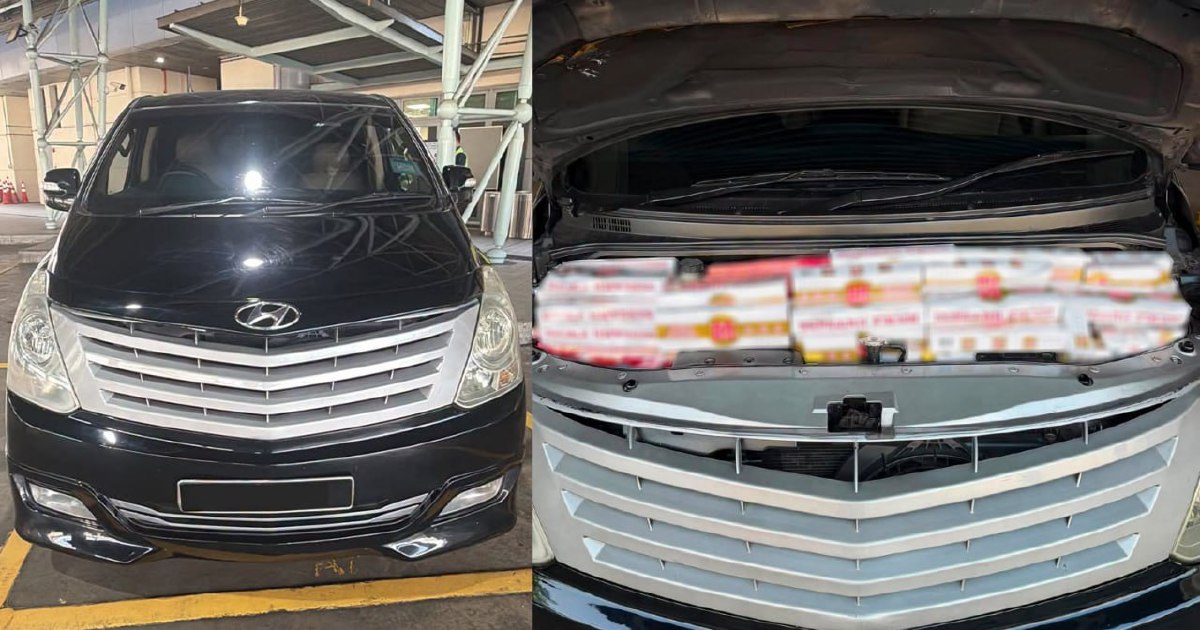
A 26-year-old Malaysian driver has been detained by Singapore's immigration authorities after officers uncovered a major cigarette smuggling operation at the border. The suspect was apprehended during a checkpoint inspection when Singapore Immigration and Checkpoints Authority (ICA) personnel discovered more than 600 cartons and 900 individual packets of duty-unpaid cigarettes concealed in a sophisticated hiding place beneath the multipurpose vehicle's floorboard. The discovery represents another significant interception in Singapore's ongoing battle against organised tobacco smuggling networks that exploit the price differential between Malaysia and Singapore.
The cache's location — hidden underneath the vehicle's structural framework — demonstrates the increasing sophistication of smuggling operations attempting to circumvent border controls. Smugglers have progressively invested in custom vehicle modifications and concealment techniques, reflecting the substantial profits available from transporting untaxed cigarettes across the causeway. The sheer volume suggests this was not merely a personal import but part of a larger distribution network. Cigarettes remain among the most frequently intercepted contraband items at Singapore's borders, driven by the city-state's significantly higher excise duties on tobacco products compared to neighbouring Malaysia.
Singapore's tax regime on cigarettes creates one of the widest price gaps in the region. A packet of cigarettes in Singapore costs considerably more than in Malaysia due to substantial import duties and the Goods and Services Tax, creating powerful financial incentives for smuggling operations. This price disparity fuels a persistent black market where illegally imported cigarettes undercut legitimate retailers. The substantial mark-up available to smugglers makes the risks worthwhile for criminal organisations operating across the Malaysia-Singapore border, which handles millions of vehicles and passengers daily.
The ICA's discovery underscores the agency's continued focus on detecting contraband at entry points, where officers conduct random and targeted inspections based on intelligence. Although the majority of cross-border traffic passes through without incident, authorities maintain sophisticated screening protocols to intercept contraband shipments. The successful detection in this instance reflects both improved detection techniques and information-sharing between regional authorities tracking smuggling networks. ICA officers have become increasingly adept at identifying vehicles with unusual modifications that suggest concealment mechanisms.
For Malaysian travellers and residents, such incidents carry implications regarding border crossing procedures and vehicle inspections. While the overwhelming majority of legitimate crossers experience minimal delays, cases like this inevitably prompt authorities to intensify checks during peak travel periods. Malaysian nationals frequently transit through Singapore for business, tourism, and employment purposes, and high-profile smuggling arrests can create friction in bilateral relations despite both nations' shared interest in securing their common border.
The seizure also highlights the environmental and public health dimensions of cigarette smuggling. Duty-unpaid cigarettes often lack proper regulation and quality controls, potentially exposing consumers to substandard products. The black market cigarette trade deprives governments of crucial tax revenue designated for healthcare programmes and infrastructure. In Singapore's case, tobacco excise duties contribute substantially to the national budget and fund anti-smoking initiatives and public health campaigns.
Criminal networks involved in tobacco smuggling frequently operate across multiple jurisdictions, necessitating coordinated enforcement between Malaysian and Singaporean authorities. Both countries have strengthened cooperation mechanisms to disrupt supply chains and prosecute organisers of large-scale operations. However, the persistence of such attempts indicates that organised groups continue to view the risk-reward calculation as favourable. The relatively porous nature of maritime smuggling routes also means some contraband bypasses land crossings entirely.
The arrested individual now faces prosecution under Singapore's customs and excise laws, which carry substantial penalties including fines and imprisonment for trafficking in duty-unpaid goods. Conviction records for smuggling offences can have lasting consequences for employment prospects and future border crossing privileges. The multipurpose vehicle's seizure represents an additional financial loss to the accused, as authorities typically retain vehicles used in smuggling offences. Such consequences, while serious, have not entirely deterred smuggling attempts, suggesting the profit margins involved remain sufficiently attractive to risk-takers.
This interception represents merely one instance among countless daily border transactions, yet it underscores the continuous efforts required to maintain effective customs enforcement. As technology evolves, so too do concealment methods, creating an ongoing challenge for authorities. Intelligence-led policing and vehicle scanning technology have improved detection rates, but perfectly intercepting every smuggling attempt remains impractical given the volume of cross-border traffic. The case serves as a reminder of the enduring tension between free movement and security at one of Southeast Asia's busiest international boundaries.

