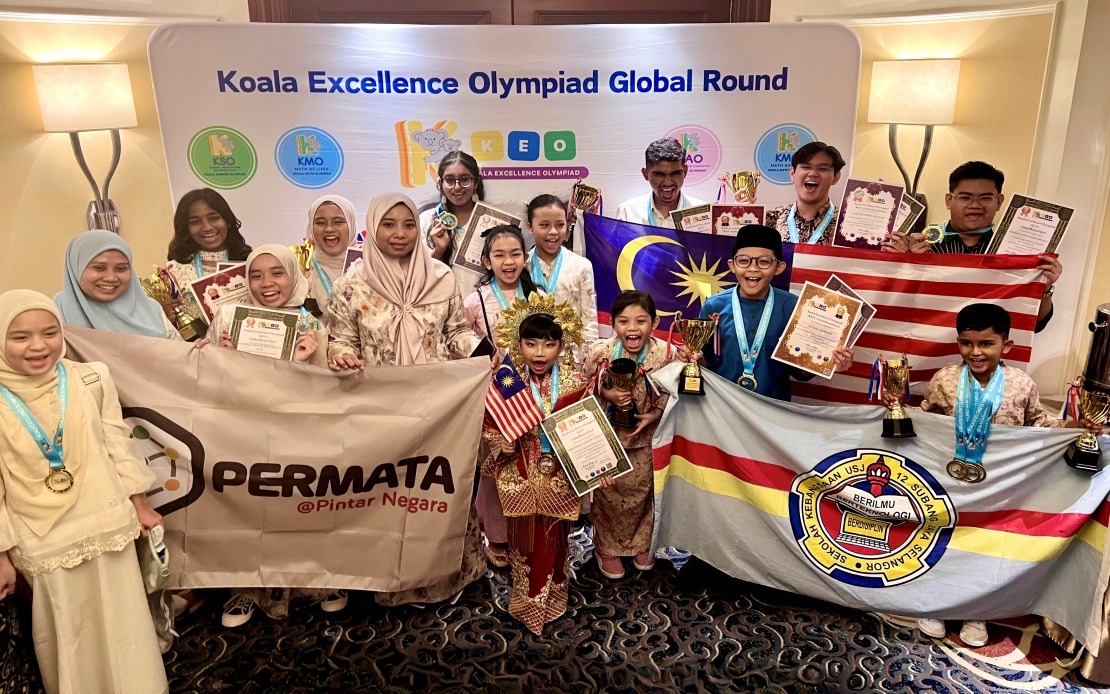
Malaysia has demonstrated its academic prowess on the international stage after a contingent of seventeen students secured nine overall awards and twenty-two medals at the Koala Excellence Olympiad 2026, a prestigious international competition that concluded recently in Macau. The achievements underscore the country's capacity to nurture young talent capable of competing with peers from across the globe, particularly in disciplines that demand critical thinking and innovative problem-solving rather than rote learning alone.
The Malaysian team brought home an impressive haul comprising five gold medals, six silver, and eleven bronze, coordinated through the Malaysian Young Scientists Organisation (MYSO). Aidah Misran, the coordinator who led the contingent to the southern Chinese territory, highlighted that the competition drew students from multiple nations to test their abilities across English, Mathematics, Science, and Arts Olympiads. This international exposure provides invaluable experience for young Malaysians, allowing them to benchmark their knowledge against competitors with different educational backgrounds and teaching methodologies.
The participating students represented a diverse cross-section of Malaysian institutions, reflecting both elite and mainstream educational pathways. Four competitors came from Kolej PERMATA@Pintar Negara at Universiti Kebangsaan Malaysia, an institution known for nurturing gifted learners, while six were drawn from Sekolah Menengah Kebangsaan Ungku Aziz. Additional representation came from Sekolah Sultan Alam Shah, which contributed two students, and Sekolah Kebangsaan Convent (2) Bukit Nanas with three participants. Single representatives participated from SMK Convent Teluk Intan, SK USJ 12, SK Seri Hartamas, and SK Convent Sentul 1, demonstrating that excellence in academics is not confined to a handful of elite schools but is distributed across the national education system.
The standout performer of the Malaysian contingent was Year Six student Mukridz Mardzuki from SK Seri Hartamas, who claimed the overall Science Olympiad championship in the primary school category. This achievement is particularly significant as it showcases that even students in the foundation years of their education can compete at world-class standards when given appropriate support and opportunity. The primary school victory suggests a pipeline of talent that can sustain Malaysia's competitive advantage in future international academic competitions.
Secondary school participants also demonstrated notable accomplishment, with two students securing runner-up positions in Science Olympiad categories. Sarah Isabel Maryam Ahmad Suhael from SK Convent (2) Bukit Nanas achieved this distinction in the primary category, while Alfie Rizq Danial Azlan from Sekolah Sultan Alam Shah secured a runner-up finish in the secondary division. These placements indicate that Malaysian secondary students possess scientific knowledge and analytical capabilities comparable to their international counterparts, a reassuring indicator for the quality of science instruction within the national curriculum.
Beyond the Science discipline, Malaysian students distinguished themselves in other domains. Ayra 'Adani Muhammad 'Aizat from Kolej PERMATA@Pintar Negara at UKM earned recognition as overall runner-up in the English Olympiad, suggesting that proficiency in English communication remains a strength within Malaysia's education system. The ability to perform at high levels in English-medium competitions carries particular relevance for Malaysian students seeking to pursue higher education or professional opportunities in English-speaking environments globally.
Additional third-place finishes rounded out the medal count and demonstrated depth across multiple disciplines. Marvyn Zef Mark Philip was particularly impressive, securing two category wins in both Science and English whilst also placing third overall, indicating versatility across different subject areas. P Prem's third-place Science finish, Muhammad Khairul Mauidz Khairul Azman's placement in Mathematics, and AK Shashini's recognition in English showcased that Malaysian talent spans across all four competition disciplines, from the sciences through the humanities.
The Koala Excellence Olympiad itself represents a carefully designed framework that diverges from traditional examination approaches that emphasise memorisation. Developed by Australian educational experts, the competition is deliberately aligned with international curriculum standards while prioritising critical thinking, creative problem-solving, and the application of knowledge to real-world scenarios. For Malaysia, participation in such competitions signals a progressive orientation towards educational assessment methods that equip students with transferable skills increasingly valued in the twenty-first-century workforce.
The competition's four-discipline structure—English, Mathematics, Science, and Arts—reflects a holistic conception of academic excellence that recognises different forms of intellectual capability. Malaysian students' success across all four areas indicates that the national education system is producing well-rounded learners rather than narrow specialists, an asset as economies worldwide demand graduates with broad knowledge and adaptable competencies. The inclusion of Arts alongside traditional STEM subjects further demonstrates the competition's commitment to recognising diverse forms of intelligence and creativity.
For Malaysian parents and educators, these results offer validation that national schools and curriculum approaches can compete internationally. The representation from neighbourhood schools such as SK Seri Hartamas and SK Convent branches, not merely elite institutions, suggests that high achievement is achievable across different school environments. This distribution of success may encourage expanded investment in academic enrichment programmes at the community and grassroots levels, potentially widening the talent pipeline from which future Malaysian Olympiad participants emerge.
The MYSO's coordination of this international participation represents an important bridge-building function between Malaysia's education system and global competitions. Organisations that identify and prepare students for such events perform critical roles in fostering academic excellence and international competitiveness. Expanded support for such initiatives could position Malaysia as a regular contender in international academic competitions, enhancing the country's soft power and educational reputation regionally.
Looking forward, the Koala Excellence Olympiad results suggest that Malaysia possesses abundant academic talent capable of competing at the highest international levels. The challenge ahead involves ensuring that such opportunities remain accessible to talented students regardless of their economic background or school type, and that the skills developed through Olympiad participation translate into contributions to Malaysia's economic and social development. As the country seeks to position itself as a knowledge economy, nurturing and showcasing young talent through international platforms becomes increasingly strategic.

