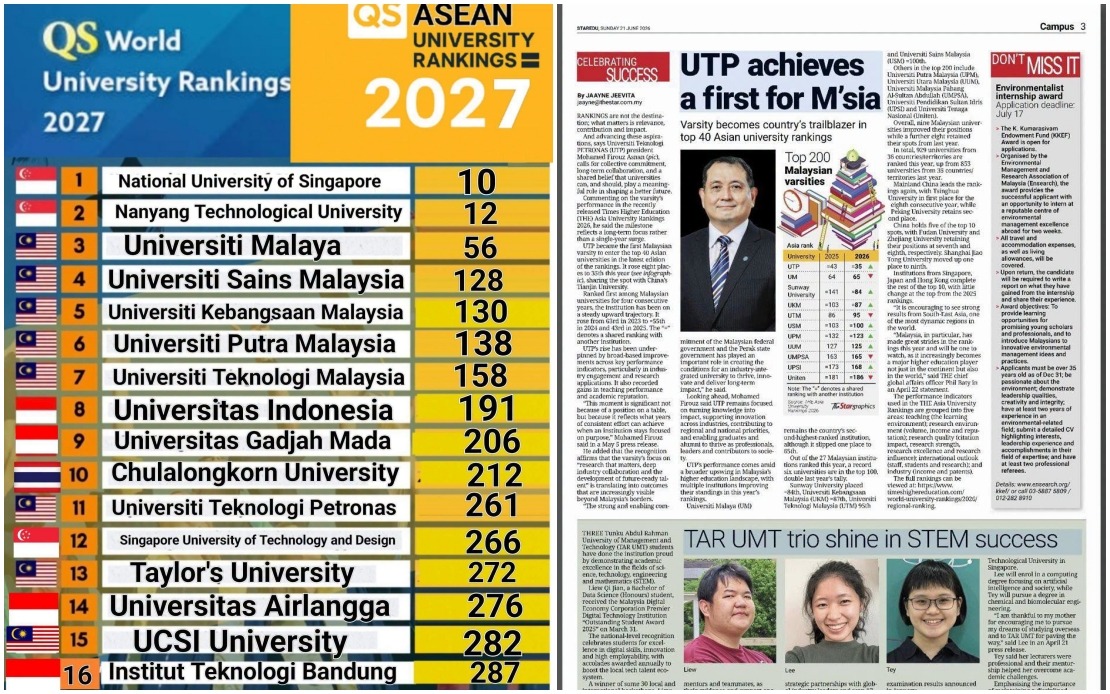
Malaysia's higher education landscape is gaining increasing recognition on the international stage, with the country's universities posting strong performances in the latest global rankings that underscore the nation's emergence as a competitive education hub in the Asia-Pacific region. The results highlight the strategic investments and institutional efforts that have positioned Malaysian universities as viable alternatives to established institutions in the developed world, particularly for students seeking quality education closer to home.
Higher Education Minister Datuk Seri Dr Zambry Abd Kadir has framed these achievements as validation of Malaysia's broader ambitions to become a globally recognized center for academic excellence and research innovation. While emphasizing that international rankings should not be treated as the singular measure of institutional success, he acknowledged their value as benchmarks for assessing quality, reputation, and competitive standing within the demanding international education marketplace. This nuanced perspective reflects a maturation in how policymakers view tertiary education outcomes—recognizing that rankings serve as meaningful signals to international students, scholars, and research partners while understanding that academic excellence encompasses dimensions beyond numerical placement.
The minister's commentary points to a collaborative ecosystem that has driven improvements across the sector. Success at Malaysian universities, he stressed, stems from sustained contributions by academic staff, research teams, student populations, alumni networks, and industry collaborators who have collectively prioritized quality enhancement and knowledge advancement. This systemic approach contrasts with institution-by-institution competition and instead emphasizes that lifting the overall quality of the national higher education system benefits the country's international reputation as a whole. For Malaysian policymakers, this framing suggests an understanding that human capital development and research capacity are linked to broader economic competitiveness.
Universiti Teknologi Petronas has achieved a milestone that carries symbolic weight for the sector. The institution's ascent to 35th position in the Times Higher Education (THE) Asia University Rankings 2026—climbing from 43rd the previous year—marks the first time a Malaysian university has broken into the continental top 40. This breakthrough suggests that Malaysian institutions are not merely maintaining international standing but advancing through meaningful quality improvements. For a petrochemical-focused engineering university to achieve this ranking reflects strong research output and likely substantial industry collaboration, positioning specialized institutions as potential engines of national competitiveness.
The breadth of Malaysia's ranking achievements underscores systemic health within the sector. Twenty-seven Malaysian institutions secured places in this year's comprehensive rankings, demonstrating that quality is not concentrated in a handful of flagship universities but distributed across the higher education ecosystem. More significantly, six Malaysian universities now rank within Asia's top 100, while eleven institutions occupy positions in the top 200. These numbers suggest that Malaysian higher education has moved beyond a single-institution success story to build a diversified portfolio of capable institutions serving different educational missions and regional markets.
The institutions honored by the minister's recognition represent both longstanding research-intensive universities and more recently established institutions. Universiti Malaya continues its traditional leadership role, while Sunway University demonstrates that private institutions can achieve international recognition. Public universities including Universiti Kebangsaan Malaysia, Universiti Teknologi Malaysia, Universiti Sains Malaysia, and Universiti Putra Malaysia maintain competitive standings, indicating that Malaysia's public higher education investment has generated measurable returns. Younger institutions such as Universiti Malaysia Pahang Al-Sultan Abdullah and Universiti Pendidikan Sultan Idris feature in rankings, suggesting upward mobility across the generational spectrum of Malaysian universities.
For Southeast Asian context, Malaysia's ranking achievements carry particular relevance. The region's higher education systems compete for international reputation and student recruitment, with rankings increasingly influencing international student mobility patterns and academic partnerships. Malaysia's rising performance may enhance the country's ability to attract talent from across ASEAN and beyond, potentially strengthening both research networks and revenue streams through international student enrollment. This is especially significant given regional competitors' own ranking advances and the growing emphasis on tertiary education as an export service within ASEAN economies.
The ranking improvements also reflect strategic positioning within global knowledge networks. Malaysian universities that achieve international recognition gain better access to collaborative research partnerships, international funding opportunities, and scholar recruitment. These dynamics matter for long-term capacity building because sustained competitiveness requires ability to attract and retain research talent. Malaysian institutions' rising rankings may therefore signal emerging capability to participate more equally in cross-border research initiatives that increasingly characterize academic work in engineering, life sciences, and technology domains critical to regional development.
The minister's call for this excellence momentum to continue addresses a practical challenge: maintaining competitive standing requires sustained investment and institutional excellence rather than one-time achievements. Higher education rankings are dynamic, with institutions constantly competing for improved positions. Malaysia's performance gains require ongoing commitment to research support, faculty development, infrastructure investment, and internationalization strategies. For policymakers, this underscores that short-term funding cuts or policy inconsistencies could reverse recent gains and damage the country's emerging reputation for quality.
Moreover, rankings achievements carry implications for Malaysia's talent retention and national development. When Malaysian universities gain international recognition, they become more attractive to high-performing students who might otherwise pursue degrees abroad, potentially retaining human capital within the national system. Similarly, improved institutional rankings can support efforts to attract diaspora scholars back to contribute to research and teaching. For a country facing middle-income challenges and seeking to move toward innovation-based economic development, maintaining and growing university quality directly connects to long-term economic strategy and competitiveness in higher-value sectors.
The recognition extended to both established and emerging institutions reflects understanding that Malaysia's education hub ambitions require a layered approach. Research-intensive universities drive innovation and advanced knowledge production, while specialized and regional institutions serve broader access and workforce development missions. This ecosystem approach, when functioning well, creates multiple pathways for students and supports diversified economic needs across sectors and regions. The ranking improvements suggest that this differentiated institutional strategy may be gaining traction and international recognition.
Looking forward, sustaining this momentum requires attention to underlying drivers of ranking improvements. International recognition typically reflects strong research productivity, citations indicating scholarly influence, international faculty recruitment, diverse student populations, and institutional reputation built over time. Malaysian universities must continue investing in these foundations while resisting the temptation to pursue rankings as ends in themselves. The balance between rankings-driven institutional strategy and genuine quality development remains the strategic challenge facing Malaysia's higher education leadership as the sector seeks to consolidate gains and build toward the country's broader aspirations as a regional knowledge center.
%22%2F%3E%3C%2Fpattern%3E%3C%2Fdefs%3E%3Crect%20width%3D%22100%25%22%20height%3D%22100%25%22%20fill%3D%22url(%23ph24037g)%22%2F%3E%3Crect%20width%3D%22100%25%22%20height%3D%22100%25%22%20fill%3D%22url(%23ph24037p)%22%2F%3E%3Ctext%20x%3D%2250%25%22%20y%3D%2250%25%22%20text-anchor%3D%22middle%22%20dominant-baseline%3D%22central%22%20fill%3D%22rgba(255%2C255%2C255%2C0.95)%22%20font-family%3D%22Georgia%2C%20'Times%20New%20Roman'%2C%20serif%22%20font-weight%3D%22700%22%20font-size%3D%22320%22%20letter-spacing%3D%22-0.02em%22%3EIran%3C%2Ftext%3E%3C%2Fsvg%3E)
%22%2F%3E%3C%2Fpattern%3E%3C%2Fdefs%3E%3Crect%20width%3D%22100%25%22%20height%3D%22100%25%22%20fill%3D%22url(%23ph1r7fsg)%22%2F%3E%3Crect%20width%3D%22100%25%22%20height%3D%22100%25%22%20fill%3D%22url(%23ph1r7fsp)%22%2F%3E%3Ctext%20x%3D%2250%25%22%20y%3D%2250%25%22%20text-anchor%3D%22middle%22%20dominant-baseline%3D%22central%22%20fill%3D%22rgba(255%2C255%2C255%2C0.95)%22%20font-family%3D%22Georgia%2C%20'Times%20New%20Roman'%2C%20serif%22%20font-weight%3D%22700%22%20font-size%3D%22320%22%20letter-spacing%3D%22-0.02em%22%3EIran%3C%2Ftext%3E%3C%2Fsvg%3E)