The government has unveiled an ambitious slate of 16 side programmes to amplify the 2026 National Day and Malaysia Day (HKHM) celebrations, signalling a strategic shift toward broader, community-centred observances that extend well beyond the capital. Harun Ali, secretary of the Communications Ministry's Management Services Division, outlined the expanded initiative during a radio interview, emphasising the administration's determination to make these commemorations accessible and meaningful for Malaysians across all demographic and geographic boundaries.
The expanded festival calendar encompasses a diverse range of activities tailored to engage different segments of the population. Among the headline programmes are Kembara Merdeka Jalur Gemilang, which will traverse the nation promoting the national flag, the National Month Decoration Competition encouraging community beautification efforts, Ekspresi Merdeka showcasing artistic expression, and the Kita MADANI Carnival integrating entertainment with civic messaging. These initiatives, alongside numerous localised cultural and community-based activities, represent a deliberate attempt to decentralise the celebrations and foster grassroots participation rather than concentrating ceremonial focus in a single location.
A notable departure from previous years involves relocating the primary Merdeka Eve Celebration from Putrajaya to the historically significant Stadium Merdeka in Kuala Lumpur. This decision carries symbolic weight, anchoring the festivities to the venue where Malaysia's independence movement achieved its defining moments. The stadium's historical resonance provides a powerful backdrop for connecting contemporary Malaysians with their nation's foundational narrative, potentially deepening the emotional and patriotic dimensions of the observance.
Prime Minister Datuk Seri Anwar Ibrahim will deliver a specially crafted Merdeka Address at Stadium Merdeka as the nation transitions into the celebration at midnight. This ceremonial speech carries particular significance given the government's ongoing emphasis on national unity and collective purpose. By positioning the Prime Minister's address at this juncture—when the clock strikes the moment of independence commemoration—the programme designers have sought to create a unifying focal point that broadcasts simultaneously the symbolic transfer of authority and collective national resolve to Malaysians watching nationally.
Among the creative innovations for 2026 stands "Melukis Senja," an aerial spectacle featuring aerobatic displays by Aero 3 over Putrajaya's skyline. The aerobatic team will execute precision manoeuvres generating distinctive smoke trails while coordinating with fireworks displays, creating a visually striking panorama intended to capture popular imagination and generate memorable imagery for broadcast and social media dissemination. This investment in innovative visual presentation reflects growing recognition that contemporary celebrations must compete for attention in an increasingly crowded media and entertainment landscape.
Harun's remarks emphasised the underlying philosophy animating these expanded celebrations: ensuring that independence commemorations resonate with and remain accessible to all Malaysians regardless of background, location, or socioeconomic status. The government's positioning of these programmes as expressions of nationwide appreciation for independence suggests an attempt to counterbalance any perception that national celebration rituals may be concentrated among elite or urban populations. By distributing programmes across communities and incorporating diverse cultural expressions, the initiative acknowledges Malaysia's multicultural composition and seeks to accommodate varied forms of patriotic expression.
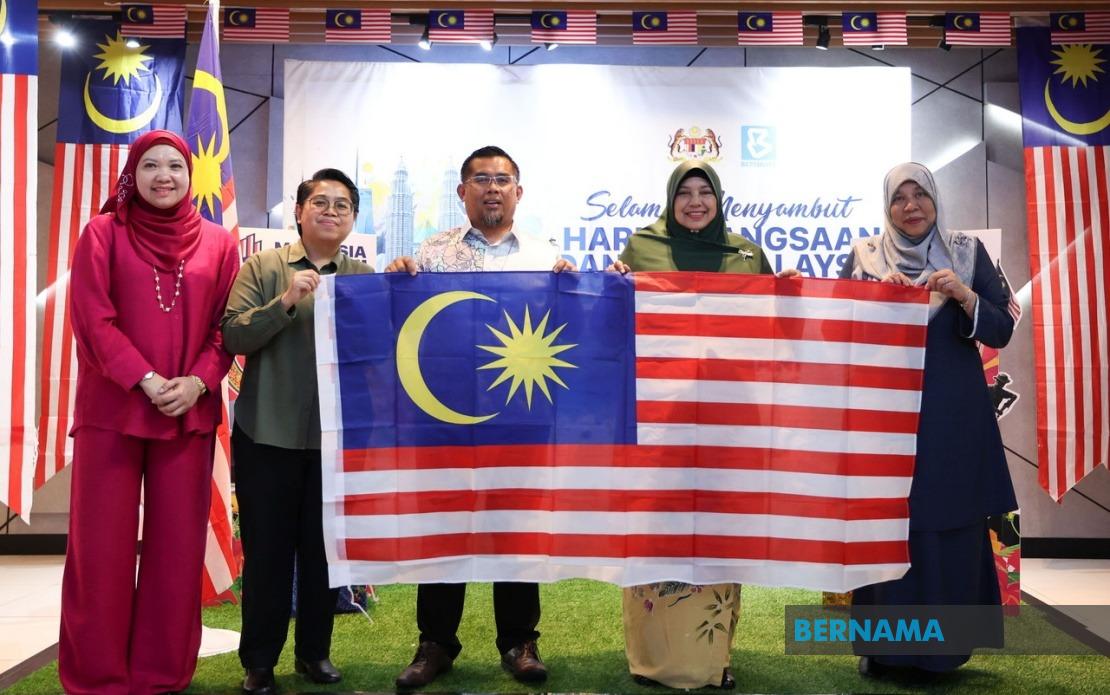
The flag distribution campaign constitutes a recurring symbolic element, with Harun calling on all Malaysians to display the Jalur Gemilang as a tangible manifestation of national pride and gratitude for their place within the Malaysian community. The handing over of flags to staff at the Malaysian National News Agency (Bernama) during an official ceremony underscores the government's mobilisation of institutional networks to amplify the campaign's reach. This grassroots flag proliferation strategy, when multiplied across numerous government agencies and participating organisations, creates a visual transformation of the public sphere during celebration months.
Harun's invocation of independence's historical cost—emphasising that Malaysia's freedom was neither inexpensively purchased nor effortlessly secured—provides important context for understanding the government's investments in celebration infrastructure. By reminding contemporary Malaysians of the sacrifices embedded within the nation's founding, the government seeks to cultivate renewed appreciation and counter what officials may perceive as complacency regarding independence among younger generations. This intergenerational transmission of patriotic consciousness represents an implicit objective underlying the expanded programme portfolio.
For Southeast Asian observers, Malaysia's approach to national commemorations offers instructive insights into how regional governments balance tradition with modernity, centralisation with decentralisation, and official messaging with popular participation. The 2026 celebration framework demonstrates increasing sophistication in utilising cultural programming, technological spectacle, and symbolic geography to reinforce national narratives. The expansion from concentrated ceremonial observances to distributed, community-based celebrations reflects broader trends across the region toward democratising public ritual and encouraging wider civic engagement.
The practical implications for ordinary Malaysians involve numerous opportunities for direct participation in nationally organised activities throughout the celebration period. Citizens in provincial areas will gain access to signature events previously confined to the capital, while urban residents benefit from expanded entertainment and cultural offerings. This geographic distribution strategy potentially addresses longstanding critiques that national celebrations have disproportionately benefited populations near Kuala Lumpur and Putrajaya.
Further details regarding the comprehensive programme schedule remain available through the official HKHM 2026 website, enabling Malaysians to plan participation according to their interests and circumstances. The government's commitment to information accessibility suggests recognition that effective civic engagement requires transparent communication regarding programme timing, locations, and participation requirements. As the 2026 celebrations approach, the Communications Ministry's multifaceted initiative will test whether diversified, community-embedded programming can generate levels of national engagement comparable to or exceeding those produced by more concentrated, ceremonial approaches to independence commemoration.

