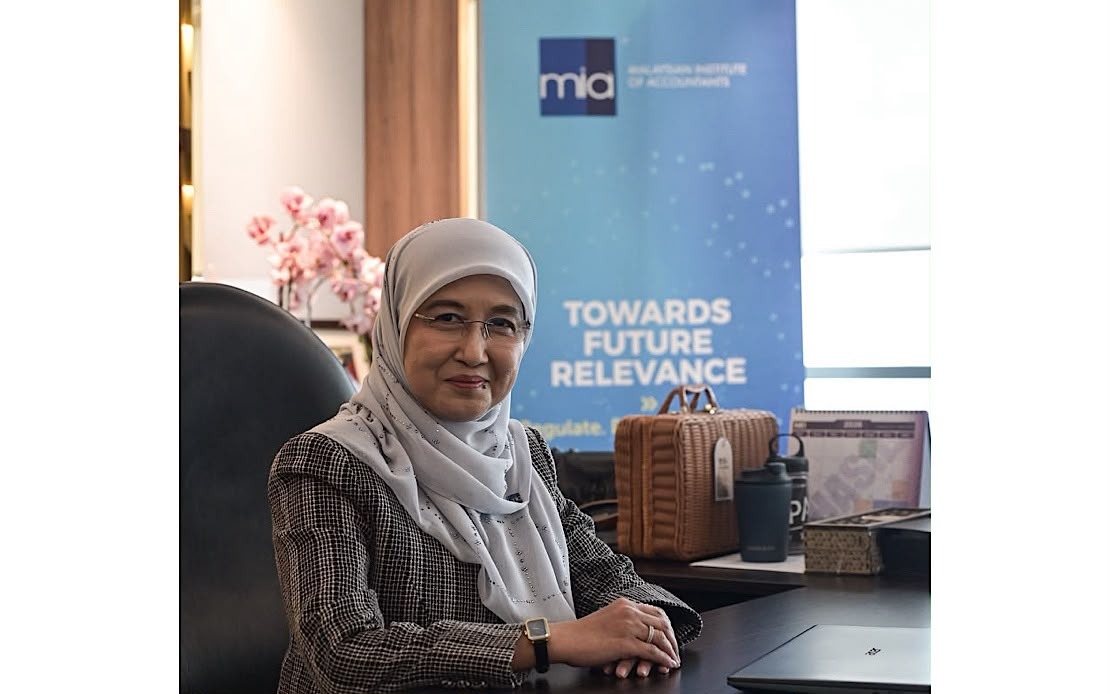
The Malaysian Institute of Accountants (MIA) has called for the country's accountancy profession to undergo fundamental evolution, positioning itself as both technologically advanced and deeply rooted in ethical principles to strengthen Malaysia's standing as a competitive global financial hub. Speaking in Kuala Lumpur on August 10, MIA president Datuk Saniza Said stressed that accountancy professionals face an imperative to adapt their roles and capabilities in response to accelerating technological change and intensifying corporate sustainability expectations. The challenge, according to the institute's leadership, involves maintaining the traditional pillars of trust, integrity and accountability that define the profession while simultaneously embracing innovation and expanding into strategic advisory domains.
Saniza, who made history as MIA's first woman president upon her election on December 8, 2025, articulated a vision of accountants functioning beyond conventional financial record-keeping. Contemporary accounting professionals, she explained, increasingly shoulder responsibility for guiding business strategy, facilitating critical decision-making processes and protecting the interests of multiple stakeholders. This expanded remit demands not only technical competence but also the exercise of sound professional judgment grounded in ethical reasoning. The institute's president emphasised that building public confidence in the profession represents a foundational objective, achievable only through consistent demonstration of transparency, accountability and unwavering commitment to the public interest.
The technological disruption reshaping the accounting landscape presents both opportunity and risk. While some industry observers voice concerns about automation displacing accounting professionals, MIA's leadership rejects this framing as overly simplistic. Saniza acknowledged that technological transformation cannot be circumvented, and practitioners who resist upskilling will inevitably face marginalisation. Artificial intelligence and automation will progressively assume responsibility for routine bookkeeping operations and data entry tasks. However, this development does not diminish but rather amplifies the strategic value of human accountants, whose judgment, critical thinking and ethical accountability remain irreplaceable when organisations confront complex business decisions, regulatory compliance challenges and stakeholder assurance requirements.
MIA chief executive officer G. Shanmugam expanded on this perspective, characterising the profession as approaching a transformative inflection point driven by artificial intelligence, sophisticated data analytics, automation technologies and emerging digital innovations. As computational systems assume ownership of repetitive procedural tasks, accountants will progressively redirect their professional capacity towards higher-order functions including advanced data interpretation, formulation of business strategy, identification and mitigation of enterprise risk, and delivery of sophisticated advisory services. This transition fundamentally reshapes the profession's value proposition, positioning accountants as trusted strategic partners rather than administrators of financial records.
Shanmugam highlighted that contemporary business leadership increasingly expects accountants to transcend traditional reporting functions and assume advisory roles grounded in deep understanding of organisational strategy, competitive dynamics and performance metrics. Executives and investors increasingly solicit guidance extending beyond historical financial data, seeking instead forward-looking intelligence regarding future scenarios, emerging challenges and strategic opportunities. This requires accountants to cultivate what Shanmugam termed "foresight capabilities"—sophisticated capacity to anticipate market trends, organisational risks and competitive disruptions. The transition demands development of specialised competencies including data analytics, predictive modelling and trend identification, enabling professionals to support organisations in navigating uncertainty and positioning themselves advantageously in evolving market conditions.
Sustainability considerations represent a particularly significant dimension of this professional evolution. The recent introduction of MIA's Sustainability Blueprint for the Accountancy Profession and the Sustainability Roadmap initiative reflects recognition that environmental, social and governance factors increasingly influence investor decision-making, regulatory oversight and organisational strategy. Accountants will play expanding roles in supporting organisations' sustainability reporting obligations and potentially providing independent verification of sustainability-related disclosures as regulatory frameworks mature and stakeholder demand intensifies. Development of these competencies through structured professional development pathways will equip practitioners with requisite expertise to navigate this emerging domain.
The institute currently serves approximately 42,000 members, with membership expanding at an annual rate between 1.5 and 2.0 per cent. To support ongoing professional development, MIA administers roughly 1,000 Continuing Professional Development programmes annually, complemented by specialised conferences, digital learning platforms and professional networking initiatives. This institutional commitment to member development reflects recognition that sustained relevance in an era of rapid technological change demands continuous learning and deliberate skill enhancement. The strategic focus on upskilling ensures that practitioners maintain currency with evolving professional standards, emerging technologies and shifting business expectations.
Counterintuitively, the acceleration of automation and artificial intelligence may enhance the profession's appeal to younger talent entering the field. By automating mundane and repetitive administrative functions, technological advancement creates opportunity for recent graduates to advance more rapidly into analytical, managerial and strategic positions. The nature of accounting work itself becomes increasingly intellectually engaging and dynamic as routine tasks migrate to computational systems. Rather than representing a threat to employment prospects, technological transformation potentially makes accounting careers more attractive by enabling professionals to engage with complex problems requiring sophisticated judgment and creative problem-solving rather than routine procedural execution.
Malaysia's position as a trusted regional financial centre depends substantially on the integrity, competence and strategic capacity of its accountancy profession. International investors allocating capital to Malaysian enterprises depend on accountants to provide independent, credible assurance regarding financial disclosures and organisational governance. As financial misconduct becomes increasingly sophisticated and scams more elaborate, the assurance function assumes heightened importance. A profession that successfully combines technological sophistication with uncompromising ethical standards and robust professional judgment will strengthen investor confidence and reinforce Malaysia's reputation as a jurisdiction where financial integrity is taken seriously.
The MIA leadership's strategic vision represents a nuanced understanding of technological change that rejects both naive technophobia and uncritical techno-utopianism. Rather than perceiving artificial intelligence as a threat requiring defensive resistance, this perspective recognises that thoughtful integration of advanced technologies will liberate accountants from repetitive labour, creating space for the high-value professional judgment and strategic insight that organisations increasingly require. This reframing positions the profession not as vulnerable to disruption but as poised to evolve into a more strategically significant and intellectually rewarding domain. Success in executing this transition depends on the profession's commitment to continuous learning, ethical practice and deliberate cultivation of the foresight capabilities that will define accounting excellence in forthcoming decades.

