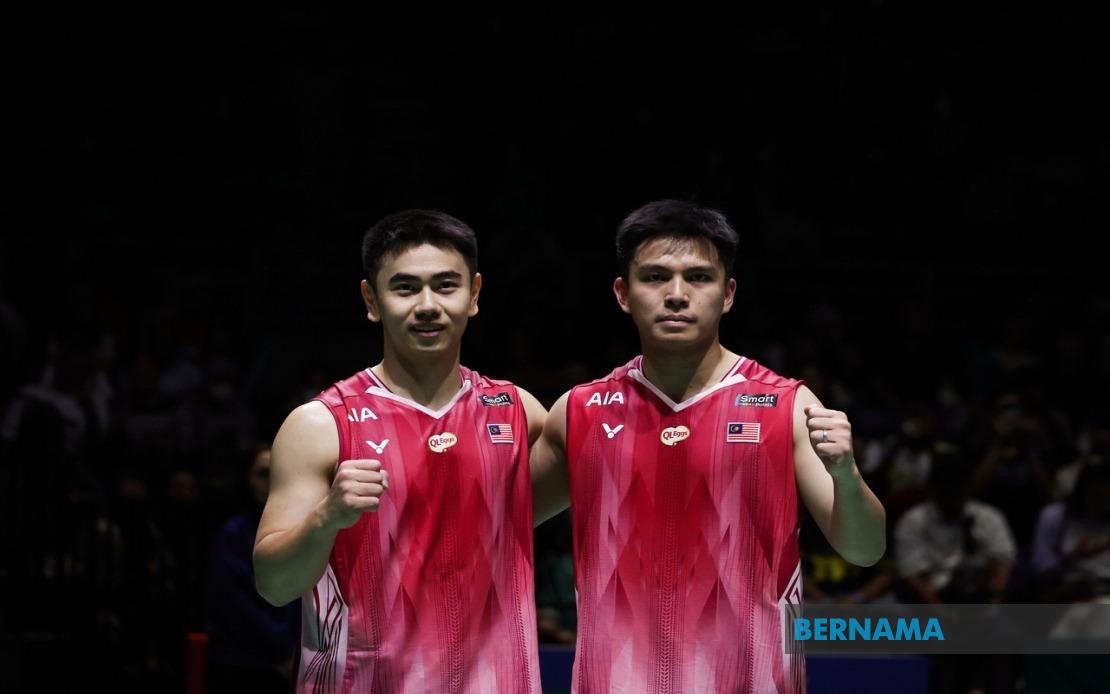
Malaysia's badminton contingent at the Japan Open 2026 has secured a significant presence in the tournament's final stages, with two pairs advancing to the semifinals in Tokyo. The mixed doubles combination of Jimmy Wong-Cheng Su Yin and the men's doubles team of Goh Sze Fei-Nur Izzuddin Rumsani both secured quarterfinal victories, maintaining Malaysian competitiveness in one of Asia's premier badminton competitions.
The most striking result came from the unseeded Jimmy-Su Yin pairing, who delivered an outstanding performance to eliminate Denmark's third-seeded Mathias Christiansen-Alexandra Boje. The Malaysian mixed doubles specialists demonstrated composure and tactical acumen throughout the contest, dispatching their higher-ranked opponents with identical set scores of 21-17, 21-17 in just 39 minutes. This victory proved particularly significant as it allowed the Malaysians to level their head-to-head record against the Danish pair at 1-1, erasing the memory of a previous defeat and establishing themselves as genuine threats in the mixed doubles category.
The triumph by Jimmy-Su Yin represents the kind of upset that elevates Malaysia's profile in international badminton. Mixed doubles has become an increasingly competitive discipline across Asia, with Chinese, Indonesian, and Thai pairs dominating rankings in recent seasons. Malaysia's ability to overcome a seeded European combination demonstrates that local players possess the technical skills and strategic intelligence required to compete at the highest levels. The 39-minute duration also suggests efficiency in execution, with the Malaysians controlling rallies and minimizing extended baseline exchanges that could have favoured their more experienced opponents.
Their semifinal assignment presents a fresh challenge, as they now face Hong Kong's seventh-seeded Tang Chun Man-Tse Ying Suet in an unprecedented matchup. Neither pair has faced the other previously, introducing an element of unpredictability into what could prove an entertaining encounter. Hong Kong's pairing represents different stylistic characteristics compared to the Danish combination, potentially requiring tactical adjustments from the Malaysian duo.
In the men's doubles draw, Goh Sze Fei-Nur Izzuddin advanced through a more grueling quarterfinal encounter against the United States' Chen Zhi Yi-Presley Smith. The Malaysian fifth seeds required the full distance to secure their passage, ultimately prevailing 21-18, 15-21, 21-13 after a demanding 50-minute affair. This victory extended their recent dominance over the American pairing to four consecutive wins, suggesting an improved understanding of how to dismantle their opponents' game plans across different match situations.
The capacity of Sze Fei-Izzuddin to recover from losing the second set against a determined American challenge speaks to their mental fortitude and technical versatility. The reversal of momentum in the third set, where they posted a commanding 21-13 result, indicates that the Malaysians identified critical weaknesses to exploit once the match entered its decisive phase. Against American players known for their attacking prowess and court coverage, grinding out a comeback victory on what is likely a faster court surface in Tokyo demonstrates significant progress in their development as a pairing.
However, the road to a Japan Open final has become considerably steeper for the Malaysian men's doubles team. They now confront South Korea's top-seeded Kim Won Ho-Seo Seung Jae, one of the world's most accomplished pairs currently competing. The head-to-head record between these partnerships stands perfectly balanced at 2-2, yet recent momentum favours the Malaysians, who recorded a significant victory over the Korean champions at the Indonesia Open 2026. That triumph in a neighbouring country provides psychological advantage and evidence that the Malaysian pairing possesses tactical knowledge and execution capabilities to trouble world number one players.
The Korea-Malaysia men's doubles semifinal will likely emerge as the most compelling clash in the final four, given the competitive balance between the pairs and their relatively recent encounters. Kim Won Ho-Seo Seung Jae have demonstrated the consistency required to reach the top ranking, combining explosive attacking capability with shrewd defensive transitions. For Sze Fei-Izzuddin to advance, they would need to replicate their Indonesia Open formula, likely emphasizing precision in net play and avoiding unnecessary long baseline exchanges that could favour the more experienced Korean combination.
The early exits of other Malaysian pairs underscore the depth of competition at this tournament. Kang Khai Xing-Aaron Tai fell to the aforementioned Korean top seeds in straight sets, losing 21-13, 21-10, a result suggesting that the Koreans were operating at near-optimal efficiency. This loss indicates that Malaysia's badminton strength currently concentrates within specific partnerships rather than being distributed across multiple competitive men's doubles teams.
The presence of two Malaysian pairs in the semifinals represents solid tournament performance, though it falls short of the deeper penetration Malaysia achieved in previous decades when the nation regularly boasted three or more semifinalists at major international tournaments. The mixed doubles success through Jimmy-Su Yin suggests that Malaysia maintains competitiveness across multiple disciplines, preventing over-reliance on any single category.
Looking toward the semifinals, Malaysian badminton enthusiasts will monitor both pairings closely. The Jimmy-Su Yin team must maintain consistency and tactical discipline against an unfamiliar opponent, while Sze Fei-Izzuddin will attempt to convert their recent head-to-head advantage into a final-reaching performance against the world's premier men's doubles pairing. Success in either contest would enhance Malaysia's standing within the Asian badminton hierarchy and provide momentum heading into the closing stages of the 2026 international season.

