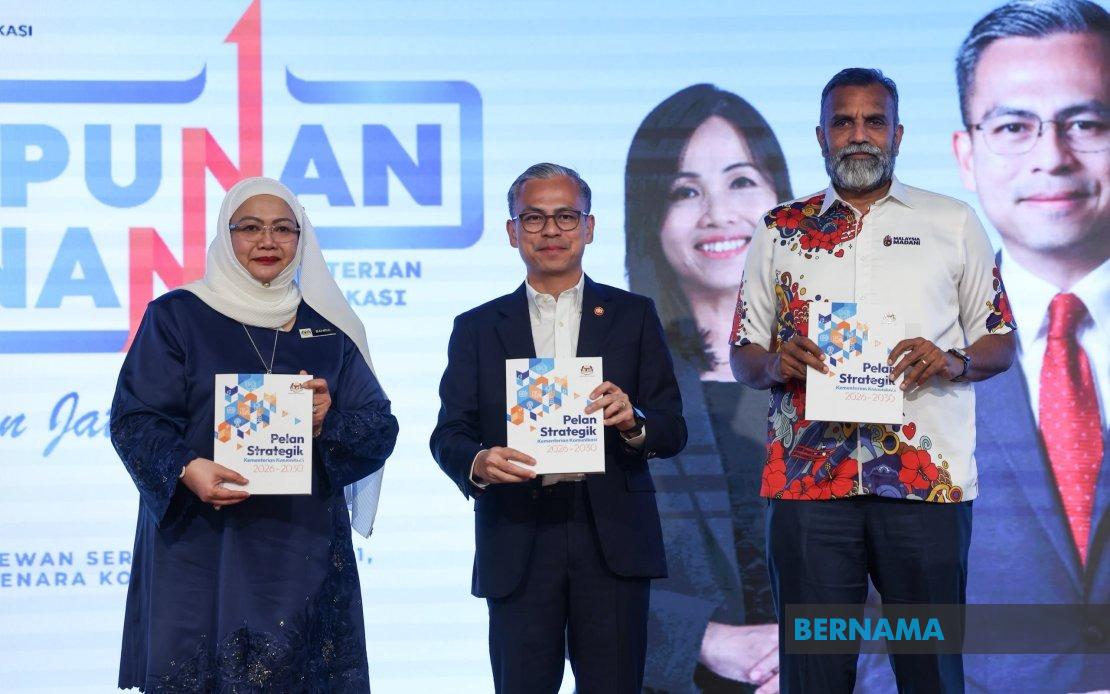
Malaysia's Communications Ministry has unveiled an ambitious five-year strategic blueprint designed to reshape the nation's digital landscape and align communications policy with the government's broader Malaysia MADANI development agenda. Minister Datuk Seri Fahmi Fadzil unveiled the Communications Ministry Strategic Plan (PSKK) 2026-2030 at the ministry's monthly gathering in Putrajaya on July 20, establishing a comprehensive framework that will guide departmental priorities and programmes through 2030 while supporting objectives outlined in the 13th Malaysia Plan.
The strategic plan addresses what Fahmi identified as the ministry's most pressing mandate: delivering superior internet infrastructure, expanding locally-produced creative content, and ensuring citizens receive trustworthy and balanced information. These three cornerstones reflect acknowledged public concerns that the ministry has consistently faced from constituents, industry stakeholders, and civil society organizations seeking improvements in connectivity, media diversity, and information reliability across the nation.
Under the overarching vision of creating 'A Connected, Informed and Creative Malaysia', the ministry has structured its approach around three complementary missions that collectively address infrastructure, information ecosystems, and cultural industries. The first mission emphasizes reinforcing Malaysia's communications infrastructure alongside developing robust regulatory mechanisms that can adapt to rapidly evolving technological landscapes. The second recognizes that information integrity remains fundamental to social cohesion and good governance, requiring deliberate efforts to distribute accurate, representative information across diverse Malaysian communities. The third targets acceleration of the creative sector—film, music, and related industries—positioning these as competitive economic drivers in the digital economy.
To operationalize these missions, planners identified four strategic thrusts that translate broad objectives into actionable departmental priorities. The foundational thrust concentrates on modernizing Malaysia's communications ecosystem, ensuring that connectivity reaches underserved communities while maintaining security standards befitting a digital economy. Officials recognize that digital inclusion remains incomplete across rural regions and lower-income urban areas, necessitating deliberate infrastructure expansion and affordability measures. The second thrust specifically targets film and music sector competitiveness, reflecting government recognition that Southeast Asia's creative industries represent significant export potential and employment generation opportunities that currently remain underdeveloped compared to Thailand, Vietnam, and Indonesia.
The third strategic thrust involves transforming how government and private entities deliver information to the public, moving toward integrated platforms that citizens can access seamlessly across devices and regions. This recognizes that fragmented information delivery through separate ministry channels, broadcast systems, and digital platforms creates confusion and reduces effectiveness. The fourth thrust signals a fundamental shift toward customer-centric government service delivery, moving away from bureaucratic convenience toward responsiveness to actual public needs and expectations. This reflects broader public sector reform principles increasingly adopted across Malaysia's government apparatus.
The strategic plan encompasses 94 specific programmes distributed across these thrusts, providing concrete implementation pathways rather than abstract policy statements. By articulating discrete, measurable programmes rather than vague aspirations, the ministry creates accountability mechanisms and enables stakeholders to assess progress. Malaysian observers have noted that previous strategic plans sometimes lacked specificity, making it difficult for the public or opposition parliamentarians to evaluate whether ministries actually achieved stated objectives.
The timing of this strategic plan reflects Malaysia's positioning within broader regional digital development competition. Thailand, Vietnam, and Indonesia have accelerated digital transformation initiatives, establishing 5G networks, expanding broadband access, and supporting creative industry development. Malaysia's strategic framework positions the nation to maintain competitive advantage while addressing domestic digital divides. The emphasis on authentic information reflects broader Southeast Asian concerns about misinformation, particularly following regional experiences with false health claims and politically-motivated disinformation campaigns that undermined public trust.
Creative industry development carries particular significance for Malaysian economic diversification. As traditional resource-based sectors face commodity price volatility, governments across Southeast Asia increasingly recognize that music, film, gaming, animation, and design sectors offer sustainable, high-value employment and export revenue. By establishing dedicated strategic focus on these industries, Malaysia signals commitment to competing effectively against regional neighbours already investing substantially in creative economy development. Government support through regulatory clarity, training investment, and international market access could substantially enhance Malaysian creative sector output.
The emphasis on information trustworthiness addresses contemporary governance challenges that extend beyond Malaysia. Public confidence in institutional communications has declined across developed and developing democracies, partly reflecting rapid media fragmentation and algorithmic content distribution systems that amplify sensational narratives. By explicitly prioritizing authentic, inclusive information dissemination, the ministry acknowledges that information policy constitutes essential infrastructure for functioning democracy, comparable to roads or electricity grids.
Implementation of this strategic plan will require coordination across multiple government agencies and private sector entities falling under communications ministry purview. The ministry oversees broadcasting regulators, telecommunications bodies, postal services, and government information agencies—entities with sometimes divergent interests and capabilities. Fahmi's statement that programmes are already being implemented in accordance with the plan suggests the ministry is not starting from zero but rather consolidating and accelerating existing initiatives within a unified strategic framework.
Malaysian stakeholders monitoring government digital policy should recognize this plan as signal of communications ministry intent, though actual outcomes will depend on budget allocation, political leadership continuity, and effectiveness of inter-agency coordination. The strategic plan's success ultimately depends on whether the ministry can translate rhetorical commitment into resourced programmes that demonstrably expand digital access, enhance information credibility, and nurture competitive creative industries capable of competing in Southeast Asia's increasingly dynamic media landscape.

