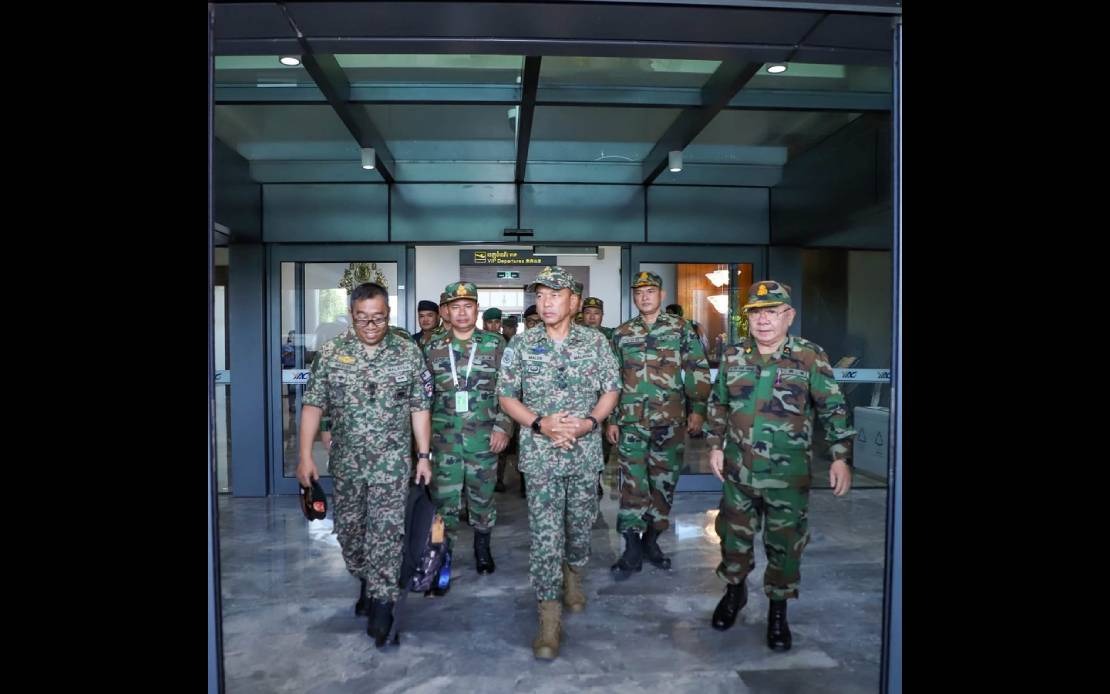
Malaysia's Chief of Defence Force Gen Tan Sri Malek Razak Sulaiman has undertaken a high-level visit to Cambodia's northwestern border region, underscoring Kuala Lumpur's commitment to maintaining stability in Southeast Asia's most sensitive frontier zones. During the visit to Banteay Meanchey province, the Malaysian defence chief received briefings from the ASEAN Observer Team stationed there, gaining direct insights into the current security posture along the Cambodia-Thailand border. The inspection reflects Malaysia's broader engagement with regional peace-building efforts and its role in supporting ASEAN mechanisms designed to prevent conflict escalation among member nations.
The timing of Malek Razak's tour carries significance given the persistent tensions that have characterised the Cambodia-Thailand frontier. The AOT was established in response to serious military confrontations that erupted on July 24, 2025, stemming from longstanding border disputes between Phnom Penh and Bangkok. These clashes prompted ASEAN to deploy the observer mission, tasked with monitoring adherence to ceasefire arrangements and preventing a recurrence of direct military engagement. Malaysia's decision to conduct a direct assessment at this juncture suggests Kuala Lumpur views the situation as important enough to warrant high-level attention from the nation's top uniformed officer.
The ASEAN Observer Team represents one of the bloc's most tangible mechanisms for crisis management on its territory. Currently led by the Philippines, which holds the ASEAN chair, the mission operates as a confidence-building measure that allows member states to cooperate in reducing the risk of accidental escalation or miscalculation. The team's presence on the ground provides real-time monitoring and serves as a channel for dialogue between the feuding parties. Malaysia's engagement with the AOT through its defence chief signals that countries beyond those directly involved in the dispute maintain active interest in ensuring the ceasefire holds and that grievances are addressed through dialogue rather than military means.
Malek Razak's four-day visit, running from July 8 to 11, was conducted at the formal invitation of General Vong Pisen, Commander-in-Chief of the Royal Cambodian Armed Forces. This bilateral element of the visit underscores the diplomatic dimensions underlying the military mission. Hosting Malaysia's defence chief provides Cambodia with an opportunity to brief a key ASEAN player on its perspective regarding the border situation, its ceasefire compliance, and its security concerns. Conversely, the visit allows Malaysia to convey ASEAN's expectations regarding the maintenance of stability and the importance of resolving disputes through established regional mechanisms rather than through renewed confrontation.
For Malaysia, maintaining stability along the Cambodia-Thailand border carries direct strategic implications. As a major Southeast Asian economy and a nation situated in one of the world's busiest maritime regions, Malaysia has a vested interest in preventing any escalation that could destabilise the region, disrupt trade flows, or create refugee pressures. A sustained conflict could strain regional resources, divert ASEAN's collective attention from other priorities, and potentially create openings for extra-regional powers to exploit regional divisions. By conducting high-level visits and maintaining engagement with peace-keeping mechanisms, Malaysia reinforces the principle that ASEAN member states have responsibilities to one another to maintain the stability framework upon which the bloc's prosperity and unity depend.
The Cambodia-Thailand border dispute itself represents one of Southeast Asia's most intractable conflicts. Rooted in competing historical claims and demarcation disagreements, the dispute has periodically flared into violence despite various mediation attempts. The 2025 escalation marked a particularly serious incident that prompted urgent regional intervention. The establishment of the ASEAN Observer Team represented the bloc's determination to prevent a repeat of such confrontations, though the fundamental territorial questions remain unresolved. Malaysia's involvement in supporting the AOT and maintaining dialogue with both parties indicates recognition that long-term stability requires sustained multilateral engagement.
The visit also reflects Malaysia's broader role within ASEAN as a responsible middle power. Unlike nations directly involved in border disputes, Malaysia can position itself as an honest broker and trusted voice for regional consensus. By demonstrating active engagement with peace-keeping mechanisms and maintaining high-level military-to-military contact with both Cambodia and Thailand, Malaysia helps sustain the web of relationships and institutions that prevent ASEAN from fracturing along conflict lines. This diplomatic and security engagement is particularly important given that ASEAN operates on consensus principles, meaning that unresolved tensions between any two members can complicate the bloc's ability to address broader regional and global challenges.
The ground assessment obtained during Malek Razak's tour provides Malaysian defence planners with current intelligence regarding the security environment along a border that, while not directly involving Malaysia, remains strategically relevant to regional stability. Understanding the effectiveness of the AOT, the commitment of both Cambodia and Thailand to the ceasefire, and the potential flashpoints that could trigger renewed violence informs Malaysia's own defence posture and its participation in ASEAN's peace-building efforts. Such first-hand knowledge enables Malaysian officials to contribute more effectively to discussions within ASEAN forums regarding how the bloc should manage ongoing tensions and work towards lasting political settlement.
The focus on Banteay Meanchey province during the visit reflects the location of the most sensitive parts of the Cambodia-Thailand border, where previous military clashes have been concentrated. This northwestern region has historically been a flashpoint due to territorial ambiguities and the presence of contested areas claimed by both nations. The ASEAN Observer Team's positioning in this province places it at the epicentre of potential flashpoint locations, making it the most strategically significant posting for the mission. Malek Razak's direct engagement with the AOT officers stationed there demonstrates Malaysia's commitment to understanding the real challenges faced by personnel operating in what remains a tense environment.
Looking forward, Malaysia's continued engagement with Cambodia and support for ASEAN's peace-keeping mechanisms will remain important. The region faces evolving security challenges, including maritime disputes, transnational crime, and the need to manage great power competition. A region fractured by unresolved border conflicts becomes vulnerable to these broader challenges and less able to present a united front. Malaysia's diplomatic and military engagement with the ASEAN Observer Team mission and with both parties to the Cambodia-Thailand dispute contributes to the resilience of ASEAN's conflict management architecture, even as the bloc works towards more permanent political solutions to the underlying territorial questions that drive these tensions.

