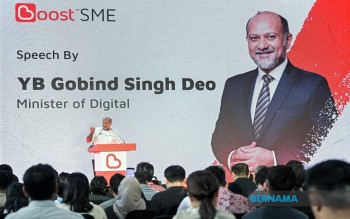
Malaysia's digital economy is advancing steadily toward a ambitious 2030 target, with Digital Minister Gobind Singh Deo confirming that the sector remains on course to constitute roughly 30 per cent of the nation's gross domestic product within the next six years. Speaking after the launch of the Boost SME platform in Kuala Lumpur on August 18, the minister outlined how recently introduced policy frameworks are creating the conditions necessary for this transformation, positioning the country to capitalise on technological advancement and financial inclusion across its business ecosystem.
The trajectory toward this milestone represents a substantial increase from current levels. As of last year, the digital economy's contribution to Malaysia's GDP stood at 25.5 per cent, indicating that policymakers are targeting an additional 4.5 percentage point boost over the coming years. This incremental growth, while seemingly modest in numerical terms, translates into billions of ringgit of additional economic activity and reflects the compounding effects of technological adoption, digital infrastructure investment, and the emergence of new digital business models across multiple sectors.
Two major policy instruments are anchoring this growth strategy. The National Artificial Intelligence Action Plan 2026-2030 and the broader Malaysia Digital 2030 framework represent coordinated government efforts to position artificial intelligence as a foundational technology for economic expansion. Rather than treating digital transformation as a peripheral concern, these policies embed AI and digital services into the core of Malaysia's economic development approach, signalling to investors, entrepreneurs, and established corporations alike that government support for digitalisation is genuine and long-term.
Implementation responsibility has been centralised within the Digital Ministry's operational unit, MyDigital Corporation, which functions as the primary vehicle for translating policy ambitions into concrete outcomes. By tasking this dedicated entity with monitoring progress against the established targets, the government has created accountability mechanisms designed to ensure that initiatives translate from announcements into measurable results. This structural arrangement reflects lessons learned from previous attempts at large-scale economic transformation, where ambitions often exceed execution capacity.
Small and medium enterprises occupy a particular focus within the government's strategic thinking about digital expansion. These businesses, which collectively employ millions of Malaysians and generate significant economic output, have historically lagged behind larger corporations in adopting digital technologies. Budget 2027 allocations demonstrate a deliberate pivot toward lowering barriers to AI adoption among SMEs, with the Digital Ministry prioritising efforts that reduce the financial and educational obstacles preventing smaller firms from leveraging these powerful tools. This represents a pragmatic recognition that broad-based digital transformation cannot be achieved by focusing exclusively on large multinational corporations or technology champions.
Cost remains perhaps the most significant barrier preventing widespread SME adoption of artificial intelligence solutions. Digital Minister Gobind Singh Deo explicitly acknowledged that without deliberate policy intervention to manage implementation costs, many smaller businesses would struggle to justify investment in AI systems, regardless of potential long-term benefits. Budget 2027 therefore emphasises making AI utilisation financially accessible, with the government functioning as a facilitator rather than simply an observer of the digitisation process. This approach seeks to invert the typical technology adoption curve, where costs gradually decline following mass market emergence, by using public investment to accelerate affordability from the outset.
Beyond cost considerations, capability represents an equally critical dimension of the challenge. Many SME operators and their staff possess limited familiarity with artificial intelligence, cloud computing, or sophisticated digital payment systems. The Digital Ministry's stated commitment to ensuring that SMEs "understand the technology, have access to it and encourage its widespread adoption" acknowledges that technological literacy must be simultaneously built while access barriers are lowered. Education and training initiatives therefore function alongside infrastructure development and financial incentives as complementary pillars of the broader digitisation strategy.
The launch of Boost SME exemplifies how private sector platforms can serve government digitalisation objectives while pursuing commercial viability. Developed by Boost, a digital financial services provider, this fully digital business banking platform consolidates banking services, financial solutions, and payment capabilities within a unified digital environment. By targeting underserved SMEs specifically, Boost SME addresses a gap in Malaysia's financial ecosystem where many smaller enterprises lack adequate access to banking services tailored to their operational needs and technological sophistication.
The platform's design reflects contemporary understanding of how digital services can facilitate business growth for enterprises that might otherwise struggle with fragmented banking relationships or cumbersome legacy systems. By integrating multiple financial functions into a seamless ecosystem, Boost SME reduces friction in daily business operations and provides a foundation upon which SMEs can progressively adopt more sophisticated digital and analytical tools. This incremental approach recognises that not all businesses can simultaneously undertake complete digital transformation; instead, progressive capability enhancement through integrated platforms allows operators to develop competency and confidence gradually.
Minister Gobind Singh Deo has explicitly linked these sectoral initiatives to Prime Minister Datuk Seri Anwar Ibrahim's overarching vision of establishing Malaysia as an AI Nation by 2030. This rhetorical framing connects departmental policies to national strategic objectives, creating alignment across multiple levels of government and signalling to market participants that AI adoption represents not merely a competitive advantage but an essential component of Malaysia's positioning in the global digital economy. The nation's capacity to retain talent, attract foreign investment, and generate high-value economic activity increasingly depends on establishing itself as a sophisticated AI adopter.
The target of 30 per cent digital economy contribution to GDP by 2030 must be understood within the regional context of Southeast Asian competition for digital economy dominance. Neighbouring economies including Singapore, Indonesia, and Thailand are simultaneously pursuing aggressive digitalisation strategies, with significant capital commitments and policy support. Malaysia's targets reflect realistic assessments of competitive positioning rather than aspirational rhetoric disconnected from implementation capacity.
The articulation of these specific numeric targets, coupled with named policy frameworks and designated implementation agencies, represents a shift toward measurable accountability in Malaysian digital policy. Rather than pursuing vague commitments to technological progress, the government has established explicit benchmarks against which progress can be evaluated. This transparency creates both opportunities and risks: success in meeting targets will demonstrate policy effectiveness and boost confidence in government technological competence, while shortfalls could raise questions about implementation capacity and the feasibility of grander strategic ambitions.

