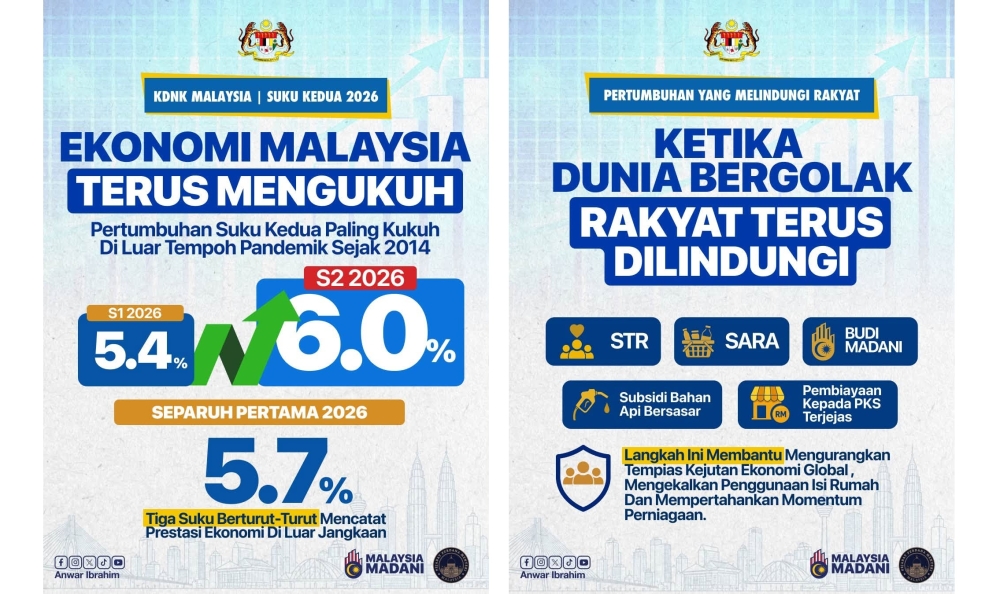
Prime Minister Datuk Seri Anwar Ibrahim has welcomed Malaysia's stronger-than-expected economic growth in the second quarter, pointing to government policies that he credits with protecting household incomes from the grip of global inflation. The announcement underscores the administration's efforts to balance growth with cost-of-living relief, a priority that has become increasingly central to Malaysia's domestic policy agenda as regional and international economic uncertainties persist.
The stronger economic performance during the April-to-June period reflects Malaysia's continued resilience despite headwinds from slowing global trade, persistent supply chain disruptions, and elevated interest rates across major economies. This expansion demonstrates that domestic demand remains sturdy, bolstered by consumer spending and ongoing private investment in key sectors. The outperformance against forecasts suggests that Malaysia's diverse economic structure—spanning manufacturing, services, and agriculture—has provided sufficient momentum to offset external shocks that have hampered growth prospects in other parts of the region.
The Prime Minister's emphasis on household protection reveals the government's dual-track economic strategy: pursuing expansion while ensuring that ordinary Malaysians do not bear the full brunt of price increases. This approach has manifested through targeted subsidies, price controls on essential items, and strategic social transfers designed to maintain purchasing power among lower and middle-income groups. Such interventions have proven crucial in sustaining consumer confidence, which typically drives the bulk of economic activity in Malaysia's economy.
Globally, inflation has emerged as a defining economic challenge for policymakers worldwide, with central banks tightening monetary policy aggressively to bring price pressures under control. Malaysia, too, has faced inflationary waves, particularly in food, energy, and transport costs. The government's successful buffering of household budgets from these shocks contrasts with experiences in some neighbouring economies, where real wages have compressed and poverty rates have ticked upward. This comparative advantage may enhance Malaysia's appeal to both consumers and investors seeking stability in an uncertain environment.
The second quarter results arrive amid a complex global backdrop characterised by sluggish growth in advanced economies, persistent geopolitical tensions affecting energy and commodity markets, and the lingering effects of aggressive rate hikes by major central banks. Malaysia's outperformance gains significance in this context, suggesting that the country's growth engines—including tourism recovery, semiconductor demand, and regional trade integration—are firing more robustly than some analysts had anticipated. Tourism arrivals have rebounded strongly following the post-pandemic normalization, while the semiconductor sector continues to benefit from structural demand drivers tied to artificial intelligence and digital transformation.
Domestically, the government's fiscal position has also supported growth dynamics. While Malaysia maintains a commitment to fiscal consolidation and debt reduction, strategic spending on infrastructure projects and human capital development has continued, laying groundwork for longer-term productivity improvements. The construction sector, in particular, has contributed to employment and activity, buoyed by projects aligned with the government's industrialisation and urbanisation goals.
The Prime Minister's message also carries political significance within Malaysia's electoral landscape, where economic performance and household welfare directly influence voter sentiment. By highlighting both growth acceleration and inflation protection, the administration is attempting to demonstrate competent stewardship across multiple economic fronts—a complex balancing act that affects public confidence ahead of future electoral contests. This framing resonates with both those prioritizing growth and those concerned with immediate purchasing power, a necessary coalition for any governing party.
Regionally, Malaysia's economic trajectory carries implications for Southeast Asian development patterns. As a major economy within ASEAN with substantial manufacturing capacity and financial markets, Malaysia's growth helps sustain demand across the region's value chains. A stronger Malaysian economy supports export opportunities for suppliers in Vietnam, Thailand, Indonesia, and other neighbours, while also maintaining a sizable consumer base for regional goods and services. This interdependency underscores why individual national performance matters for broader Southeast Asian prosperity.
Looking ahead, the Prime Minister's comments suggest confidence in the continuation of these trends, though external uncertainties remain. Global interest rate trajectories, potential shifts in US trade policy, and energy market volatility could all influence Malaysia's growth outlook in coming quarters. The government's continued emphasis on structural reforms—including efforts to improve logistics efficiency, digital infrastructure, and human capital—indicates an intent to move beyond cyclical factors toward sustainable competitive advantages.
The successful navigation of inflationary pressures while maintaining growth momentum will likely remain a central plank of government messaging as Malaysia seeks to consolidate its recovery from pandemic impacts and position itself favourably within regional economic hierarchies. The balancing act between stimulus and restraint, between short-term relief and long-term fiscal sustainability, will continue to define economic policymaking in the months ahead.

