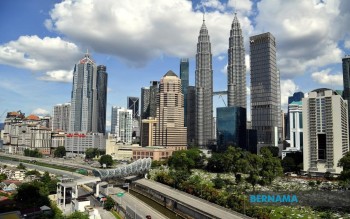
Malaysia's economy has continued to outperform regional and global expectations, expanding at 6.0 per cent in the second quarter of 2026, a feat Prime Minister Datuk Seri Anwar Ibrahim attributes to decisive government intervention and structural economic reforms. The growth rate surpassed both the Department of Statistics Malaysia's preliminary estimate and analyst consensus, marking the third consecutive quarter of resilient expansion even as geopolitical tensions in West Asia threaten supply chains worldwide.
The government's multi-pronged approach to shielding the domestic economy from external shocks has centred on protecting vulnerable segments of society while maintaining business continuity. Financing assistance channelled to small and medium enterprises, combined with carefully calibrated fuel subsidies and cash assistance programmes such as Sumbangan Tunai Rahmah and Sumbangan Asas Rakmah, has cushioned household spending and sustained business investment. These measures reflect the broader MADANI Economy framework, which Anwar emphasises is designed to distribute growth benefits equitably across Malaysian society rather than concentrating gains among elites.
Inflation management has emerged as a critical success factor in Malaysia's economic performance. Despite global supply chain disruptions pushing prices upward across most developed and developing economies, Malaysia has maintained inflation at just 1.9 per cent in the second quarter of 2026. This achievement contrasts sharply with the double-digit inflation rates plaguing several regional peers and highlights the effectiveness of targeted subsidy mechanisms under the BUDI MADANI programme. The government's willingness to deploy fiscal resources to moderate price pressures, particularly for essential commodities, has proved instrumental in preserving purchasing power among lower-income households.
The second-quarter result represents Malaysia's strongest second-quarter performance outside pandemic-affected years since 2014, underscoring the durability of the current economic expansion. Domestic demand has remained the primary engine of growth, with Malaysian households and businesses continuing to spend and invest despite headlines about global instability. The external sector has also performed robustly, suggesting that despite West Asian disruptions, Malaysia's exporters have found alternative routes or maintained sufficient market access to sustain production and sales.
Performance in the first half of 2026 has positioned Malaysia favourably relative to government forecasts. With combined growth of 5.7 per cent across the first and second quarters, the economy has already established a solid foundation for achieving the full-year target of 4.0 to 5.0 per cent growth. This puts Malaysia among the faster-growing Southeast Asian economies and positions the country competitively for attracting foreign investment seeking stable, growing markets insulated from the worst global shocks.
However, Anwar has acknowledged that headline economic indicators mask uneven benefits distribution across Malaysian society. While aggregate growth remains impressive, many workers and businesses face genuine hardship from rising operational costs, particularly in sectors affected by supply chain disruptions or input price inflation. This candour reflects growing recognition within government that GDP figures alone fail to capture lived experiences of ordinary Malaysians navigating higher expenses for food, transport, and utilities. The prime minister's emphasis on ensuring that growth translates into better employment opportunities and higher real incomes suggests policy focus may shift toward labour-market interventions and targeted sectoral support.
The West Asia conflict remains the most significant external risk factor to Malaysia's economic trajectory. Continued geopolitical instability threatens not only supply chains but also shipping routes critical to Malaysian trade. While the economy has demonstrated resilience thus far, prolonged disruptions could eventually erode the buffering effects of government support measures. Energy price volatility, should Middle Eastern tensions escalate, would test the sustainability of current subsidy arrangements and inflate government expenditure further.
Employment pressures in certain sectors present another vulnerability. While headline unemployment remains contained, workers in tourism, export manufacturing, and logistics-dependent industries have experienced real stress. These segments lack the shock-absorption capacity of larger, more diversified firms and may require sustained government intervention to prevent long-term labour displacement and skills atrophy. The MADANI Government's commitment to supporting affected workers suggests targeted retraining programmes and income support mechanisms may expand beyond current arrangements.
The sustainability of Malaysia's growth premium relative to regional peers depends partly on whether government measures remain temporary cyclical supports or evolve into permanent structural reforms that enhance productivity and competitiveness. The MADANI Economy framework claims to pursue the latter through institutional reform and more equitable resource distribution. If successful, Malaysia could establish a more resilient, inclusive growth model less vulnerable to external shocks. If instead programmes become permanent subsidies without productivity gains, fiscal pressures could accumulate and eventually constrain future growth.
Looking ahead, Malaysian policymakers face a balancing act between maintaining growth stimulus to protect vulnerable segments and preparing the economy for normalisation once global conditions stabilise. The government's proactive stance has yielded positive results to date, but the long-term challenge lies in ensuring that crisis-response measures do not ossify into inefficient subsidies that distort market signals and discourage productive adaptation. For Malaysian investors and business leaders, the current environment offers stability and growth opportunity, though watchfulness regarding policy trajectory and external risks remains warranted.

