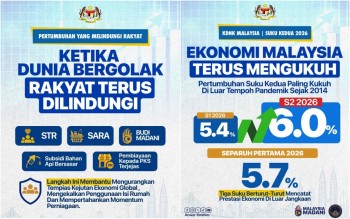
Malaysia's economic momentum accelerated sharply in the second quarter of 2026, with gross domestic product expanding at six per cent—a performance that defied widespread pessimism about the global economy and caught many forecasters by surprise. Prime Minister Datuk Seri Anwar Ibrahim announced the figure on August 14, characterising the growth as the country's most robust second-quarter expansion since the pre-pandemic era of 2014. The achievement takes on particular significance given the external headwinds battering most major economies, from supply-chain disruptions that have persisted in the aftermath of regional crises to the broader fallout from unrest in West Asia.
The timing of this announcement represents a symbolic victory for the MADANI Government, which has staked considerable political capital on economic stewardship and inclusive growth policies. Anwar attributed the outperformance to deliberate policy choices made by his administration to insulate ordinary Malaysians from the worst effects of global inflation. Rather than allowing price pressures to cascade directly into household consumption decisions, the government implemented direct cash assistance programmes including BUDI MADANI, the Sumbangan Tunai Rahmah (STR) and Sumbangan Asas Rahmah (SARA), which collectively funnelled targeted support to vulnerable demographics. These initiatives functioned as economic shock absorbers, maintaining demand within the domestic economy even as external conditions deteriorated.
Beyond the headline welfare transfers, Anwar indicated that the government had undertaken substantial behind-the-scenes intervention to maintain price stability and ensure supply-chain continuity. This dual approach—combining visible social spending with less-publicised regulatory or commercial measures—reflects a strategy to demonstrate both compassion and competent crisis management. For Malaysian readers, the implication is clear: the government views its responsibility as extending beyond simply monitoring economic indicators to actively intervening in markets and distribution networks to protect purchasing power. This approach contrasts sharply with more laissez-faire models that might rely entirely on monetary policy or market mechanisms.
The six per cent figure warrants contextualisation within the broader Southeast Asian and global landscape. Regional peers including Indonesia, Thailand and the Philippines have each struggled with growth rates considerably lower than Malaysia's second-quarter performance, making the Malaysian economy a relative bright spot in a region facing simultaneous challenges of demand weakness and inflationary pressure. Globally, most developed economies have recorded single-digit growth or outright contraction during comparable periods. The achievement therefore positions Malaysia as a case study in economic resilience—a narrative that carries both domestic political benefits and potential implications for regional economic leadership and investment flows.
However, Anwar's statement notably shifted tone in its latter sections, tempering optimism with acknowledgment of unfinished work. The Prime Minister emphasised that sustaining this growth trajectory requires continued structural reforms rather than reliance on temporary fiscal measures alone. He highlighted the necessity of translating headline GDP growth into tangible improvements in ordinary Malaysians' financial circumstances—specifically through higher meaningful incomes, superior employment quality and strengthened assistance targeting those most vulnerable to economic shocks. This caveat suggests internal government awareness that raw growth numbers, while politically advantageous, risk disconnection from lived experience if not accompanied by genuine wage growth and job creation in productive sectors.
The distinction Anwar drew between aggregate growth and inclusive prosperity speaks to a persistent challenge across emerging markets: ensuring that economic expansion reaches beyond urban middle classes and corporate sectors to genuinely improve conditions for lower-income households, rural populations and informal-economy workers. Malaysia's record on this measure has been mixed, with structural unemployment and underemployment persisting despite periods of headline growth. The government's emphasis on this dimension suggests recognition that the Q2 performance, however impressive statistically, risks becoming politically hollow if not accompanied by demonstrable improvements in household welfare metrics.
The external environment remains precarious, with the lingering supply-chain vulnerabilities and West Asian instability that Anwar cited continuing to pose downside risks. Any escalation in regional tensions or further disruption to maritime trade routes would directly threaten Malaysia's export-dependent manufacturing base and its position as a regional logistics hub. The government's growth achievements to date therefore rest partly on external conditions that lie beyond its direct control—a dependency that underscores the fragility of any celebration of economic success.
Looking forward, the MADANI Government faces a delicate balancing act between maintaining fiscal stimulus that supported Q2 performance and addressing longer-term sustainability concerns. The direct assistance programmes that cushioned inflation's impact carry significant budgetary costs and cannot be expanded indefinitely without constraint. Simultaneously, the government must pursue productivity-enhancing reforms in education, infrastructure and regulatory environments—initiatives that typically require patience and deliver benefits on longer timescales than election cycles. Anwar's invocation of continued reform efforts suggests government awareness of these tensions.
For Malaysia's business community and international investors, the Q2 growth data offers cautious encouragement, though questions persist about underlying structural strength versus temporary policy support. The coming quarters will be instructive in determining whether the six per cent expansion represents the beginning of sustained acceleration or a temporary peak before normalization to lower levels. Growth sustainability ultimately hinges on whether the government can simultaneously maintain social support, control inflation and catalyse private-sector investment and productivity improvements—an ambitious agenda that will test the administration's economic management capabilities throughout the remainder of 2026 and into 2027.

