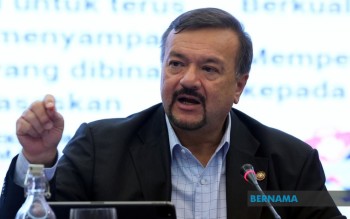
Malaysia is charting a steady course through turbulent global economic waters, with Finance Minister II Datuk Seri Amir Hamzah Azizan revealing that the nation's gross domestic product has expanded at a consistent clip even as international trade disputes and Middle Eastern tensions threaten growth elsewhere. Speaking at the GEAR-uP Progress Report press conference in Putrajaya on August 7, Amir Hamzah outlined a trajectory of expansion that demonstrates the underlying strength of Southeast Asia's third-largest economy, contradicting pessimistic forecasts that emerged when the United States and China intensified tariff confrontations last year.
The statistical narrative is compelling. Malaysia achieved 5.2 per cent GDP growth in 2024 and maintained that identical rate throughout 2025, before accelerating to 5.4 per cent in the first quarter of this year. More significantly, preliminary estimates for the second quarter suggest expansion of 5.8 per cent, bringing the year-to-date average to 5.6 per cent. This performance gains particular weight when measured against the backdrop of regional and global headwinds that have dampened expansion in neighbouring economies. The consistency of these numbers indicates structural resilience rather than temporary cyclical strength, suggesting that policy interventions have taken meaningful hold across domestic demand, investment, and productive capacity.
Amir Hamzah attributed the economy's steadiness to the framework governing government economic strategy—specifically, the MADANI Economy blueprint that prioritises inclusive growth and domestic value creation. Rather than pursuing growth metrics alone, the Finance Minister emphasised that the philosophy underpinning current policy seeks to distribute economic benefits more widely across Malaysian society while laying foundations for advancement into developed-nation status. This messaging reflects growing political emphasis on ensuring that growth translates into tangible improvements in living standards, wages, and opportunity access for ordinary Malaysians—a distinction that carries electoral and social significance as the government prepares for renewed engagement with voters.
Central to this economic strategy is the GEAR-uP programme, a domestically focused initiative mobilising RM120 billion in investment capital across the 2024-2028 period. Led by the Ministry of Finance since its inception in 2024, this scheme targets strategic sectors and capabilities that position Malaysia as a regional hub for higher-value activities. Unlike previous growth models that relied heavily on foreign direct investment or commodities exports, GEAR-uP emphasises internally generated momentum—channelling capital through government-linked investment companies and government-linked companies to catalyse ecosystem development across domestic industries. This approach acknowledges that sustainable development requires more than simply attracting foreign capital; it demands cultivation of local talent, transfer of expertise, and deep integration of investment into productive networks that strengthen competitive advantage.
The role of GLICs and GLCs in executing this vision cannot be understated. Rather than operating as isolated commercial entities, these government-connected organisations function as developmental anchors, identifying talent shortages within domestic industries and facilitating knowledge transfer from international partners. Amir Hamzah explained that this strategy recognises a fundamental constraint in purely market-driven approaches: money flows readily across borders when returns beckon, but sustainable growth requires simultaneous development of human capital, technological capability, and institutional quality. By positioning state-linked entities as intermediaries connecting domestic talent needs with international expertise and capital sources, the government seeks to compress the timeline for sectoral upgrading while ensuring that international investment creates multiplier effects throughout the Malaysian economy rather than remaining confined to special economic zones or foreign-owned enclaves.
This articulation of development philosophy carries particular relevance for Malaysia's position within Southeast Asia. As the region's economies compete for investment and talent migration accelerates, countries that can demonstrate how foreign capital translates into sustained employment generation and skills development gain competitive advantage. Malaysia's emphasis on ensuring that investment brings "funds, know-how" and supports worker advancement directly addresses anxiety in neighbouring countries about whether globalised capital flows ultimately benefit broad populations or merely enrich connected elites and expatriate professionals.
The acknowledgement of external challenges adds credibility to the government's growth claims. Amir Hamzah did not present Malaysia's expansion as occurring in a benign international environment; rather, he highlighted that 5.6 per cent year-to-date growth was achieved despite trade wars between major economies and geopolitical tensions in West Asia. This framing serves dual purposes—it acknowledges real difficulties facing Malaysian exporters and investors while simultaneously arguing that policy choices and domestic structural strengths have enabled the nation to outperform peers facing identical headwinds. For investors and policymakers assessing regional opportunities, this distinction matters considerably when evaluating Malaysia's relative attractiveness.
The transition from describing cyclical performance to articulating longer-term development aspirations reflects growing confidence within government circles about trajectory. Amir Hamzah's repeated references to Malaysia becoming "a developed country" and achieving "more mature" economic status suggest that leadership views the current phase not merely as defending growth rates but as executing a strategic transition. This echoes messaging from other senior officials about Malaysia's capacity to harness demographic advantages, geographic positioning, and technological adoption to leapfrog into higher-income status within the next decade. Such ambitions face real constraints—including labour market competition from higher-wage jurisdictions, dependence on imported energy, and educational disparities across regions—but the articulation of these goals reflects determination to escape middle-income vulnerabilities that have constrained peer economies.
The MADANI Economy Framework itself represents conceptual evolution in Malaysian economic thinking. Named to evoke notions of civilisational maturity and inclusive development, this framework signals that future growth should be calibrated against broader societal metrics than gross domestic product alone. Environmental sustainability, regional equity, poverty reduction, and social cohesion feature in this expanded conception of economic success. For Malaysian readers and investors, this messaging carries implications for policy direction—suggesting that future regulatory choices will increasingly reflect commitments to green transitions, labour standards, and community benefit alongside pure commercial considerations.
International comparison illuminates Malaysia's current performance. Most developing economies and many developed ones faced growth deceleration as global trade contracted and uncertainty persisted through 2024 and early 2025. Maintaining 5-plus per cent expansion while managing currency stability, inflation control, and fiscal sustainability required disciplined macroeconomic management and targeted sectoral support. Malaysian authorities executed this balancing act through careful monetary policy calibration, retention of exchange rate flexibility, and strategic allocation of fiscal space toward productive investment rather than consumption subsidies—choices that some regional competitors avoided despite short-term political pressure to do otherwise.
The investment community's reception to these figures and policy narrative will likely shape capital flows to Malaysia relative to competing destinations. Foreign direct investment decisions increasingly incorporate assessments of non-financial factors including governance quality, policy predictability, and government capacity for effective implementation. Amir Hamzah's focus on ensuring that GEAR-uP investments generate tangible employment and skills development speaks to these broader investor concerns. If the programme demonstrably delivers on these claims, Malaysia may attract investors explicitly seeking destinations where growth translates into sustainable ecosystem development rather than merely extractive resource capture.
Looking forward, the trajectory outlined by the Finance Minister contains both promise and vulnerability. Sustaining 5-plus per cent growth requires continued investment in education, infrastructure, and innovation even as global demand remains uncertain. Demographic challenges—including an ageing workforce and emigration of skilled professionals—could constrain growth potential if not addressed through immigration policy and worker productivity enhancement. The success of GEAR-uP in generating domestic investment momentum and ensuring international capital deployment towards developmental objectives will substantially determine whether Malaysia successfully transitions to developed-nation status or stalls in middle-income territory as numerous peers have done. For now, the government's evident satisfaction with current trajectory and stated confidence in future prospects reflects assessment that policy foundations are sound and implementation mechanisms adequate to the challenge.

