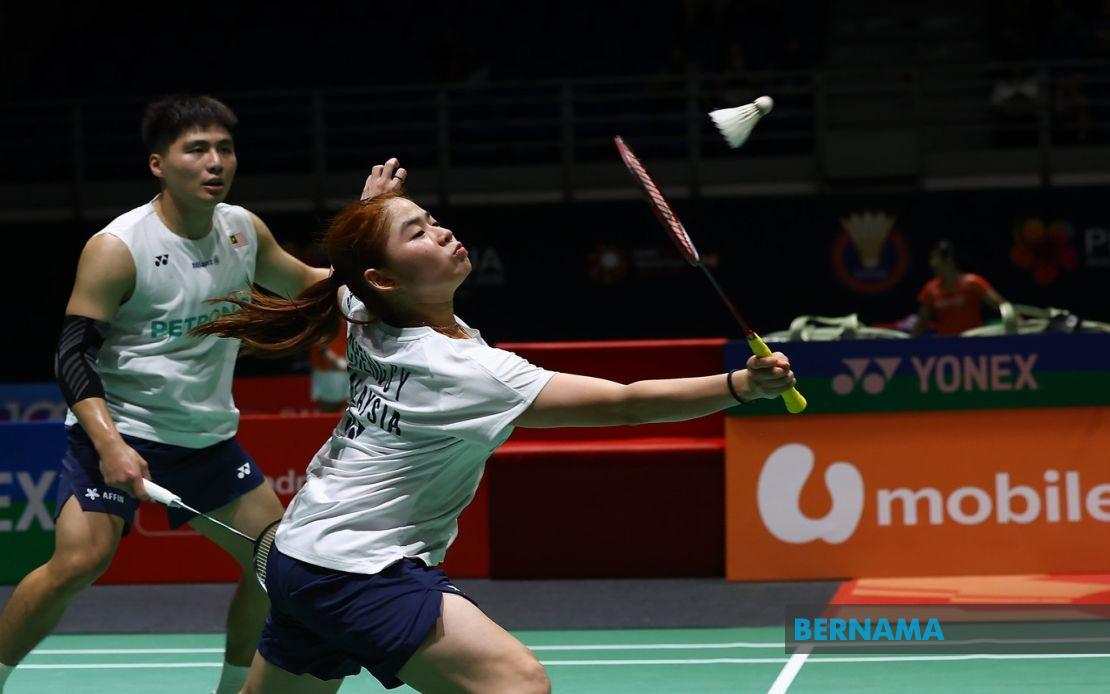
Malaysia's challenge at the Japan Open came to an end on July 18 when the nation's final two competing pairs were eliminated in the semi-finals in Tokyo, concluding what had been a spirited tournament run despite the early departures. The mixed doubles combination of Jimmy Wong and Cheng Su Yin fell first to Hong Kong's experienced Tang Chun Man and Tse Ying Suet, succumbing 17-21, 21-18, 21-15 in a closely contested match that lasted 69 minutes.
The unseeded Malaysian pair had compiled an impressive record of upsets throughout the tournament, demonstrating their capacity to challenge elite international combinations. Despite the defeat, their performance underscored the competitive quality they have developed, particularly in how they contested against opponents ranked within the world's top tier. The effort they expended across the match showcased technical proficiency and tactical awareness, suggesting that Malaysian mixed doubles badminton possesses considerable depth beyond the nation's traditionally strong singles contingent.
In the men's doubles arena, Goh Sze Fei and Nur Izzuddin Rumsani encountered South Korea's world number one pairing of Kim Won Ho and Seo Seung Jae, a matchup that effectively represented a clash between Malaysia's rising talents and the region's dominant force in the doubles discipline. The encounter extended to 58 minutes, indicating that the Malaysian pair mounted substantial resistance despite ultimately falling short. The Malaysians commenced poorly in the opening set, losing 12-21 as the South Korean favourites established early command of proceedings and rhythm.
However, the Malaysian duo mounted a dramatic comeback in the second set, securing a commanding 21-11 victory to draw the match level and force a decisive third set. This reversal demonstrated resilience and the capacity to recalibrate tactically under pressure—qualities that remain valuable for their continued development. The deciding set became the determining factor, with Kim Won Ho and Seo Seung Jae asserting their experience and superior ranking to prevail 21-13, capturing the match and securing their place in the final.
The head-to-head record between these pairs reveals a persistent competitive gap. Across five meetings to date, the South Korean combination has prevailed in three encounters, establishing a clear pattern of dominance that reflects both their consistent form and their technical maturity at the highest competitive levels. For Malaysian badminton observers, this statistical reality underscores the developmental challenge facing the nation's doubles programmes as they work toward bridging the performance divide between themselves and the region's elite operators.
The elimination of both pairs marks a significant conclusion for Malaysia's hopes in this particular event, though the performance levels displayed merit consideration within the broader context of international badminton development. The mixed doubles showing proved particularly encouraging, as unseeded combinations rarely penetrate deep into major championship semi-finals without benefiting from favourable draw circumstances or breakthrough performances. The trajectory that Jimmy Wong and Cheng Su Yin demonstrated suggests potential for sustained competitiveness in future tournaments, provided they can consolidate their technical foundations and maintain consistency across varying match conditions.
For men's doubles, the encounter against the world number one pairing provided valuable data points regarding Malaysia's competitive positioning. While the defeats were conclusive, they occurred against opponents of exceptional calibre, and the competitive nature of individual sets indicates that the Malaysian pair remains within the broader competitive band capable of contending at major tournaments. The question for Malaysian badminton administration becomes whether sufficient resources and strategic focus are directed toward developing the next generation of doubles specialists who can sustain challenges against established powerhouses.
Regionally, Malaysia's badminton federation continues navigating a landscape where countries such as South Korea and Indonesia have invested substantially in systematic doubles development programmes. The Japan Open results exemplify both the achievements and limitations of Malaysia's current approach, demonstrating competitive moments without the consistency required to claim titles at prestigious tournaments. As Malaysian badminton looks toward future campaigns, the experiences accumulated by players like Goh Sze Fei and Nur Izzuddin should inform strategic planning around training methodologies, competition scheduling, and player development pathways that could narrow the gap evident in these international encounters.

