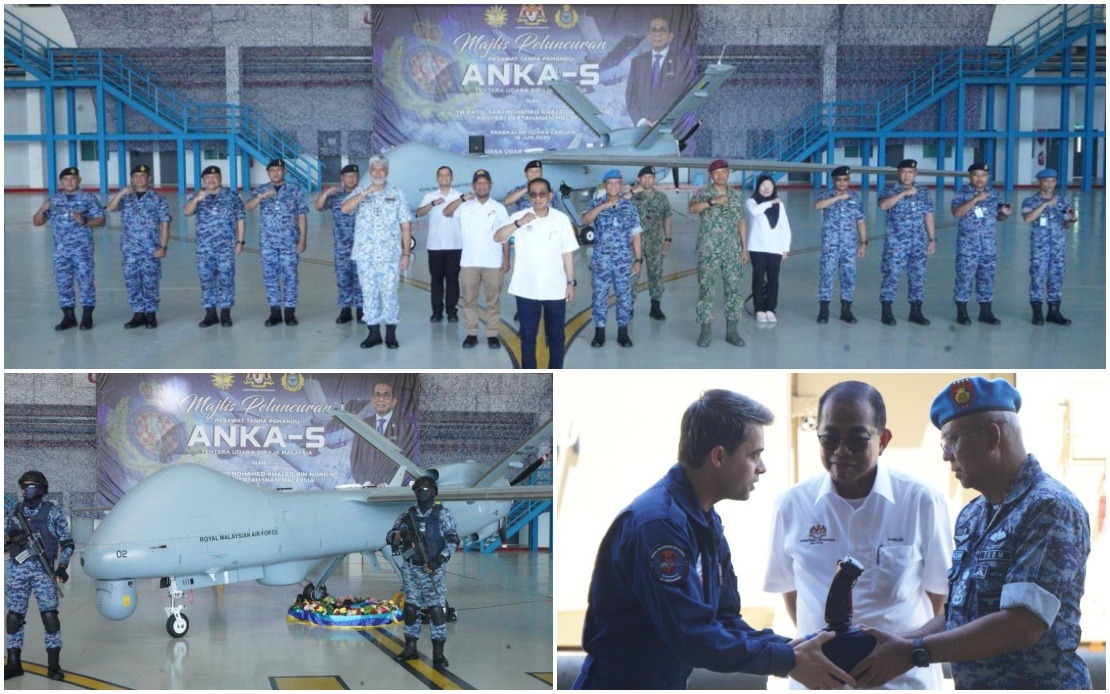
Malaysia has taken a significant step in modernizing its defence infrastructure with the operational deployment of the ANKA-S Unmanned Aircraft System by the Royal Malaysian Air Force, Defence Minister Datuk Seri Mohamed Khaled Nordin announced at Labuan Air Base today. The medium-altitude long-endurance surveillance platform represents a watershed moment for the country's ability to monitor and secure its contested maritime territories, particularly in the strategically vital South China Sea where competing territorial claims and shipping lanes intersect regional interests.
The investment of RM423.8 million for three aircraft, inclusive of ground control stations and two years of personnel training, reflects Malaysia's strategic assessment that persistent aerial surveillance has become indispensable for modern maritime defence. This acquisition arrives amid growing global attention to the South China Sea, where Malaysia maintains significant economic and security stakes through its Exclusive Economic Zone and coastal territories. The deployment at Labuan, positioned strategically in eastern Malaysian waters, enables the RMAF to establish continuous monitoring capabilities across regions previously dependent on periodic patrols by crewed aircraft.
The ANKA-S platform offers operational characteristics that fundamentally alter Malaysia's surveillance posture. Capable of remaining airborne for more than 24 hours while operating at altitudes reaching 30,000 feet, the system can maintain persistent watch over vast maritime expanses without the recurring costs associated with manned aircraft operations. This extended endurance proves particularly valuable for monitoring shipping routes and detecting unauthorized incursions across Malaysia's maritime boundaries, which extend across some of Southeast Asia's busiest waters. The aircraft's ability to function across diverse weather conditions ensures year-round operational readiness, crucial for tropical maritime environments subject to monsoon patterns and unpredictable atmospheric conditions.
Central to the system's utility is its advanced surveillance and tracking capability, which Defence Ministry officials emphasize enables precise identification of vessel profiles and patterns. Rather than conducting unfocused patrols that consume fuel and personnel resources, the RMAF can now respond with targeted asset deployment based on verified intelligence gathered by the ANKA-S. This represents a genuine efficiency gain for a defence force managing expansive maritime territories with constrained resources. The Data Exploitation Centre established to process information from the platform will serve as the analytical hub translating raw surveillance data into actionable intelligence for operational commanders.
Malaysia's deliberate decision not to equip the ANKA-S with weaponry carries particular geopolitical significance within the region's sensitive security environment. By choosing to deploy an unarmed surveillance platform rather than an armed drone system, Defence Minister Mohamed Khaled stated explicitly that Malaysia wishes to signal a defensive rather than aggressive posture to neighbouring states and the international community. This distinction matters considerably in the South China Sea context, where military build-ups by any nation generate ripple effects across regional security calculations. The choice reflects Malaysia's preference for positioning itself as a responsible maritime steward focused on sovereignty protection rather than power projection.
The government's indication that it is evaluating a second-phase acquisition of three additional ANKA-S aircraft signals confidence in the platform's operational utility and suggests expectations of sustained funding within Malaysia's defence planning framework. Such expansion would enable the RMAF to maintain more continuous coverage across multiple regions simultaneously, reducing gaps in surveillance and increasing response flexibility. For Malaysia's maritime strategy, doubling the fleet would approach something closer to the persistent presence necessary for comprehensive surveillance of its claimed maritime zones, though even six platforms represent modest numbers relative to the geographic scope of waters requiring monitoring.
The broader implications of this acquisition extend beyond Malaysia's borders. The ANKA-S deployment contributes to a regional environment where multiple nations simultaneously invest in advanced surveillance capabilities, subtly shifting the character of maritime competition toward intelligence gathering and monitoring rather than direct military confrontation. This technological development occurs alongside similar investments by other Southeast Asian nations in unmanned systems and advanced sensors, gradually creating a region increasingly blanketed by multiple overlapping surveillance networks operated by different governments with varying interests and capabilities.
For Malaysia specifically, the system addresses a genuine capability gap that has long constrained the country's ability to monitor its extensive maritime claims effectively. Compared to deploying fighter aircraft or maritime patrol vessels for surveillance missions, the ANKA-S offers substantially lower operational costs while providing continuous coverage that crewed platforms cannot sustain. This cost-effectiveness consideration likely influenced the investment decision, as Malaysia seeks to optimize its defence spending during periods of constrained public budgets and competing spending priorities across government agencies.
The operational establishment of the ANKA-S also reflects Malaysia's integration into global defence technology networks. The aircraft, a Turkish-developed system produced by Turkish Aerospace Industries, exemplifies how Malaysian defence capabilities increasingly depend on partnerships with international manufacturers and technology providers. This dependency carries implications for operational security, maintenance continuity, and strategic autonomy, factors Malaysian defence planners must weigh against the immediate capability gains the system provides. The two-year training commitment ensures Malaysian personnel can sustain operations with minimal ongoing foreign assistance, though long-term maintenance and technical support arrangements require continued cooperation with the vendor.
Looking forward, the ANKA-S system will function as a centerpiece of Malaysia's maritime surveillance architecture for the foreseeable future, likely informing broader defence strategy as the government determines whether to expand the fleet further. The platform's capabilities and limitations will shape operational doctrine, inform interagency coordination between civilian maritime authorities and military forces, and provide factual intelligence inputs into Malaysia's diplomatic and security policy discussions concerning contested maritime zones. The decision to deploy the system now, rather than waiting for potentially superior technology, suggests Malaysian defence officials judged the capability gain too significant to postpone further.