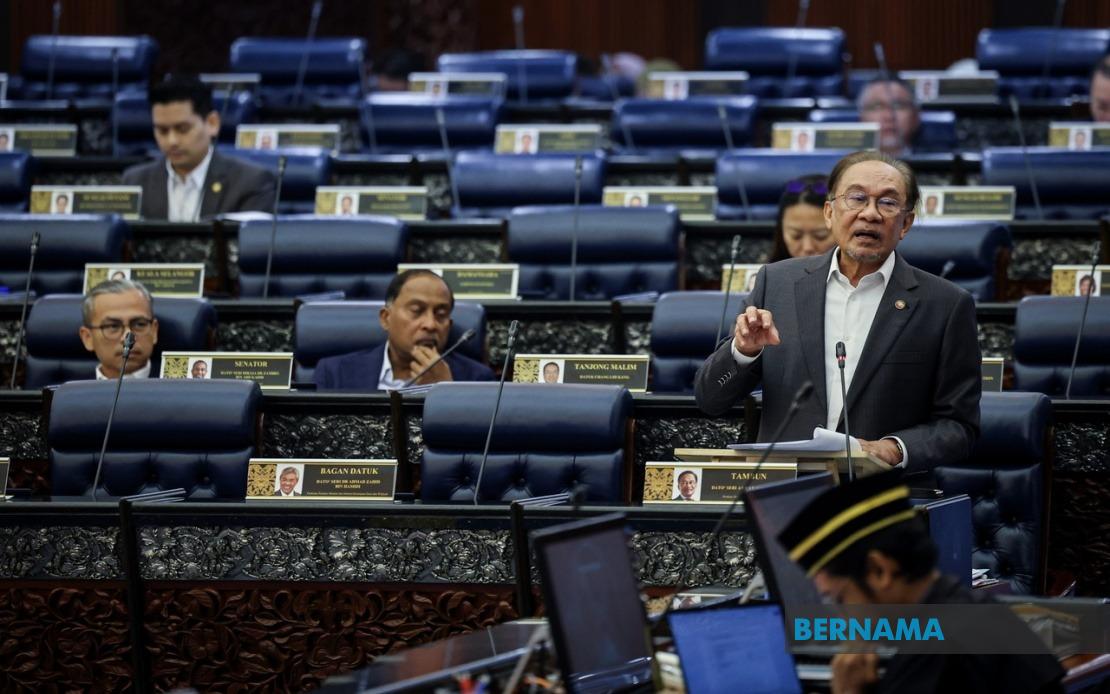
Prime Minister Datuk Seri Anwar Ibrahim has clarified that Malaysia's slip in this year's World Press Freedom Index rankings stems from international assessment criteria that examine enforcement actions taken against several media outlets, though he stressed these interventions target specific categories of content rather than legitimate political discourse. Speaking during parliamentary question time in Kuala Lumpur on July 7, the Prime Minister explained that the government distinguishes sharply between protecting sensitive national interests and restricting genuine press freedom, a distinction he suggested has not been fully appreciated by international observers conducting the annual index assessments.
The government's enforcement actions against Sin Chew Daily for publishing an inaccurate illustration of the Jalur Gemilang and against Sinar Harian regarding the Inspector-General of Police's biography have been particularly influential in lowering Malaysia's standing. Anwar acknowledged that the international media community viewed the Sin Chew Daily case as a serious breach of press freedom principles, yet he defended the government's position by emphasising that national symbols warrant protection that may not be universally understood across different cultural and political systems. He indicated that while Malaysia takes flags and national emblems with considerable seriousness, this sensitivity does not automatically translate across borders, creating a fundamental disconnect between domestic legal priorities and international press freedom assessment frameworks.
The Prime Minister's remarks reveal a deeper tension in how Malaysia balances competing obligations: the government remains bound by positions collectively agreed through the Conference of Rulers, which maintains stringent oversight of content deemed insulting to the monarchy or capable of igniting racial or religious conflict. This institutional constraint, rooted in Malaysia's constitutional architecture, operates independently of executive discretion and reflects the Federation's foundational compromises regarding sensitive communal issues. Anwar stressed that action is triggered only when content transgresses these specific boundaries, not when it contains factual errors or directs political criticism at leadership.
Recognising the distinction between different forms of speech has become increasingly important to the government's narrative on press freedom. The Prime Minister pointed out that the administration prioritises public clarification and parliamentary explanation over punitive measures when confronted with inaccuracies or criticism unrelated to the three restricted categories. This approach suggests an evolving institutional preference for transparency and dialogue rather than enforcement as the primary response to problematic reporting, a philosophical shift that nonetheless remains invisible to international ranking organisations that focus primarily on enforcement incidents rather than preventive communication strategies.
Among the government's more concrete reforms is the recent amendment to Section 233 of the Communications and Multimedia Act 1998, which decriminalised satirical remarks directed at the Prime Minister and other political leaders. This legislative adjustment signals parliamentary recognition that satire and humorous commentary, even when barbed, constitute legitimate forms of expression distinct from the intentional propagation of falsehoods or incitement. The amendment represents a deliberate narrowing of the state's prosecutorial reach, yet such refinements typically attract minimal attention from international index compilers who tend to record the existence of restrictive laws rather than document the narrowing of their application.
Anwar also placed Malaysia's ranking decline within the broader methodological context established by Reporters Without Borders, the Paris-based organisation that produces the World Press Freedom Index. The assessment methodology encompasses multiple dimensions: the political environment, the legal framework's architecture, economic conditions affecting media sustainability, socio-cultural contexts that shape public discourse norms, and security threats that may necessitate content restrictions. By foregrounding these varied criteria, Anwar suggested that Malaysia's decline reflects not a singular failure in press freedom but rather complex interactions among political, economic, and security factors that international assessments attempt to quantify but often oversimplify.
A particularly illuminating element of the Prime Minister's explanation concerns the removal of online content by social media platforms operating according to their own community standards rather than government directive. Anwar pointed to instances where his own posts concerning Hamas were deleted by platform operators despite governmental disagreement with those decisions, illustrating how private corporate policies can constrain public discourse in ways that international observers may misconstrue as government censorship. This dynamic—where American technology companies enforce content policies that may conflict with Malaysian government preferences or public opinion—creates a complex accountability landscape that traditional press freedom indices struggle to accommodate within their frameworks.
Furthermore, Anwar noted that requests issued by the Malaysian Communications and Multimedia Commission to social media platforms are not invariably honoured, as ultimate decision-making authority rests with individual platform operators in their respective jurisdictions. This asymmetry of power between regulatory authorities and transnational technology corporations reveals how press freedom challenges in Southeast Asia increasingly operate beyond the state's direct control, a phenomenon that international assessments frequently attribute to government overreach rather than corporate power dynamics. The removal of content based on user complaints and platform policies, rather than government mandate, thus contributes to Malaysia's ranking decline through mechanisms the Prime Minister suggests are fundamentally beyond his administration's control.
The Prime Minister's comprehensive parliamentary response attempts to reconstruct Malaysia's press freedom narrative around finer distinctions that international indices have not yet adequately incorporated. By separating enforcement against protected categories of content from suppression of political dissent, emphasising legislative reforms that decriminalise satirical expression, and documenting the autonomous decisions of private platforms, Anwar positions the government as constrained by constitutional agreements and institutional limitations rather than ideologically committed to censorship. Whether this reframing gains traction with Reporters Without Borders or similar organisations in future assessments remains uncertain, but it signals the Malaysian government's recognition that international press freedom rankings carry significant reputational costs and require sustained engagement with the methodological and conceptual frameworks that produce them.

