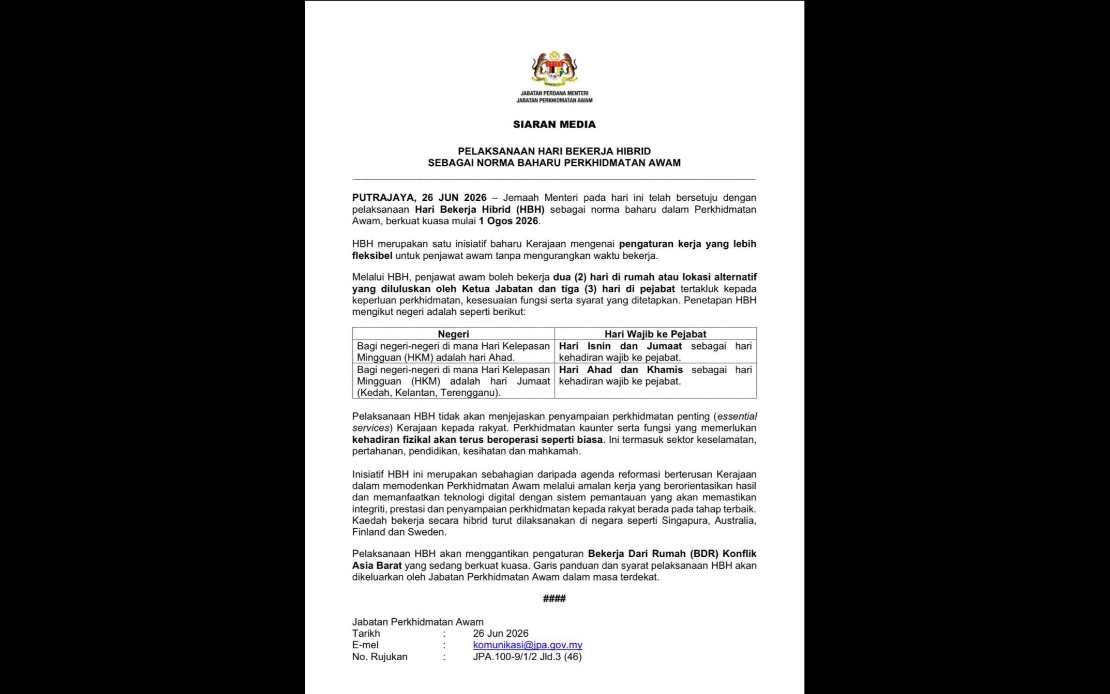
Malaysia's Cabinet has formally approved a hybrid work arrangement that will reshape how the nation's civil service operates, with the new system taking effect from August 1. The Public Service Department announced the decision on June 26, marking a significant shift from the existing work-from-home provisions that have been in place since the pandemic disrupted traditional office routines. This framework, known as Hybrid Work Day or HBH, represents the government's effort to establish a structured middle ground between full remote work and mandatory office attendance.
Under the new arrangement, Malaysia's civil servants will enjoy considerably more flexibility than they had before the pandemic, whilst remaining tied to meaningful office presence. Employees across the public sector will be permitted to work remotely for two days each week from their homes or from alternative locations that their departmental heads have authorised, while they are required to be physically present at their workplaces for the remaining three days. The implementation remains conditional on various factors, including the specific service requirements of each department, the suitability of individual job functions for remote execution, and compliance with departmental guidelines that will be established through formal procedures.
This development moves beyond the temporary pandemic-era work-from-home model that many governments worldwide adopted hastily. The Public Service Department characterised HBH as a deliberate modernisation initiative designed to offer civil servants greater freedom in managing their work schedules without compromising total working hours. The arrangement signals confidence that core productivity metrics need not depend entirely on in-office supervision, reflecting an evolution in how Malaysian government leadership views workforce management and the relationship between physical presence and actual output.
The Malaysian government has taken specific care to address the varying religious and cultural practices across the nation. In states that observe Sunday as their weekly rest day—the majority of Malaysia—Monday and Friday have been mandated as compulsory office attendance days. Conversely, in Kedah, Kelantan, and Terengganu, where Friday serves as the weekly holiday, civil servants must attend their offices on Sunday and Thursday. This accommodation recognises Malaysia's religious diversity whilst ensuring consistency in public service delivery across the country.
Critically, the Public Service Department has emphasised that the transition to hybrid arrangements will not diminish the government's capacity to deliver essential services to the public. Frontline services requiring physical presence—encompassing security and defence operations, educational institutions, healthcare facilities, and the judicial system—will maintain their existing operational patterns. Counter services and other functions where citizens need to interact directly with government officials will continue to operate normally, ensuring that Malaysians can still access critical government support without impediment. This distinction between back-office and customer-facing roles demonstrates the department's attempt to balance workforce flexibility with public service obligations.
The Public Service Department plans to introduce a comprehensive monitoring system to track the effectiveness and integrity of the hybrid arrangement. This supervisory framework will focus on maintaining performance standards and ensuring that service delivery remains at optimal levels under the new working conditions. The department recognises that introducing such a significant change to work culture across the entire civil service—which employs hundreds of thousands of people—requires robust mechanisms to identify problems quickly and adapt policies as needed.
The Malaysian government is positioning this development as part of a broader modernisation agenda for the public service, one that emphasises results-based performance measurements and deeper integration of digital technology into daily operations. Rather than viewing the hybrid model as merely a concession to employee preferences, officials have framed it as an opportunity to strengthen the public sector's competitiveness and efficiency. This perspective aligns HBH with contemporary management philosophy that prioritises outcomes over presenteeism and recognises that digital tools have fundamentally altered what productivity means in many roles.
The Public Service Department has drawn international comparisons to support the credibility of its approach. Singapore, Australia, Finland, and Sweden have all adopted comparable hybrid work systems, suggesting that this model represents mainstream practice among developed economies rather than an experimental approach. For Malaysia, which positions itself as a technologically advancing nation and a regional economic leader, adopting practices aligned with peer economies serves both practical and symbolic purposes. Such alignment also sends signals to international investors and talent that Malaysia's public sector operates according to contemporary management standards.
The implementation process will unfold in two phases. The immediate announcement provides the basic framework and rules that will apply from August 1 onwards, whilst detailed implementation guidelines and specific conditions tailored to different departments and roles will follow in subsequent communications from the Public Service Department. This phased approach suggests the department recognises the complexity of applying a uniform framework across a diverse public sector where different agencies have vastly different operational requirements and public-facing responsibilities.
For Malaysian civil servants, the transition offers tangible benefits in work-life integration, reduced commuting time and expenses, and greater autonomy over their working environment. For the government, the arrangement potentially reduces pressure on office infrastructure and associated facilities costs whilst maintaining sufficient in-office presence to preserve institutional culture and facilitate collaboration. For the Malaysian public, the hybrid model introduces both opportunities and risks—the promise of a more modern, flexible, and efficient civil service balanced against the need for vigilant monitoring to ensure that service quality does not decline under the new arrangements.
The hybrid work model represents a significant evolution in how Malaysia's government sector manages its workforce, reflecting broader global trends while attempting to preserve the institutional structures that ensure public accountability and service delivery. As the August 1 implementation date approaches, the civil service will need to communicate clearly with employees about expectations, establish clear departmental guidelines, and prepare monitoring systems to ensure the transition occurs smoothly. The success or failure of this initiative will likely influence workplace policy across Malaysia's private sector and may serve as a template for other Southeast Asian governments considering similar arrangements.

