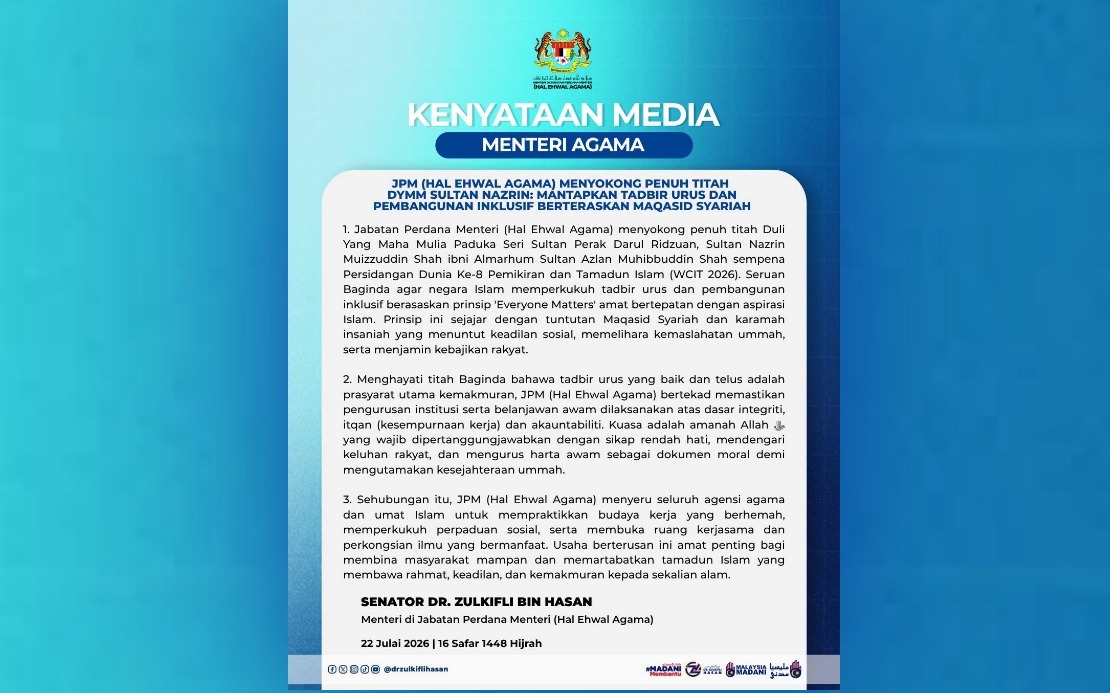
The Prime Minister's Department (Religious Affairs) has committed to advancing the governance of religious institutions through a framework centred on integrity, accountability and public welfare—principles that directly reflect Sultan Nazrin Shah's recent articulation of inclusive development for Muslim-majority nations. The pronouncement came as Minister in the Prime Minister's Department (Religious Affairs) Dr Zulkifli Hasan issued a formal statement on July 22, positioning Malaysia's religious administrative apparatus as responsive to the Perak Ruler's contemporary vision for equitable leadership.
Sultan Nazrin delivered his vision during the 8th World Conference on Islamic Thought and Civilisation (WCIT), where he underscored that effective public administration must transcend sectarian divisions, serving citizens irrespective of ethnicity, faith or political affiliation. This conception of governance, he argued, embodies national cohesion and humble stewardship—qualities that emerge only when leaders actively solicit and heed the concerns of their constituents before instituting policy. For a region wrestling with communal tensions and governance deficits, the Sultan's framing represents a significant ideological marker from Malaysia's institutional leadership.
Dr Zulkifli positioned the "Everyone Matters" principle not as a modern improvisation but as inherent to Islamic jurisprudence itself. He linked the Sultan's formulation to Maqasid Syariah—the foundational objectives of Islamic law—and karamah insaniah, the concept of human dignity enshrined in Islamic philosophy. This intellectual grounding is strategically consequential: it frames inclusive governance as doctrinally authentic rather than externally imposed, a framing that carries weight within Malaysia's Muslim-majority society and broader Islamic discourse.
The minister emphasised that Maqasid Syariah, when properly understood, mandates social justice, preservation of communal welfare and protection of the people's material and spiritual interests. By aligning his department's mandate with these theological foundations, Dr Zulkifli constructs a narrative wherein strengthened religious institutional accountability becomes not bureaucratic compliance but Islamic obligation. This rhetorical move has implications beyond rhetoric: it potentially provides ideological scaffolding for reforms within Malaysia's religious administration that might otherwise face resistance from conservative constituencies.
Sultan Nazrin's observation that development cannot proceed in isolation carries particular salience for Malaysia and Southeast Asia. In an era of globalised supply chains, technological interdependence and knowledge transfer, attempts at self-sufficiency prove illusory. The Sultan's framing acknowledges that prosperity flows not from fortress-like insularity but from strategic engagement with international commerce, investment, technological advancement and intellectual exchange. For Malaysia—a nation dependent on external capital and integrated into regional and global markets—this perspective validates the necessity of outward-oriented policy even as religious and cultural identity remain central concerns.
Dr Zulkifli's department signal commitment to institutional management grounded in three pillars: integrity, itqan (a concept denoting excellence and precision in execution), and accountability. The invocation of itqan deserves particular attention, as it moves beyond abstract ethics toward operational competence. Religious institutions, the minister suggests, must not merely aspire to honesty but demonstrate rigour in implementation, efficiency in resource deployment and measurable delivery of public benefit. This standards-based approach potentially marks a departure from traditions emphasising piety and intention over institutional output.
The principle that authority constitutes a divine trust, to be exercised with humility and attentiveness to public grievance, reframes the relationship between Malaysia's religious bureaucracy and the citizenry it serves. Rather than positioning religious authority as hierarchical and unidirectional, Dr Zulkifli's articulation suggests reciprocal accountability: leaders must listen before legislating, and public funds represent not discretionary resources but fiduciary obligations to advance community welfare. For Malaysian citizens accustomed to hierarchical administrative cultures, this reframing potentially reshapes expectations of religious institutional behaviour.
The minister extended his appeal beyond the bureaucratic apparatus to religious agencies and the Muslim community at large, calling for cultivation of courteous workplace culture, reinforcement of social cohesion, and collaborative knowledge-sharing. This emphasis on civility and collegiality within religious institutions addresses a substantive concern in Malaysian public discourse: instances where religious authority has been wielded divisively or with insufficient regard for pluralistic sensibilities. By endorsing courtesy and unity-building as institutional values, the department signals intent to model behaviour that transcends sectarian boundary-drawing.
For Malaysia's broader Southeast Asian context, these pronouncements carry significance beyond domestic religious administration. As Muslim-majority nations throughout the region navigate tensions between traditional authority structures and modernising pressures, between religious principle and secular governance, the framework articulated by Sultan Nazrin and Dr Zulkifli offers a template: principled religious leadership compatible with inclusive governance, where Islamic jurisprudential objectives align with contemporary demands for accountability, efficiency and respect for human dignity. Whether implementation matches aspiration remains an open question, but the intellectual positioning establishes a governance paradigm that may influence not only Malaysia's religious institutions but potentially resonate across Southeast Asia's Islamic establishments.
The challenge ahead lies in translating these commitments into institutional practice. Religious bureaucracies worldwide have demonstrated capacity to resist accountability mechanisms or to use procedural compliance as cover for substantive resistance to change. For Malaysia's Religious Affairs Ministry, the test will be whether the invocation of integrity, itqan and accountability produces demonstrable reforms in institutional transparency, responsiveness to public concerns and equitable treatment across communal boundaries—or whether the principles remain aspirational rhetoric disconnected from administrative reality.

