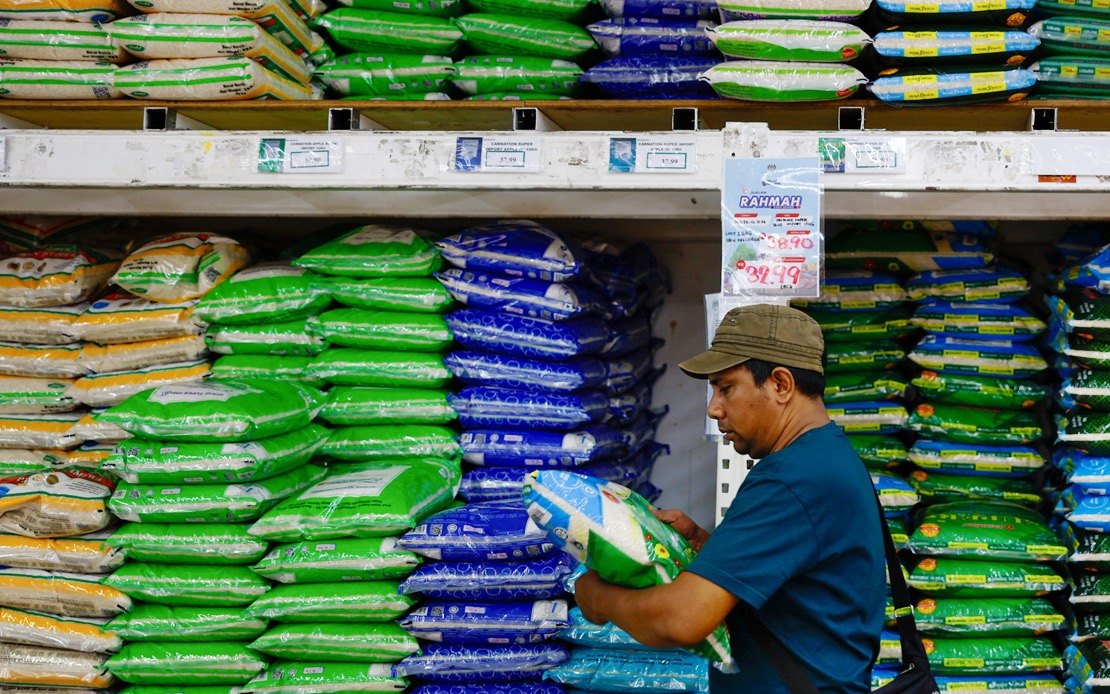
Malaysia's rice buffer remains robust and sufficient to insulate the country from potential supply disruptions arising from regional instability in West Asia, Deputy Agriculture and Food Security Minister Datuk Chan Foong Hin assured Parliament this week. The assurance comes as global supply chains face renewed scrutiny, with geopolitical tensions threatening to disrupt food commodity flows across Asia. Speaking in the Dewan Negara, Chan outlined that national rice reserves stand at 1.237 million tonnes—a strategic cushion comprising both government-managed buffer stocks and private commercial holdings—capable of sustaining domestic demand for no fewer than six months.
The composition of Malaysia's rice reserves reveals a dual-layer protection mechanism designed to weather prolonged supply crises. The national rice buffer stock, administered by state-owned Padiberas Nasional Berhad (BERNAS), accounts for 200,000 tonnes of this total, while commercial operators maintain an additional 1.037 million tonnes across the supply chain. This structure ensures that even if external shocks disrupt import flows or force price volatility in international markets, Malaysian households will continue accessing rice at relatively stable prices. The government's price stabilisation approach extends beyond physical stockpiling; subsidies on locally produced white rice create a domestic pricing floor that dampens the impact of global price swings affecting other essential commodities.
The acknowledgement of these reserves comes against a backdrop of rising anxiety over food security across Southeast Asia. While Malaysia has historically imported a portion of its rice from Thailand, Vietnam and other regional suppliers, maintaining substantial domestic reserves reduces vulnerability to sudden trade restrictions or logistical disruptions. For Malaysian consumers and policymakers alike, this six-month buffer represents a critical breathing space—sufficient time to negotiate alternative supply arrangements, adjust consumption patterns, or accelerate domestic production if circumstances deteriorate. The reserve levels also provide psychological reassurance in an increasingly volatile geopolitical environment where food security can rapidly become a strategic concern.
However, the government's long-term vision extends well beyond current reserve adequacy. Malaysia has set an ambitious target of achieving 80 per cent self-sufficiency in rice production by 2030, a goal driven by recognition that reliance on imports leaves the country exposed to external pressures and market fluctuations. Reaching this threshold would represent a substantial shift from current production patterns, requiring coordinated investments across breeding programmes, irrigation infrastructure and farming practices. The Ministry of Agriculture and Food Security is pursuing multiple pathways to close this self-sufficiency gap, which has widened in recent years as domestic paddy yields stagnated while global demand pressures mounted.
Central to the self-sufficiency strategy is the deployment of drought-resistant padi varieties, specifically cultivars designated MR 380, MR 381 and MR 382. These genetic variations have been engineered to maintain productivity under water-stressed conditions—an increasingly critical trait as climate variability and El Niño phenomena threaten traditional growing seasons across the region. Complementing varietal improvements, the ministry is promoting water-efficient cultivation techniques including Alternate Wetting and Drying (AWD) and the System of Rice Intensification (SRI). These practices reduce irrigation demand whilst maintaining or even enhancing yields, addressing a core constraint in tropical paddy production where competition for water intensifies as populations expand and industrial demand rises.
Implementation of these agronomic innovations is being concentrated in established rice bowls, particularly under the Muda Agricultural Development Authority (MADA) in the northern peninsula, a region responsible for a significant proportion of Malaysia's paddy harvest. The government is coupling agricultural research with infrastructure upgrades, modernising irrigation systems to improve efficiency and reliability. A five-season rice cultivation initiative spanning two years represents an experimental approach to intensifying production within existing land areas, avoiding the environmental costs of agricultural expansion whilst squeezing additional output from established farmland.
Direct support for farmers constitutes another pillar of the production expansion strategy. The government recognises that rising input costs—particularly for fertilisers—squeeze margins and discourage production expansion or intensification. To alleviate this burden, a temporary exemption from the Sales and Service Tax on agricultural fertilisers including rock phosphate and magnesium sulphate has been scheduled to take effect from January 2026 through December 2027. This targeted tax relief lowers production costs during a critical implementation window as farmers experiment with new varieties and practices, reducing the financial risk associated with agricultural innovation.
Ploughing incentives for the 2026 planting season have been elevated from RM160 to RM300 per hectare, a near-doubling that reflects escalating operational expenses. This uplift, backed by an additional RM40 million budgetary allocation, will reach approximately 200,000 farming households across the country. The financial stimulus addresses a fundamental problem: many smallholder paddy farmers operate on razor-thin margins and cannot absorb the full cost of production innovations without government support. By subsidising the transition toward more efficient and productive systems, the government hopes to sustain farmer participation and accelerate technology adoption across a fragmented agricultural sector.
The timing of these initiatives matters considerably for Malaysian food policy. Global rice markets remain sensitive to supply concerns, with major exporters Thailand and Vietnam potentially diverting supplies toward premium markets or supporting domestic consumption if regional tensions escalate. Southeast Asian nations that depend heavily on rice imports face the prospect of competing for limited supplies at elevated prices. Malaysia's combination of physical reserves, domestic price management, and production-enhancement measures positions the country better than many peers to navigate this uncertain environment. Yet the six-month buffer, while substantial, is not indefinite—underscoring the critical importance of achieving the 2030 self-sufficiency target.
From a regional perspective, Malaysia's food security strategy carries implications for broader Southeast Asian stability. If rice production and pricing become sources of tension within ASEAN, supply-chain cooperation and coordinated policy frameworks will be essential. Malaysia's investments in drought-resistant breeding, water-efficient farming, and farmer incentive schemes align with approaches being pursued elsewhere in the region, suggesting potential for knowledge transfer and collaborative research. Simultaneously, the recognition that current reserves are necessary but insufficient—as reflected in the push toward 80 per cent domestic sufficiency—acknowledges hard truths about population growth, dietary changes, and climate unpredictability that extend across the entire region.
Looking forward, the success of Malaysia's rice security strategy will depend on execution consistency across multiple domains: continued investment in agricultural research and infrastructure, sustained farmer participation in transitioning toward new cultivation methods, and maintenance of political commitment to support domestic rice producers. The present environment of heightened geopolitical risk has crystallised policymaker attention on food security, providing a window for advancing productivity-enhancing reforms that might otherwise face resistance from incumbent interests. Whether this moment is seized effectively will determine whether Malaysia inches closer to the 2030 self-sufficiency goal or remains dependent on an international system increasingly vulnerable to disruption.

