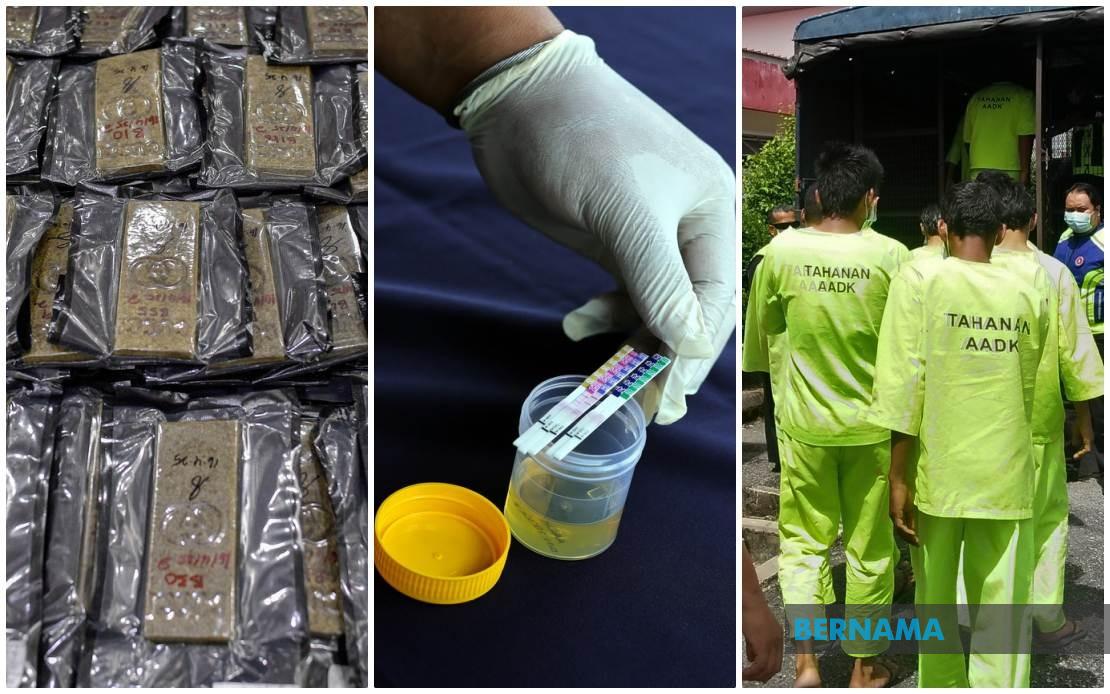
Synthetic drug abuse has solidified its position as Malaysia's most pressing narcotics challenge, with Home Minister Datuk Seri Saifuddin Nasution Ismail revealing that 141,817 abuse cases were documented in 2024. The figure represents a troubling upward trajectory when examined against the previous two years of data, establishing a pattern of accelerating substance misuse that extends far beyond traditional recreational drug use into a widespread public health emergency affecting multiple layers of Malaysian society.
The scale of the problem becomes more apparent when contextualised within the broader drug abuse landscape. Synthetic substances now dominate national addiction patterns, accounting for approximately 70 per cent of all recorded drug abuse incidents nationwide. This concentration on chemical drugs, particularly Amphetamine-Type Stimulants (ATS) such as methamphetamine or syabu, signals a fundamental shift in how Malaysians are abusing drugs. The prevalence of synthetic compounds over traditional narcotics like heroin or cannabis indicates that traffickers and users have transitioned toward laboratory-produced substances that are cheaper to manufacture, easier to distribute through clandestine channels, and increasingly potent in their neurological effects.
Geographic analysis reveals that Malaysia's east coast region has emerged as ground zero for this synthetic drug epidemic. States including Kelantan, Terengganu, and Pahang face disproportionately high concentrations of cases, a pattern that prompted government researchers to map abuse hotspots across the nation. Within this corridor, the traditional hierarchy of drug abuse has inverted entirely. What were once dominant substances—cannabis, heroin, or ketum—have surrendered prominence to ATS, reshaping the nature of interventions required by law enforcement and rehabilitation services across these jurisdictions. This geographic concentration suggests either superior distribution networks in these regions, socioeconomic vulnerabilities that increase susceptibility to substance abuse, or gaps in enforcement capacity that traffickers have exploited.
Among the most concerning recent discoveries is the emergence of fentanyl, a synthetic opioid whose potency dwarfs that of traditional narcotics. Police operations targeting illicit vaping products have uncovered this substance, which possesses approximately 50 to 100 times the analgesic strength of morphine. Although current fentanyl prevalence remains limited compared to methamphetamine and other ATS drugs, its very presence signals a disturbing escalation in trafficker sophistication and willingness to introduce substances with exceptionally high addiction potential and fatality risk into Malaysian markets. The government has responded by amending both the Drug Dependants (Treatment and Rehabilitation) Act and the Dangerous Drugs Act 1952 to classify fentanyl as a scheduled substance, enabling authorities to prosecute its manufacture, distribution, and consumption.
Demographic vulnerability patterns underscore how synthetic drug abuse transcends socioeconomic boundaries. Approximately 75 per cent of recorded cases involve individuals between 15 and 39 years of age, implicating youth and young adults as populations requiring targeted intervention. This age concentration reflects the vulnerability of educational and early professional years to peer influence, psychological stress, and the allure of performance-enhancing or mood-altering substances marketed through online channels. The statistics challenge any assumption that drug abuse remains confined to economically disadvantaged populations, instead revealing a societal challenge penetrating across educational and class hierarchies.
District-level analysis provides more granular insight into regional variations. Pendang district records the highest incidence rate, trailed by Kuala Krai, with additional hotspots including Bachok, Besut, and Mersing. These concentrations suggest that tackling synthetic drug abuse requires hyper-localized strategies recognizing that a national approach cannot adequately address phenomena driven by distinct supply chains, demographic characteristics, and enforcement gaps varying between districts. The clustering of cases within specific administrative boundaries may also reflect reporting bias or differential policing intensity, though this does not diminish the urgent need for district-specific intervention architectures.
The corrections system has become a microcosm of the broader synthetic drug crisis. Approximately 70 of every 100 inmates within Malaysian prisons maintain connections to drug-related offences, whether as convicted prisoners or individuals remanded pending trial. In certain facilities such as Machang, this proportion approaches 100 per cent, indicating that the criminal justice system has become a repository for individuals whose offences stem directly from substance abuse and trafficking. This reality demands that correctional services prioritize rehabilitation and addiction treatment within prison settings, transforming detention facilities into spaces where underlying dependencies are addressed rather than merely warehousing offenders until release inevitably returns them to communities where driving factors for drug abuse remain unmitigated.
Technological advancement has fundamentally altered the dynamics of drug distribution and access. Online platforms operating without meaningful regulation of product authenticity or legality have become vectors through which Malaysians procure synthetic drugs with relative ease and anonymity. The internet has eliminated geographical barriers that once constrained supply networks, allowing consumers to source narcotics from anywhere globally without physical interaction with distributors. This digital transformation of the drug trade has outpaced enforcement capacity, creating what observers increasingly recognize as a structural enforcement gap that conventional policing strategies prove inadequate to address.
The National Anti-Drugs Agency (AADK) has deployed multifaceted prevention strategies encompassing community-based initiatives, educational programmes within schools and tertiary institutions, and family and workplace intervention programming. These endeavours recognize that enforcement alone cannot stem demand-side drivers of synthetic drug abuse. Collaborative arrangements involving the Royal Malaysia Police (PDRM) and the Customs Department provide enforcement infrastructure, yet these approaches operate within significant resource constraints and face determined traffickers whose supply chains have grown increasingly sophisticated. The AADK strategy implicitly acknowledges that sustainable reductions in synthetic drug abuse require simultaneous action across prevention, treatment, and enforcement dimensions.
East coast prevalence patterns warrant specific analytical attention for Malaysian policymakers and regional observers. The concentration of cases within this corridor may reflect structural factors including port access facilitating transnational drug trafficking, lower enforcement capacity relative to case volume, or socioeconomic conditions elevating abuse vulnerability. Understanding the root drivers of this geographic concentration becomes essential for designing interventions with higher success probability than blanket national campaigns. Similarly, the transition from traditional drugs to synthetic substances within east coast communities suggests that prevention messaging and enforcement priorities require calibration to regional substance abuse realities rather than generic approaches.
With 192,000 cases recorded across all drug categories since January this year alone—equivalent to 560 cases per 100,000 population—Malaysia confronts a synthetic drug challenge of extraordinary scale. This rate positions substance abuse among the nation's most consequential public health and criminal justice priorities. The trajectory of cases over recent years, coupled with technological enablement of distribution networks and the emergence of exceptionally potent substances like fentanyl, suggests that absent transformative policy innovation and resource allocation, synthetic drug abuse will continue expanding its footprint across Malaysian society, overwhelming treatment capacity and generating cascading impacts across families, workplaces, and correctional institutions.