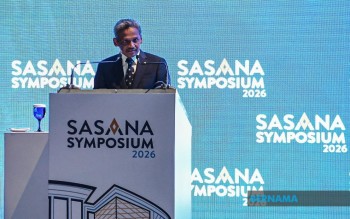
The successful placement of Malaysia's US$1.5 billion global sukuk last week underscores robust international confidence in the country's economic trajectory and governance framework, according to Bank Negara Malaysia Governor Datuk Seri Abdul Rasheed Ghaffour. Speaking at the opening of the two-day Sasana Symposium 2026 in Kuala Lumpur, he highlighted the remarkable reception of the issuance as evidence that global investors remain convinced of Malaysia's capacity to manage its finances prudently and execute meaningful structural reforms.
The scale of investor appetite proved extraordinary, with demand for the sukuk reaching nearly five times the amount being offered. This oversubscription reflected not merely willingness among international fund managers to deploy capital into Malaysia, but crucially their readiness to do so on unusually favourable financial terms. The pricing achieved record-low spreads, meaning Malaysia obtained the funds at a significantly lower borrowing cost than typical market conditions would suggest—a testament to the premium investors place on the country's creditworthiness and economic stability.
AbdulRasheed characterised the strong response as "a clear vote of confidence in Malaysia's economic fundamentals, our reform agenda and our commitment to sound economic management." This assessment carries particular weight given the global uncertainties that persist in international financial markets. The ability to attract substantial external capital at advantageous rates during a period of economic flux demonstrates that Malaysia's policy direction and macroeconomic performance have earned credibility among sophisticated international investors who actively monitor geopolitical risks and emerging market dynamics.
The Sasana Symposium 2026, themed "Reforms for Resilience: Navigating Uncertainties," provided the platform for these remarks and serves as a venue for examining Malaysia's approach to critical economic and financial challenges. The symposium agenda encompasses discussions spanning economic resilience-building, wage growth and cost-of-living pressures, investment facilitation, energy security frameworks, Islamic finance development, and the evolving landscape of private healthcare. These topics reflect the multifaceted policy challenges Malaysia confronts as it seeks to sustain growth while addressing social concerns and maintaining financial stability.
Beyond the immediate triumph of the sukuk placement, Ghaffour highlighted Malaysia's significant progress in attracting and channelling investment into productive capacity. Over the preceding two years, Malaysia has green-lit RM815 billion in investments—a figure equivalent to nearly half the nation's annual gross domestic product. If these approved projects materialise fully, they are projected to generate approximately 245,000 new employment opportunities, with a substantial portion anticipated to represent higher-skilled positions that offer greater income potential and career advancement prospects than traditional manufacturing or service roles.
Yet Ghaffour recognised that merely creating jobs represents only a partial solution to Malaysia's economic challenges. The critical complementary requirement is ensuring that the workforce possesses the competencies and training necessary to fill these emerging roles effectively. Currently, the employment landscape reflects an entrenched reality: more than two-thirds of Malaysian workers remain concentrated in low-skilled or mid-skilled occupations, a distribution that constrains productivity gains and limits income-earning potential across significant segments of the population. This structural mismatch between job creation and workforce capability threatens to underutilise investment returns and perpetuate wage stagnation for substantial cohorts of workers.
Encouragingly, the trajectory is shifting, though progress remains measured. The proportion of Malaysians engaged in high-skilled employment increased from 27.5 per cent in 2019 to 30.1 per cent in 2025, signifying a gradual but observable reorientation of the labour market toward higher-value activities. Ghaffour cautioned against expecting rapid transformation, noting that "structural shifts in the labour market rarely happen overnight," and that building high-skilled employment at scale necessarily requires sustained effort across multiple years. This measured perspective reflects realistic understanding of how labour market dynamics evolve and the time required for substantial portions of the workforce to acquire new competencies.
The governor emphasised that Malaysia's economic future hinges on recognising that the traditional model of acquiring a single skill and deploying it throughout a working lifetime has become obsolete. As technology and artificial intelligence fundamentally reshape industrial structures and occupational requirements, continuous learning and periodic retraining have become non-negotiable for workforce relevance. Malaysian workers will increasingly need access to upskilling and reskilling programmes throughout their careers, requiring both employer investment and individual commitment to professional development. Without such mechanisms embedded throughout the economy, even robust job creation risks producing misalignment between vacancies and available skills.
Addressing these interconnected challenges, Bank Negara Malaysia launched iTEKAD Employment, an initiative positioned as the latest component of the broader iTEKAD social finance programme. This intervention targets individuals from economically vulnerable communities, providing support mechanisms to facilitate their transition into stable employment with reliable income streams. By combining capital availability with structured support for workforce preparation, iTEKAD Employment embodies recognition that market forces alone may leave disadvantaged populations behind, and that deliberate policy intervention can expand economic opportunity across a wider demographic base. The programme reflects understanding that inclusive growth requires deliberate mechanisms to connect marginalised workers with emerging employment opportunities.

