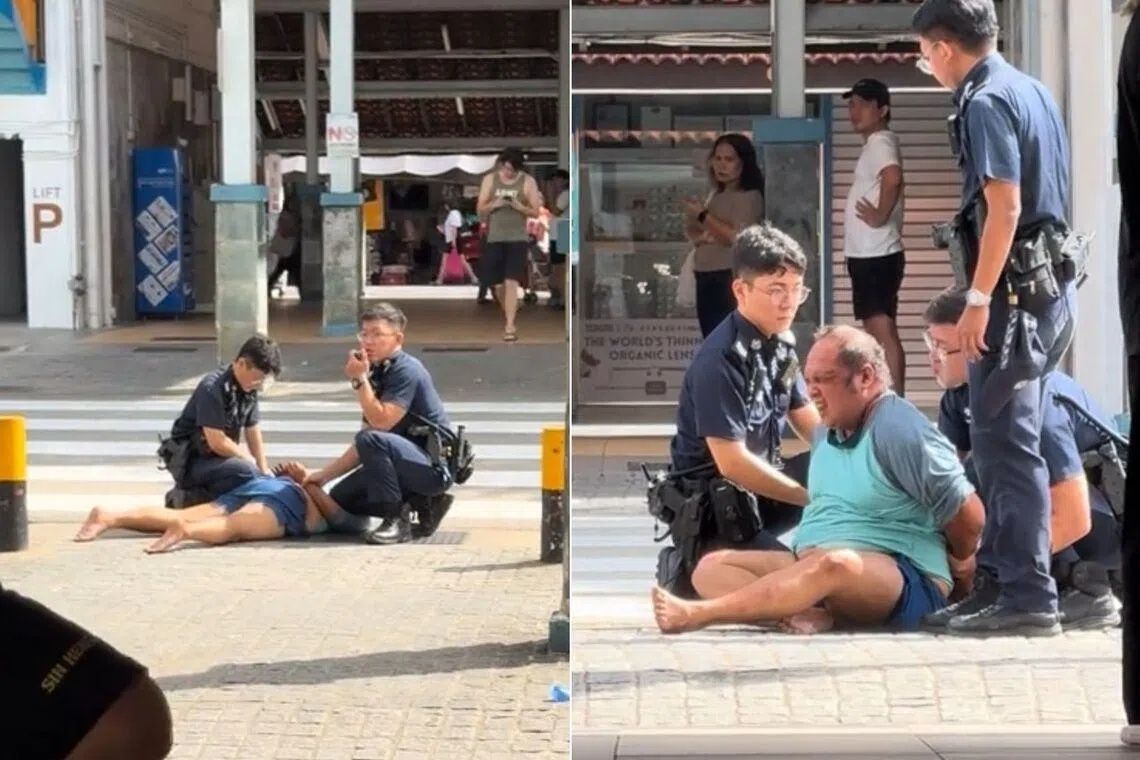
Singapore's police force responded to a disturbance call in the Toa Payoh Central area on Sunday morning, June 28, resulting in the arrest of a 36-year-old man accused of committing an obscene act and assaulting a law enforcement officer. The incident, which unfolded at Block 184 Toa Payoh Central around 9.45am, highlighted the challenges officers face when responding to disruptive behaviour in public spaces, particularly within bustling commercial districts that cater to early morning food service crowds.
According to a police media statement, officers arrived at a coffee shop in the block following a call for assistance reporting that a man was creating a disturbance and engaging in indecent behaviour. The situation escalated during the arrest process when the suspect, who was barefooted at the time of the police response, physically resisted detention by striking a police officer in the face. This act of violence against law enforcement added a serious criminal dimension to the original offence, as assaulting an officer performing official duties carries significant legal consequences under Singapore law.
The arrested man now faces multiple charges stemming from the incident. The primary charge relates to committing an obscene act in public, while a secondary charge addresses voluntarily causing hurt to a public servant with the explicit intent to deter that officer from executing his or her lawful duties. This second charge reflects the gravity with which Singapore's legal system treats violence directed at law enforcement personnel, recognising that such acts undermine public order and the rule of law.
Social media footage of the arrest, captured and shared by TikTok user Kee Wee Shang, provides documentation of police response procedures. The videos show multiple officers physically restraining the suspect on the ground as they worked to control the situation and execute the arrest. Subsequent footage demonstrates the professional manner in which the suspect, now handcuffed, was escorted away from the scene by the responding officers, illustrating standard protocol for managing individuals in custody.
The officer who sustained the injury during the altercation was 19 years old, making him among the younger cohort of Singapore's police force. Despite being struck in the face, the officer was fortunate to suffer only minor injuries and was transported to hospital in a conscious condition. His recovery appears uncomplicated, though the incident serves as a sobering reminder of the occupational hazards that uniformed personnel encounter, particularly when responding to reports of erratic behaviour in public establishments.
Coffee shops and similar informal dining venues in Singapore's Housing and Development Board estates serve as important social hubs, particularly during morning hours when residents gather for breakfast. These spaces, while generally peaceful, can occasionally become focal points for disruptive incidents, placing both staff and other patrons at risk. The Toa Payoh area, one of Singapore's older and more densely populated residential districts, has historically maintained relatively low crime rates, making this incident noteworthy within the local context.
The circumstances that prompted the initial disturbance call remain unexamined in the available public record, though police investigations are understood to be continuing. Understanding the underlying triggers for such incidents—whether related to mental health crises, substance abuse, interpersonal conflicts, or other factors—remains important for developing preventive approaches and ensuring that interventions are calibrated appropriately to the situation at hand.
For Malaysian observers monitoring developments in Singapore's law enforcement landscape, this incident underscores the ongoing challenges faced by police services throughout Southeast Asia in managing public order while protecting the safety of officers and bystanders. Singapore's relatively transparent approach to documenting and responding to such incidents reflects institutional frameworks that emphasise accountability and professional standards. The incident also illustrates the role that social media has come to play in recording and circulating documentation of police activities, creating both evidentiary records and public scrutiny mechanisms.
The response by Singapore police in this instance demonstrates established protocols for managing physical resistance during arrest procedures. The deployment of multiple officers to manage the situation, the use of restraint techniques, and the subsequent transportation to medical facilities for the injured officer all reflect training and procedures designed to minimise harm while maintaining public safety. Such professional approaches serve as models for law enforcement agencies throughout the region as they navigate increasingly complex urban environments and interactions captured on personal recording devices.

