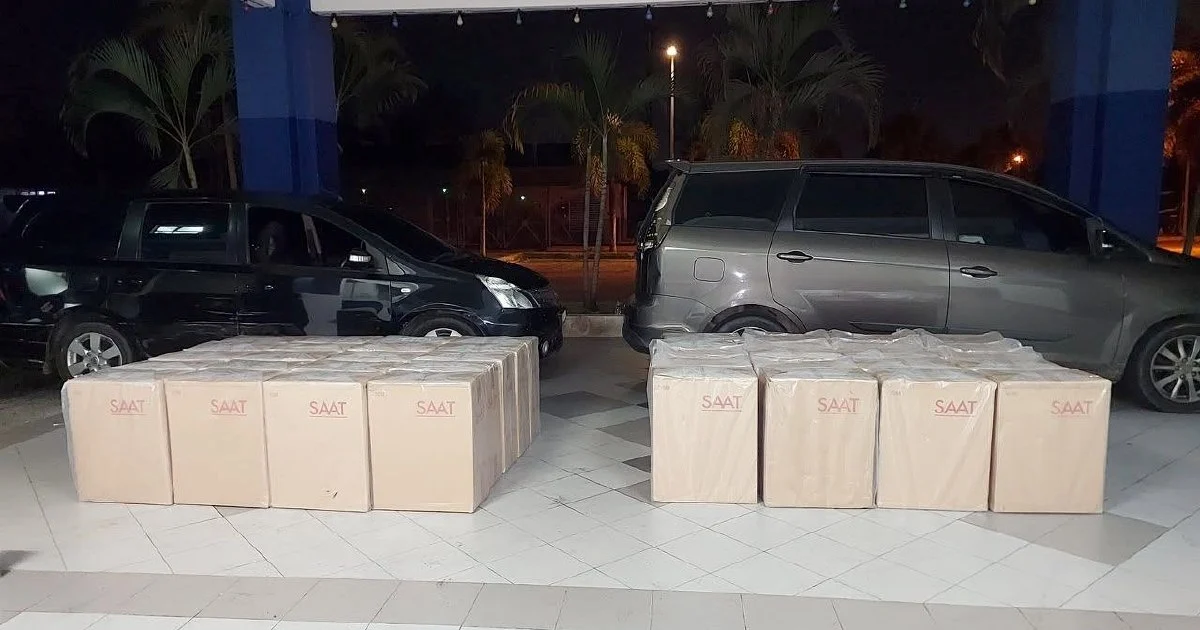
A 29-year-old suspect now faces serious charges after Kelantan police intercepted what is believed to be a significant consignment of illicit cigarettes during a pursuit in Kampung Pulau Panjang, Kota Baru, yesterday evening. The operation resulted in the confiscation of approximately 400,000 cigarette sticks, with authorities placing the street value of the contraband at RM813,000. The apprehension underscores the persistent challenge of tobacco smuggling across Malaysia, a trade that continues to drain government revenue and complicate enforcement efforts across the nation's borders.
The arrest comes amid escalating concerns about the scale of cigarette smuggling operations in Malaysia, particularly across the northern region. Smuggled tobacco products remain among the most frequently intercepted contraband items at Malaysian checkpoints, rivalling drug trafficking in terms of operational complexity and profit margins. The RM813,000 valuation attached to this single seizure illustrates the substantial financial incentives driving criminal networks to transport untaxed cigarettes across state lines and into local markets. Such operations typically involve sophisticated logistical arrangements, including encrypted communications and regular route variations to evade detection.
The circumstances surrounding the chase provide insight into the operational tactics employed by enforcement agencies in combating this trade. When police identified the suspect's vehicle, pursuit became necessary, suggesting the driver recognised the imminent risk of interception and attempted evasion. This behaviour is characteristic of smuggling operations in the region, where suspects often employ vehicles selected specifically for speed and manoeuvrability. The successful apprehension demonstrates that despite resource constraints, law enforcement remains capable of mounting effective operations when intelligence gathering and field coordination align effectively.
Cigarette smuggling networks function within a broader ecosystem of illicit commerce that destabilises regional economies. The untaxed products flooding Malaysian markets represent lost tax revenue for the federal government—revenue that might otherwise fund healthcare, education, and infrastructure projects. Beyond fiscal implications, the proliferation of counterfeit and unregulated tobacco products poses public health risks, as such goods often lack quality controls and may contain harmful additives. Consumers purchasing contraband cigarettes remain unaware of production standards or chemical composition, effectively gambling with their health to save marginally on purchase price.
The northern corridor, encompassing states like Kelantan, Terengganu, and Perlis, has emerged as a critical battleground in this enforcement struggle. Geographical proximity to Thailand, combined with porous border areas and the presence of active smuggling networks, creates an environment where contraband tobacco flows continuously into Malaysian territory. Local law enforcement agencies have intensified operations in recent months, yet the volume of seizures suggests that confiscated quantities represent only a fraction of total smuggling volumes transiting the region. Intelligence suggests that sophisticated criminal organisations, some with transnational connections, orchestrate these operations with military precision.
The economics of cigarette smuggling render it exceptionally attractive to criminal entrepreneurs. Malaysian taxation on cigarettes remains among the highest globally, with excise duties significantly amplifying retail prices relative to neighbouring countries. This pricing differential incentivises arbitrage operations where suppliers purchase cigarettes legally in low-tax jurisdictions and transport them clandestinely into Malaysia for underground distribution. The profit margins justify considerable expenditure on logistics, corruption facilitation, and operational security measures. Moreover, the relative absence of violence associated with tobacco smuggling—compared to drug or arms trafficking—means sentences remain comparatively lighter, further reducing the perceived risk for perpetrators.
Enforcement responses have become increasingly sophisticated in response to evolving smuggling tactics. Customs authorities now utilise advanced scanning technologies, canine detection units, and intelligence-sharing platforms to intercept contraband before it penetrates deeper into distribution networks. The interagency coordination between the Malaysian Royal Police, Customs Department, and state-level enforcement units has improved marginally, though fragmented jurisdiction occasionally permits gaps in coverage. Technology adoption, including real-time tracking systems and data analytics to identify suspicious shipping patterns, has yielded measurable results. However, the scale of operations typically discovered—such as the RM813,000 seizure—suggests that enforcement successes represent only the visible portion of a much larger problem.
The investigation phase following this arrest will likely reveal supply chain details and identify upstream suppliers or downstream distribution networks. Malaysian authorities typically conduct comprehensive interrogations to map organisational structures, identify financiers, and locate storage facilities containing additional contraband. Such intelligence feeds into broader law enforcement strategies aimed at disrupting entire networks rather than merely apprehending individual operatives. Previous investigations have uncovered sophisticated warehousing operations, falsified documentation schemes, and even corruption within port facilities facilitating illicit cargo movement.
Prosecution of smuggling cases proceeds through established legal frameworks, with sentences typically ranging from substantial fines to imprisonment depending on quantity and intent. The suspect's age and criminal history will influence sentencing calculations, though quantities exceeding 400,000 units generally attract custodial sentences. Beyond legal consequences, successful convictions generate deterrent effects within smuggling communities, though effectiveness remains limited given the financial incentives driving participation. Rehabilitation prospects for individuals arrested in lower-tier roles—such as vehicle drivers—remain constrained, as economic desperation frequently motivates recruitment into smuggling operations.
Regional cooperation represents an essential but underdeveloped dimension of anti-smuggling strategy. Thailand's domestic cigarette pricing and regulatory environment significantly influences smuggling patterns affecting Malaysia, yet bilateral coordination mechanisms remain relatively informal. Enhanced intelligence sharing, joint operations at the border, and coordinated customs procedures could substantially reduce contraband flows. ASEAN frameworks theoretically provide platforms for such cooperation, yet political considerations and divergent national interests frequently limit practical implementation. The arrest in Kota Baru serves as a reminder that unilateral enforcement efforts, while necessary, cannot fully address challenges requiring transnational solutions.

