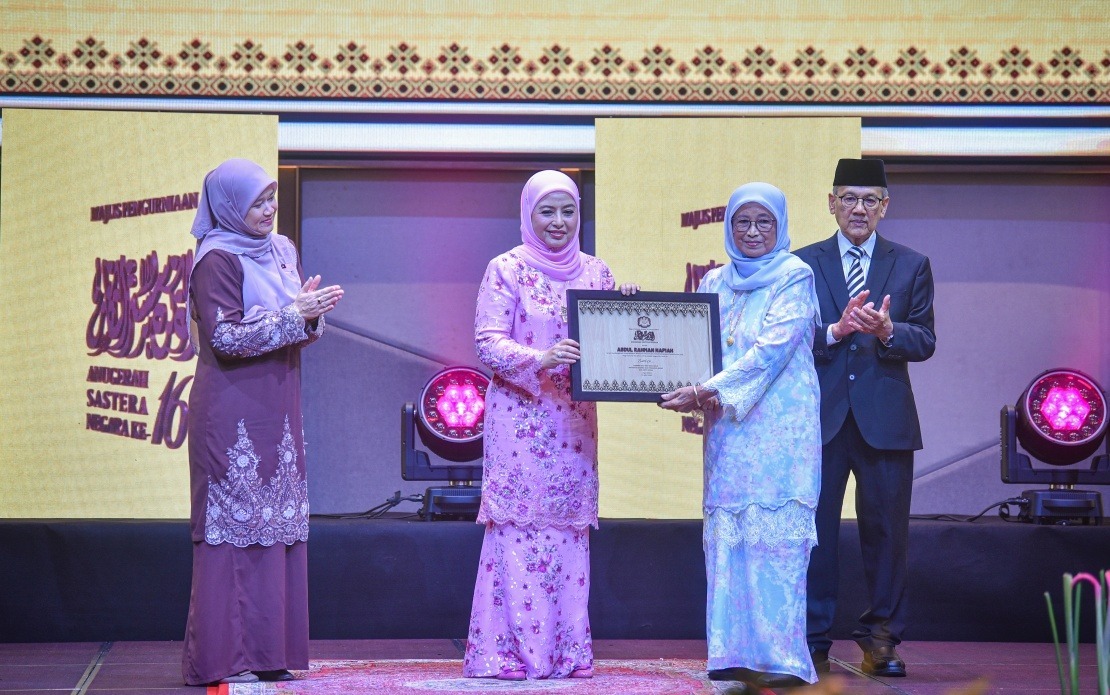
Dr Abdul Rahman Napiah, the acclaimed writer better known by his pen name Mana Sikana, has been posthumously honoured as Malaysia's 16th National Laureate, cementing his legacy as one of the nation's most significant literary figures. The recognition came during a ceremony at which Her Majesty Raja Zarith Sofia, Queen of Malaysia, presented the award to the author's widow, Salmah Ali. The honour represents the government's highest recognition for writers whose sustained and exceptional contributions have shaped the trajectory of Malaysian literature.
Mana Sikana's selection underscores the enduring impact of a writer whose career spanned decades and encompassed more than 100 published works. Education Minister Fadhlina Sidek, who chaired the award selection panel, emphasised how his literary output transcended entertainment to serve a deeper cultural purpose. Through his novels, essays, and critical writings, Mana Sikana cultivated awareness among readers about complex social issues, fostered genuine empathy across Malaysia's diverse communities, and created spaces for meaningful cultural dialogue that illuminated the human dimension of Malaysian society.
The minister highlighted three distinct areas in which Mana Sikana's influence proved particularly transformative. First, he substantially expanded the technical and aesthetic possibilities of Malaysian creative writing, pushing writers to experiment with form and approach. Second, he championed critical thinking within literary discourse, encouraging writers to examine not merely what they wrote but how their work engaged with broader social and philosophical questions. Third, and perhaps most significantly for the long-term health of Malaysian letters, he devoted considerable energy to nurturing successive generations of writers, researchers, and literary critics through his university teaching, seminars, and scholarly publications.
Born in Bagan Serai, Perak, on 9 October 1946, Mana Sikana initially pursued a career in teaching before transitioning into academia. His academic journey took him to several prestigious Malaysian institutions, including Universiti Kebangsaan Malaysia (UKM), and he also held teaching positions abroad at Singapore's Nanyang Technological University and Universiti Pendidikan Sultan Idris (UPSI) in Malaysia. His doctoral qualification from UKM provided the rigorous intellectual foundation that would characterise his scholarly work throughout his career.
The accolades Mana Sikana accumulated during his lifetime testify to the breadth of recognition he received from Malaysia's literary establishment. Among these were the Malaysian Literary Prize, the Malaysian Perdana Literary Prize, the Perak Laureate Award, and the Darul Ridzuan Lifetime Literary Achievement Award. Each represented validation from different quarters of the literary community, suggesting that his influence extended across multiple circles and that his work resonated with both institutional gatekeepers and broader audiences.
As the 16th National Laureate, Mana Sikana's estate receives substantial recognition and resources. The award package comprises a national letter of honour, a cash prize of RM60,000, and a publishing allocation capable of covering up to 50,000 copies or RM500,000 in value. Rather than remaining symbolic, this publishing component carries genuine practical significance: the government commits to purchasing and distributing the allocated books across schools, libraries, government departments, and agencies throughout the country. This mechanism ensures that Mana Sikana's works will reach institutional settings where they can influence students, researchers, and the general public for years to come.
Mana Sikana's death in May 2025 at the age of 80 followed heart complications. The timing of the National Laureate award as a posthumous honour reflects a practice common in recognising major cultural figures, allowing for comprehensive assessment of a lifetime's work and its lasting influence. Importantly, the award arrived at a moment when his contributions could be evaluated with the perspective that only time provides, free from the pressures of contemporary literary fashions or commercial considerations.
For Malaysian readers and writers, the recognition carries broader implications. It reinforces the notion that literary achievement remains valued at the highest levels of government and cultural institutions, even as popular attention may gravitate toward other forms of media and expression. The honour suggests a continuing commitment to sustaining a national literary culture and preserving the works of writers who have shaped Malaysian consciousness and artistic practice. In an era when digital content and entertainment dominate, such recognition serves as a counterweight, insisting that literature and the serious engagement with language and ideas remain central to national identity.
Mana Sikana's ascension to National Laureate status also underscores the importance of academic and critical work in shaping literary cultures. His influence as a theorist, critic, and educator proved as significant as his role as a creative writer, demonstrating that literary greatness encompasses multiple dimensions. For Malaysian universities and institutions devoted to literary studies, his example suggests that rigorous intellectual engagement with creative works, combined with generous mentorship of emerging writers, constitutes a legitimate and valuable path to enduring cultural influence. His legacy will likely inspire future generations to think seriously about their responsibilities not merely to produce artistic work but to contribute meaningfully to the broader literary conversation and to invest in developing the writers and thinkers who will follow.

